Muslims stop immersion of idol of Goddess Durga, pelt stones at Hindu devotees
 Garhwa, Jharkhand, India
  11 October, 2024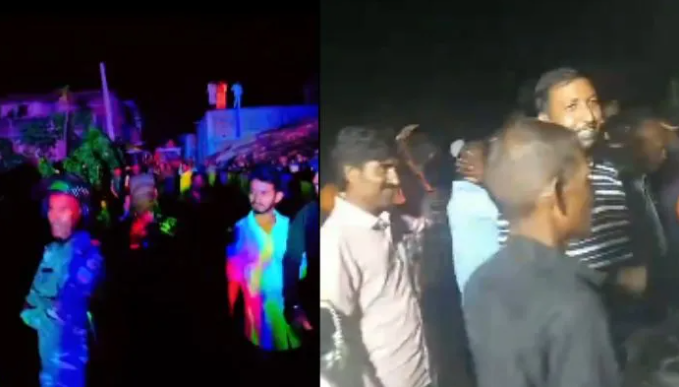
Case Summary
On October 12th, 2024, chaos erupted in Lakheya village, Garhwa district, Jharkhand, when Muslims stopped the immersion of the idol of Goddess Durga. Hindu devotees were carrying the idol through a Muslim-majority area for the traditional "Visarjan" (immersion) when they were stopped mid-way. The situation escalated when the Hindu worshippers were attacked with stones by a Muslim mob, leaving many injured. The police were called to the scene but, instead of taking immediate action, they reportedly pleaded with the residents of the Muslim-dominated colony. This delay left the immersion procession stranded for 6-7 hours. BJP leader Babulal Marandi took to social media, urging the police to take strict action against those obstructing the immersion, warning that social harmony could be disturbed. Later, the police had to resort to a lathi charge to control the situation, and a large police force was deployed to prevent further unrest. Former BJP leader Satyendra Nath Tiwari arrived at the scene to support the Hindu devotees and vowed that the idol procession would continue through the same route. A peace meeting was eventually arranged between the Hindu and Muslim communities, brokered by Satyendra Nath Tiwari. An agreement was reached that Hindus would not use the road through the Muslim colony for idol immersion, and in return, Muslims would not use Hindu-majority roads for Muharram processions. Following the agreement, the immersion took place without further incidents. The police filed an FIR against the stone pelters and assured strict action against anyone disturbing the peace.
Why it is Hate Crime ?
This case has been added to the tracker under the prime category of 'Attack not resulting in death'. Under this, three sub-categories have been selected based on the case details. The first is- Attack on religious procession. The outward celebration and display of religious symbols in an intrinsic part of Hinduism. Religious processions on various festivals are age-old traditions and a way to manifest faith and form a part of the religious practices of Hindus. On several occasions, such religious processions come under attack by non-Hindu mobs, in a manifestation of their animosity towards Hinduism and their practices. The reasons cited for such violent attacks are many and range from crossing a non-Hindu resident-dominated area to playing loud music, crossing from an area where there is a religious structure of another faith etc. The violent attacks are triggered by the outward display of religiosity by Hindus. The attacks are mainly a manifestation of religious supremacist doctrine which believes that idolatry, essentially the Hindu faith, is one that deserves to be annihilated since the very tenets of Hinduism, its practices and traditions are considered a sin in those doctrines. Since these attacks emanate from intrinsic and doctrinal animosity towards Hindus and Hinduism, it is considered a religiously motivated hate crime under this category. The second sub-category relevant in this case is- Attack against Hindu devotees. Hindu devotees are a few of the easiest targets of religiously motivated hate crimes because during the festival/procession/puja etc, for non-Hindus it is easy to profile their victims on the basis of religion. Hindu devotees come under attack on several occasions by individual non-Hindus or mobs of non-Hindus owing to their animosity against Hinduism, its symbols and tradition/practices. There are several instances of Hindu devotees being attacked while they worship in temples or temporary religious structures, during religious processions, doing bhajan/kirtan/puja in their own homes, in the residential society etc. These attacks are perpetrated by non-Hindus primarily because of their animosity towards Hindus and their faith. In some cases, the trigger for the violence may be non-religious, however, there are two elements that make these hate crimes. First, the Hindus who come under attack are attacked violently while indulging in religious activity. Whether they are in a place of worship or not is immaterial to the crime. When individuals are attacked while indulging in religious practices, the attack in itself is a hindrance to their freedom to practice religion and therefore constitutes a hate crime. Secondly, religious supremacist doctrines and ideologies deem religious practices of Hindus to be offensive ab initio since they are considered “sinful” by these ideologies, worthy to be annihilated by force or coercion. Driven by these religious supremacist ideologies and doctrines, the attacks against Hindu devotees stem from intrinsic animosity towards Hinduism. In some cases, the trigger for the violence may be non-religious, however, it develops into a religiously motivated crime during the course of the violence. Since these attacks stem from animosity towards Hindus and Hinduism, they are considered religiously motivated hate crimes under this category. The third sub-category is 'Attacked for crossing Muslim area'. One of the reasons that Hindus get attacked unprovoked specifically by Islamists is for crossing ‘Muslim areas’. Essentially, Muslim mobs often attack Hindus crossing or present in certain areas which have a majority Muslim population. It has often been cited as one of the reasons to blame Hindus for attacks against themselves, signalling that Hindus displaying religious symbols, taking our religious processions or crossing any area which is dominated by Muslim residents is a provocation in and of itself. These areas are mostly ghettoized areas where mobs mobilize quickly to attack Hindus for a variety of reasons like playing music during a religious procession, crossing a mosque, wearing a tilak or any other religious symbol in a Muslim-dominated area, praying at a local temple in that area etc. There have been cases where the few local Hindus of that area have been attacked on their way to the Temple for prayers as well, simply because the area is considered a Muslim-dominated area. Several times, it is entirely possible that the immediate trigger for the violence against Hindus was non-religious in nature, however, the violence became religiously motivated in nature because the area was Muslim dominated and the residents on the whole harboured animosity towards Hindus, evidenced from the actions of the mob, the slogans, and the nature of the attack. Such crimes are motivated by the religious identity of the victims and are therefore classified as hate crimes under this category. In this instance, the Hindus participating in a religious procession being taken out on the festival of Navratri, a major Hindu festival dedicated to the worship of the goddess Durga, were brutally attacked by a group of Muslims who took offence by the procession passing through an area which they consider to be a Muslim area as it is predominantly occupied by people of their community. Stones were pelted at the Hindu devotees, leaving several gravely injured. By labelling the area as exclusively Muslim due to the demographic majority, the Muslims try to intimidate the Hindus and restrict them from following their religious practices. In a pluralistic society, the right to practice and celebrate one's religious traditions is fundamental, regardless of the demographic composition of a particular area. Denying this right can be seen as a violation of religious freedom and can contribute to a sense of alienation and resentment among the affected community. This is particularly done, when one community harbours animosity for the religious beliefs of the other community. Such actions are discriminatory and indicative of religious bias. Consequently, this incident is being categorised as a religiously motivated hate crime against Hindus.


Case Status
Complaint registered


Perpetrators Details
Perpetrators
Muslim Extremists
Perpetrators Range
Unknown
Perpetrators Gender
unknown
 Sources




