Ziaul Haq pretends to be Hindu to entrap woman, drugs and rapes her, uses videos as blackmail, threatens with death if she refuses to convert to Islam and marry him
 Lucknow, Uttar Pradesh, India
  13 August, 2024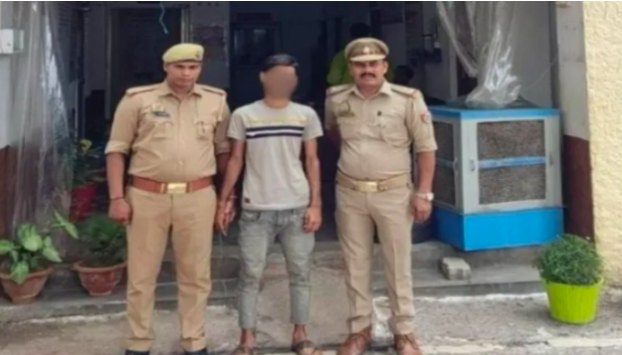
Case Summary
In Lucknow, Uttar Pradesh, Ziaul Haq, a Muslim driver from Barabanki district, committed multiple crimes against a Hindu woman. The complaint against him was lodged on August 14. Haq, who initially pretended to be a Hindu, befriended the victim, a domestic worker employed at a Muslim doctor’s residence. On the pretext of having tea, Haq took the victim to a hotel where he drugged and sexually assaulted her. He recorded the assault and used these videos and photos to blackmail her, demanding ₹1 lakh for their deletion. Despite receiving a partial payment, Haq sent the footage to some of her relatives. He then pressured her to convert to Islam and marry him, making threats of violence when she refused. The victim, who feared for her safety, reported the case to the police after Haq's continued threats and attempts to contact her through various numbers. The complaint also revealed that Haq had similarly harassed another Hindu woman from the Other Backward Class (OBC) category. The police registered an FIR against Haq. He was arrested on August 20, and further investigation and legal proceedings are underway.
Why it is Hate Crime ?
The case has been placed under the prime category 'Hate crime against women inn relationship and sexual crimes' of the hate tracker. Further, as per case details, three sub-categories have been selected under the abovementioned category. The first is- man pretends to be Hindu- under which two tertiary categories, namely, 'name changed' and 'pattern of targeting Hindu women' have also been selected. When a non-Hindu man pretends to be a Hindu to deceive a Hindu woman into a relationship, the act is seen as triggered by malafide intentions. In some cases, the woman eventually accepts the man’s original religious identity and converts after the man’s identity is revealed. These cases could be argued as cases of religious brainwashing and a result of the pressure a woman feels after getting into a relationship with a man. The woman, it can be argued, also changed her religious identity because of the stigma she believes she might face if she chooses to walk out of a deceptive relationship. However, for the purpose of documenting hate crimes, the cases in this subcategory are limited to those where there is explicit violence aimed at religious conversion against the wishes of the victim (force-feeding beef, blackmailing with intimate videos, rape on refusal to convert, etc), or if the woman herself complains of the man’s religious deception. In such cases, it is established that the deception of the non-Hindu man had a specific aim of religious conversion or targeting of the victim due to her Hindu religious identity, therefore, making it a religiously motivated hate crime. The second sub-category selected here is- blackmailed to convert- When Hindu women are in a relationship with non-Hindu men, there are cases where the woman is blackmailed to convert her religion, owing to her religious identity of being a Hindu. Such relationships may be consensual with the religious identity of the non-Hindu man known to the victim, however, there could be cases where the relationship is not consensual and the non-Hindu man starts blackmailing a Hindu woman to convert her religion. In these cases, it is often seen that the Hindu woman is blackmailed with intimate photos and/or videos, threats of harm to her or her family, threats of violence etc. Such cases are driven by specific religious motivations and against the religious identity of the victim and are therefore qualified as hate crimes. The third sub-category under which this case has been placed is- When Hindu women are in a relationship with non-Hindu men, there are cases where the woman faces threats or assault after she refuses to convert and change her religious identity owing to pressure/force by the non-Hindu man. Such relationships may be consensual with the religious identity of the non-Hindu man known to the victim. Somewhere along the relationship, the non-Hindu man starts pressurizing the Hindu woman to convert to Islam and upon her refusal, assaults or threatens the victim. Such cases are driven by specific religious motivations and against the religious identity of the victim and are therefore qualified as hate crimes. Cases where the Hindu woman converts to Islam and does not file a complaint about the force or threat, are not considered a part of the hate tracker, even though, it may be argued that the woman was brainwashed or threatened to convert to Islam. Here, a Muslim youth, under the guise of a Hindu, deceives a Hindu girl, exploiting her trust by pretending to share her faith. He not only violates her by raping her but also records obscene videos to blackmail her into converting to Islam. This act goes beyond mere criminal behaviour; it is a calculated and malicious attack on her religious identity. By assuming a false Hindu identity, the Muslim perpetrator betrays the girl's trust, manipulating her into a situation where he can coerce her into abandoning her faith. The use of blackmail to force conversion is a clear demonstration of religious hate, as it targets the victim's religious beliefs and seeks to erase her identity. This case is a glaring example of how deep-seated intolerance can manifest in violent and coercive actions, with the ultimate goal of religious subjugation and domination. The deliberate nature of the deception and the subsequent attempt to force conversion highlights the extent of disdain the accused harboured for the victim's faith, making this a clear case of religiously motivated hate. Here it is important to note that the Muslim perpetrator is a repeat offender. He had previously also targeted a Hindu woman. When a perpetrator specifically targets women of a particular faith, the crime transcends mere random violence; it becomes an act deeply rooted in religious intolerance. Such targeting is not only an attack on the individual but also a symbolic assault on the entire community that the victim represents. The perpetrator’s actions may be driven by a desire to assert religious superiority, to humiliate the community, or to forcefully impose their own beliefs on others. This is particularly evident when the crime involves elements like forced conversion, physical or sexual violence, or psychological manipulation intended to strip the victim of her religious identity. This type of targeted violence is not just an individual crime but a hate crime with broader social and religious implications. It stems from the perpetrator's deep animosity towards the victim's faith. This is why this case has been included in the tracker.
Victim Details
Total Victim
1
Deceased
0
Gender
- Male 0
- Female 1
- Third Gender 0
- Unknown 0
Caste
- SC/ST 0
- OBC 0
- General 0
- Unknown 1
Age Group
- Minor 0
- Adult 1
- Senior Citizen 0
- Unknown 0


Case Status
Arrested


Perpetrators Details
Perpetrators
Muslim Extremists
Perpetrators Range
One Person
Perpetrators Gender
male
 Sources




