Muslim mob pelt stones at Avanti Bai Lodhi's procession over loud DJ music near mosque
 Meerut, Uttar Pradesh, India
  15 August, 2024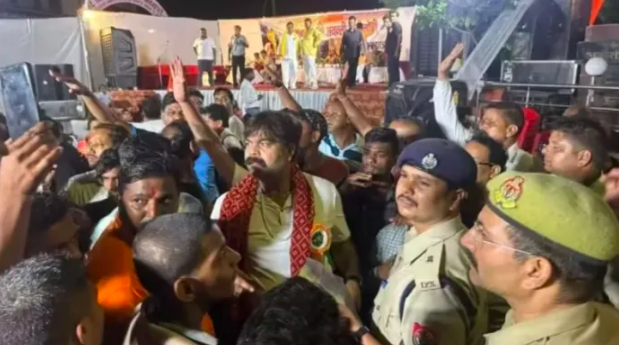
Case Summary
Communal tensions flared in Meerut, Uttar Pradesh, after Muslims pelted stones at a Veerangna Avanti Bai Lodhi procession on August 16, 2024. The clash began after a dispute over playing DJ music near a mosque during Namaz. Muslims objected to the loud music, claiming it disturbed prayers. Tensions escalated when a speaker from the procession allegedly fell, injuring a Muslim child. This led to stone-pelting and physical altercations. A member of the organising committee denied that the speaker injured the child, stating the injury was caused by something else. The procession, organised by Lodhi Yuva Sangathan to celebrate Veerangna Avanti Bai Lodhi’s birthday, had started from Shivshakti Nagar and passed through several areas before reaching the Hauz Wali Mosque. Police, led by SP Ayush Vikram Singh, quickly intervened, closing local markets and ensuring the procession concluded under tight security. A police force was stationed in Khairnagar to prevent further violence. A BJP leader said the attack occurred when Muslims removed the key from a generator being repaired by procession members, leading to a physical confrontation and stone-throwing. He called for those responsible to be charged under the National Security Act (NSA), emphasising that the procession has occurred annually since 2006.
Why it is Hate Crime ?
This case has been added under the prime category, 'Attack not resulting in death', of the hate tracker due to the details that suggest that the crime was committed while harbouring a bias against the Hindu faith. Further, three sub-categories have been selected here. The first subcategory is- Attack on religious procession. The outward celebration and display of religious symbols in an intrinsic part of Hinduism. Religious processions on various festivals are age-old traditions and a way to manifest faith and form a part of the religious practices of Hindus. On several occasions, such religious processions come under attack by non-Hindu mobs, in a manifestation of their animosity towards Hinduism and their practices. The reasons cited for such violent attacks are many and range from crossing a non-Hindu resident-dominated area to playing loud music, crossing from an area where there is a religious structure of another faith etc. The violent attacks are triggered by the outward display of religiosity by Hindus. The attacks are mainly a manifestation of religious supremacist doctrine which believes that idolatry, essentially the Hindu faith, is one that deserves to be annihilated since the very tenets of Hinduism, its practices and traditions are considered a sin in those doctrines. Since these attacks emanate from intrinsic and doctrinal animosity towards Hindus and Hinduism, it is considered a religiously motivated hate crime under this category. The second sub-category selected here is- Communal clash. Communal clash is a form of collective violence that involves clashes between groups belonging to different religious identities. For a communal clash between Hindus and non-Hindus to qualify as a religiously motivated hate crime, the trigger of the violence itself would have to be anti-Hindu in essence. For example, if there is a Hindu religious procession that comes under attack from a non-Hindu mob and after the initial attack, Hindus retaliate in self-defence, leading to a communal clash between the two religious communities. While at a later stage, both communities are involved in the clash/violence, the initial trigger of the violence was by the non-Hindu mob against the Hindus and therefore, it could safely be termed as an anti-Hindu violence. Further, the trigger would also have to be religiously motivated. In the cited example, the attack by the non-Hindu mob was against religious processions and therefore, can be concluded to be religiously motivated. In some cases, the trigger may be non-religious, however, it develops into religious violence against Hindus at a later stage. In such cases too, the foundational animosity towards Hindus becomes the motivating factor of the crime and therefore, it would be classified as a religiously motivated hate crime against Hindus under this category. The third is- Attacked for crossing 'Muslim area'. One of the reasons that Hindus get attacked unprovoked specifically by Islamists is for crossing ‘Muslim areas’. Essentially, Muslim mobs often attack Hindus crossing or present in certain areas which have a majority Muslim population. It has often been cited as one of the reasons to blame Hindus for attacks against themselves, signalling that Hindus displaying religious symbols, taking our religious processions or crossing any area which is dominated by Muslim residents is a provocation in and of itself. These areas are mostly ghettoized areas where mobs mobilize quickly to attack Hindus for a variety of reasons like playing music during a religious procession, crossing a mosque, wearing a tilak or any other religious symbol in a Muslim-dominated area, praying at a local temple in that area etc. There have been cases where the few local Hindus of that area have been attacked on their way to the Temple for prayers as well, simply because the area is considered a Muslim-dominated area. Several times, it is entirely possible that the immediate trigger for the violence against Hindus was non-religious in nature, however, the violence became religiously motivated in nature because the area was Muslim dominated and the residents on the whole harboured animosity towards Hindus, evidenced from the actions of the mob, the slogans, and the nature of the attack. Such crimes are motivated by the religious identity of the victims and are therefore classified as hate crimes under this category. In this instance, the Islamist mob launched a vicious attack on a religious procession taken out by Hindu devotees. The procession was attacked when it was passing through a mosque. Notably, there was no provocation from the Hindu side. The trigger for the attack on the procession was the DJ music being played by the Hindu devotees as the procession passed through the mosque. The members of the Muslim community were the ones who initiated the attack by hurling stones at the Hindu devotees, who then attacked in self-defence and reprisal. Obviously, it was not the music played by the Hindu devotees that actually triggered the Islamists, in fact, the unprovoked attack was driven by intrinsic and doctrinal religious animosity which also stemmed from the fact that the Hindu procession was crossing an area which had a Muslim-majority population. In areas with a majority Muslim population, Hindus often face hostility since the tenets of Islam harbour antagonism towards the Hindu faith and the adherents of Hinduism. Such religious and doctrinal animosity manifests in violence against Hindu devotees when religious processions pass areas with a Muslim majority. Since the violence was a product of religious animosity, this case is being categorised as a religiously motivated hate crime.


Case Status
Unknown


Perpetrators Details
Perpetrators
Muslim Extremists
Perpetrators Range
Unknown
Perpetrators Gender
unknown
 Sources




