Books describing non-Muslims as 'Kafirs' being taught in Bihar's Madrasas, Hindu children are also enrolled in such Madrasas
 Bihar, India
  17 August, 2024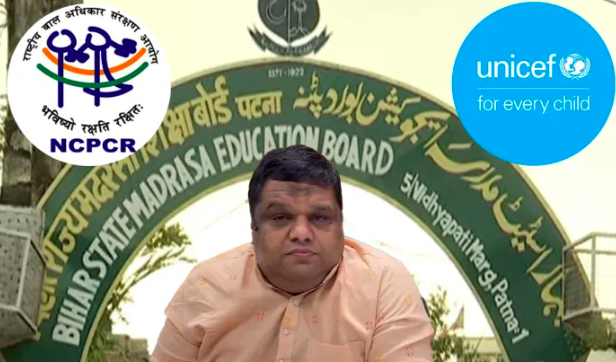
Case Summary
On August 18, Priyank Kanoongo, the Chairperson of the National Commission for Protection of Child Rights (NCPCR), raised concerns about the radicalisation in the curriculum of government-funded Madrasas in Bihar. He specifically expressed that Hindu children should not be enrolled in Madrasas and criticised UNICEF for drafting a radical curriculum for these institutions. Kanoongo further suggested that the Madrasa Board should be dissolved. In a post on X, Kanoongo highlighted that books like Taleem-Ul-Islam, which declare non-Muslims as "Kafirs" doomed to eternal punishment, are being taught in Bihar's Madrasas. He noted that although reports suggest Hindu children are also enrolled in these Madrasas, the Bihar government has not provided official information regarding the enrollment ratio. Kanoongo called for Hindu children to be transferred from Madrasas to schools. He argued that funds meant for child protection should not be misused for creating religiously charged content, which violates the Indian Constitution and the UN Convention on the Rights of the Child (UNCRC). He called on the United Nations to investigate this misuse of funds. Kanoongo also revealed that an investigation is underway into the content of the Madrasa curriculum, noting that many of the books are published in Pakistan.
Why it is Hate Crime ?
This case has been added under two prime categories of the tracker. The first category under which this case has been placed is- Hate speech against Hindus. Within this, the sub-category selected is- Anti-Hindu slurs, mocking faith. Anti-Hindu slurs and the deliberate mocking of the Hindu faith owing to religious animosity involve the usage of derogatory terms, stereotypes, or offensive references to religious practices, symbols, or figures. One of the common anti-Hindu slurs used against Hindus is “cow-worshipper” and “cow piss drinker”. The intention of using this term is to demean and mock Hindus as a group and their religious beliefs since Hindus consider the cow holy. Additionally, some symbols and the slurs attached to them have a historical context that exacerbates the insult, hate, stereotyping, dehumanisation and oppression against Hindus. Cow worship has been used for centuries to denigrate Hindus, insult their faith and oppress Hindus specifically as a religious group. There has been overwhelming documentation about how cow slaughter has been used to persecute Hindus with cow meat being thrown in temples and places of worship. There has also been overwhelming documentation where cow meat (beef) has been force-fed to Hindus to either forcefully convert them to Islam or denigrate their faith. Apart from cow worship, the Swastika – which holds deep religious significance for the Hindus – has also been misinterpreted and distorted to use as a slur against Hindus. Similarly, the worship of the Shivling has been used by supremacist ideologies and religions to denigrate Hindus owing to religious animosity. Such slurs and denigration stem out of inherent animosity and hate towards Hindus and their faith, therefore, it is categorised as hate speech targeted at Hindus specifically owing to their religious identity. The second category under which the case has been placed is- Predatory proselytisation and within this, the sub-category selected is- Proselytisation by grooming, brainwashing, manipulation or subtle indoctrination. Religious brainwashing essentially means the often subtle and forcible indoctrination to induce someone to give up their religious beliefs to accept contrasting regimented ideas. Religious grooming or brainwashing also involves propaganda and manipulation. It involves the systematic effort, driven by religious malice and indoctrination, to persuade “non-believers’ to accept allegiance, command, or doctrine to and of a contrasting faith. Cases of such grooming or brainwashing are far more nuanced than direct threats, coercion, inducement and violence. In such cases, it is often seen that there is repeated, subtle and continual manipulation of the victim to induce disaffection towards their own faith and acceptance of the contrasting faith of the perpetrator. While subtle indoctrination is widely acknowledged as predatory, an element which is often understated in such conversions or the attempts of such conversion is the role of loyalty and trust which might develop between the perpetrator and the victim. Fiduciary relationships are often abused to affect such religious conversion. For example, an educator transmitting religious doctrine of a competing faith to a Hindu student. The Hindu student is likely to accept what the teacher is transmitting owing to existence of the fiduciary relationship. The exploitation of the fiduciary relationship to religiously indoctrinate victims would also be included in this category. Since the underlying animosity towards the victim’s faith forms the basis of predatory proselytization, such cases are considered religiously motivated hate crimes. This case has been classified under two key categories in the tracker. The first category is Hate speech against Hindus, where the sub-category Anti-Hindu slurs, mocking faith has been selected. This classification is based on the reported use of derogatory language and the mocking of Hindu beliefs within the Madrasa curriculum, which includes books that label non-Muslims as "Kafirs" and promote views that undermine Hindu faith and religious practices. The term "Kafir" carries a highly negative connotation and is often used in a derogatory way by radical Islamists, particularly in reference to Hindus and other non-Muslims. In the context of the Madrasa curriculum mentioned in this case, the use of such terminology to describe non-Muslims, particularly Hindus, can be seen as not only disrespectful but also as a form of religious intolerance. As such, this curriculum’s teachings about the superiority of Islam and the demonisation of non-Muslims may exert undue influence on young minds, potentially leading to forced or coerced religious conversion over time, a key hallmark of predatory proselytisation. It is a well-established fact that children are more susceptible to manipulation since they are still developing emotionally, cognitively, and socially. Their brains are not fully matured, making them more vulnerable to influence and less capable of critically evaluating information. Moreover, subtle manipulation tactics can be difficult to detect, especially when employed by trusted authority figures in positions of influence. This makes it challenging for parents, to identify and address instances of religious manipulation in schools. Consequently, cases involving religious manipulation of minors not only represent an infringement on an individual's religious freedom but also demonstrate a calculated strategy of targeting those who are less able to resist or understand the long-term implications of conversion, making it a significant case of religious motivated hate crime. For this reason, this case has been added to the tracker.


Case Status
Unknown


Perpetrators Details
Perpetrators
Muslim Extremists
Perpetrators Range
Unknown
Perpetrators Gender
unknown
 Sources




