Islamic scholar celebrates massacre of Hindus in Bangladesh, urges Muslims to destroy temples
 United States
  7 August, 2024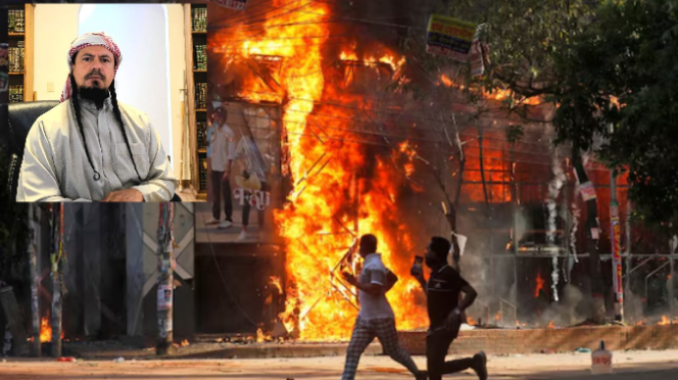
Case Summary
In the aftermath of Sheikh Hasina's resignation and the rise in anti-Hindu violence in Bangladesh, radical Islamists like Abu Najm Fernando bin al-Iskandar, a self-proclaimed Islamic scholar from the United States, expressed support for the atrocities. Fernando, who claimed to be an expert in Islamic studies, used social media to advocate for the annihilation of Hindus in Bangladesh. He cited Islamic jurisprudence, emphasizing that Hindus should either convert to Islam or face death, a stance he found solace in. Fernando mocked Hindus, suggesting they were fortunate to deal with the Hanafi school of thought, which he claimed was less brutal than others like Maliki, Shafi'i, and Hanbali. He also referenced Hanbali law, which calls for humiliating treatment of non-Muslims, to justify his support for the violence. Fernando celebrated the destruction of Hindu temples and even thanked Allah for the attack on musician Rahul Ananda’s home. He argued that Muslims in Bangladesh were failing their religious duties by not demolishing Hindu temples, which he believed was a breach of Islamic law. Fernando warned that Muslims would face divine punishment for allowing non-Muslim worship in territories they had conquered.
Why it is Hate Crime ?
This case has been added to the hate tracker under the prime category- Hate speech against Hindus and under this, the sub-category selected is- violent threats- Violent threats, explicit, implicit or implied, is the most dangerous form of hate speech since it goes beyond discriminatory and prejudicial language to express the intent of causing harm to an individual or a group of people based on their religious identity and faith. There could be several different kinds of threats that are issued to Hindus based on religious animosity. An explicit threat would mean the direct threat of violence towards an individual Hindu, a group of Hindus or Hindus at large. Physical violence, death threats, threats of destruction of property belonging to Hindus and threats of genocide would mean explicit threats against Hindus for their religious identity. Implicit threats may not be a direct threat but implied through the use of symbols of actions – for example – in the Nupur Sharma case, other than explicit threats, there were also implicit threats when Islamists took to the streets to burn and beat her effigies. It implies that they want to do the same to Nupur Sharma – thereby is considered an implicit threat. Violent threats can be delivered in person, through letters, phone calls, graffiti, or increasingly through social media and other online platforms. It would be important to understand that a threat – explicit or implicit, online or offline – to an individual who happens to be a Hindu does not qualify as a religiously motivated threat. Such a threat, while vile and dangerous, could be owing to non-religious reasons and/or personal animosity. To qualify as a religiously motivated threat, it would need to exhibit an indication that the individual is being targeted for religious reasons and/or owing to his/her religious identity as a Hindu. The second sub-category this case is being added to is 'denial or mocking of genocide/large scale persecution'. Denial or mocking of genocide/large-scale persecution/ethnic cleansing refers to the act of denying or minimizing the fact of the ethnic cleansing and/or genocide and/or religious persecution of Hindus. This often involves denying the scale, mechanisms, religious intent, or even the occurrence of the ethnic cleansing and/or genocide and/or religious persecution of Hindus. Hate speech of this kind involves the dissemination of falsehoods that deny or distort established historical facts or mock the suffering of Hindus by saying that they deserved the persecution, motivated by Hinduphobia. Denying such atrocities is not only about the denial of facts or rewriting/revising history, but it also delegitimises the religiously motivated persecution of Hindus, the religious hate/motivation/animosity that led to the persecution, and dehumanises Hindus as a religious group. Such denial of ethnic cleansing and/or genocide and/or religious persecution of Hindus not only denies the suffering but also paves the way for future/present atrocities and hate speech, inciting prejudice and violence against Hindus. It also provides a justification for violence by delinking religious animosity from religiously motivated crimes committed against Hindus. Since such denial and/or mocking of genocide/ethnic cleansing/atrocities motivated by religious animosity leads to present and future ramifications of creating more hate speech, violence, dehumanisation and delegitimisation, it would be considered hate speech under this category. The removal of Sheikh Hasina from power in Bangladesh on August 5 escalated the persecution and marginalisation of the Hindu minority in the predominantly Islamic nation, intensifying what can be described as a silent genocide. Since her ouster, Islamists have carried out unchecked atrocities against Hindus, including physical violence, the destruction of temples and religious symbols, and the systematic displacement of Hindus from their ancestral lands. Over 205 attacks on Hindu temples, shops, and businesses have been recorded following Sheikh Hasina's removal as Prime Minister. Many Hindus have been brutally murdered or injured in these assaults. Amidst all of this, the so-called Islamic scholar not only advocated for the annihilation of Hindus but also encouraged the destruction of their religious symbols, including temples. Such acts of incitement are rooted in deep-seated animosity toward Hindus and their faith. By invoking religious justifications and framing violence as a "religious duty," Fernando amplified hatred and intolerance, fueling an atmosphere where religious persecution is normalized. His rhetoric is a direct threat to the safety and dignity of the Hindu community, reflecting a dangerous blend of religious extremism and hatred.


Case Status
Unknown


Perpetrators Details
Perpetrators
Muslim Extremists
Perpetrators Range
One Person
Perpetrators Gender
male
 Sources




