BBC downplays attacks on Hindus in Bangladesh, denies large scale persecution with cherry-picked data
 London, England, United Kingdom
  17 August, 2024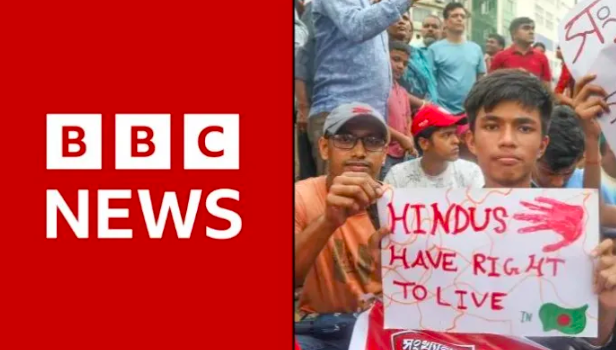
Case Summary
On August 18, 2024, the BBC published an article that downplayed the religious motivations behind attacks on Hindus in Bangladesh, instead attributing the violence to political unrest. The article, co-authored by Jacqui Wakefield and Shruti Menon and titled “Far-right spreads false claims about Muslim attacks in Bangladesh,” framed the attacks as politically driven rather than religiously motivated. The report came amid widespread violence in Bangladesh, where over 205 incidents of targeted attacks on Hindu shops, temples, and businesses had been reported. The BBC claimed that many of the videos circulating online about the attacks were either misleading or false, asserting that political tensions, rather than religious hate, were at the root of the unrest. It pointed out that Sheikh Hasina's Awami League party, which had been under attack, included both Hindu and Muslim members. By emphasising this political context, the BBC implied that the targeting of Hindus was incidental to broader political violence, rather than a direct result of religious persecution. To bolster its narrative, the BBC featured commentary from Sayeed Al-Zaman, who suggested that right-wing Indian influencers were using fear-mongering tactics to inflame tensions by spreading "misinformation" about the attacks. The article also criticised the role of Indian media and accounts that support “Hindu-nationalist values” in disseminating misleading content. It highlighted India’s political support for Sheikh Hasina’s regime as a potential factor driving these narratives, further attributing the discourse around anti-Hindu violence to a political agenda orchestrated by India. While the BBC stressed that political violence was affecting both Hindus and Muslims, it neglected to explain why only Hindu temples and businesses were targeted if the violence was merely political. The article also glossed over the demographic reality that Bangladesh is over 90% Muslim, meaning that most Awami League members would naturally be Muslim, making the disproportionate targeting of Hindu members significant. BBC selectively cherry-picked instances of Muslim protesters guarding Hindu temples to emphasise communal harmony, while failing to address the religious affiliation of the attackers. This led to accusations that the BBC was attempting to whitewash Islamist violence by downplaying its religious motivations. Critics accused the BBC of engaging in selective fact-checking, cherry-picking data, and drawing false equivalences to shield Islamist groups from accountability, while also demonising India for raising awareness about the atrocities.
Why it is Hate Crime ?
This case has been added to the hate tracker under the prime category- Hate speech against Hindus and within this, the sub-category selected is- Media bias. Under this, one tertiary category namely, 'Anti-Hindu fake news or downplaying', has also been selected. Hate speech is defined as any speech, gesture, conduct, writing, or display that is prejudicial against a specific individual and/or group of people, which is leading to or may lead to violence, prejudicial action or hate against that individual and/or group. Media plays a specific and overarching reach in perpetuating prejudicial attitudes towards a community owing to unfair, untrue coverage and/or misrepresentation/misinterpretation, selective coverage and/or omission of facts of/pertaining to issues affecting a specific religious group. This type of bias can dehumanise the victim group, making it easier for others to justify harmful actions against them, which aligns with the objectives of hate speech laws aimed at preventing such harm. It is often observed that the media takes a prejudicial stand against the Hindu community driven by their need to shield the aggressor community which happens to be a numeric minority, however, is the one perpetrating violence against Hindus. For example, the media is often quick to contextualise religiously motivated crimes against Hindus, omit or misrepresent facts that point towards religiously motivated hate crimes, justify and/or downplay religiously motivated hate crimes or simply present fake news to stereotype Hindus. Such media bias leads to the denial of persecution and is often used to dehumanise Hindus, leading to justification for violence against them. For example, the media covered several fake allegations of Hindus targeting Muslims and forcing them to chant Jai Shree Ram. Most of these cases were proved false and fabricated after police investigation. These fake news reports were subsequently never retracted or clarified. Such fake news led to the justification of violence and dehumanisation of Hindus based on the argument that since Hindus targeted Muslims and forced them to chant Jai Shree Ram, the dehumanisation of Hindus and violence against them was par for the course and merely a retaliation. Such media bias leads to prejudicial portrayal of Hindus and offers a justification for violence against them and therefore, is considered hate speech under this category. The other sub-category this case is being added to is 'denial or mocking of genocide/large scale persecution'. Denial or mocking of genocide/large-scale persecution/ethnic cleansing refers to the act of denying or minimizing the fact of the ethnic cleansing and/or genocide and/or religious persecution of Hindus. This often involves denying the scale, mechanisms, religious intent, or even the occurrence of the ethnic cleansing and/or genocide and/or religious persecution of Hindus. Hate speech of this kind involves the dissemination of falsehoods that deny or distort established historical facts or mock the suffering of Hindus by saying that they deserved the persecution, motivated by Hinduphobia. Denying such atrocities is not only about the denial of facts or rewriting/revising history, but it also delegitimises the religiously motivated persecution of Hindus, the religious hate/motivation/animosity that led to the persecution, and dehumanises Hindus as a religious group. Such denial of ethnic cleansing and/or genocide and/or religious persecution of Hindus not only denies the suffering but also paves the way for future/present atrocities and hate speech, inciting prejudice and violence against Hindus. It also provides a justification for violence by delinking religious animosity from religiously motivated crimes committed against Hindus. Since such denial and/or mocking of genocide/ethnic cleansing/atrocities motivated by religious animosity leads to present and future ramifications of creating more hate speech, violence, dehumanisation and delegitimisation, it would be considered hate speech under this category. The removal of Sheikh Hasina from power in Bangladesh on August 5 escalated the persecution and marginalisation of the Hindu minority in the predominantly Islamic nation, intensifying what can be described as a silent genocide. Since her ouster, Islamists have carried out unchecked atrocities against Hindus, including physical violence, the destruction of temples and religious symbols, and the systematic displacement of Hindus from their ancestral lands. Over 205 attacks on Hindu temples, shops, and businesses have been recorded following Sheikh Hasina's removal as Prime Minister. Many Hindus have been brutally murdered or injured in these assaults. Amidst this violence, the BBC's article attempted to downplay the attacks on Hindus and deny large scale persecution while shifting focus to cast India in a negative light. The foreign media house framed the violence as primarily political rather than rooted in religious persecution. By attributing the unrest to political tensions surrounding Sheikh Hasina's ouster, the BBC failed to adequately address the clear pattern of targeted attacks on Hindu temples, businesses, and homes. Over 205 such incidents were reported, yet the article glossed over the religious aspect, instead suggesting that the violence was incidental to broader political unrest. By selectively fact-checking and cherry-picking data, the BBC's coverage can be seen as an attempt to shield Islamist groups from accountability, portraying them as victims of political dynamics rather than aggressors in a religiously charged conflict. This narrative, combined with accusations against Indian media for inflaming tensions, serves to deflect attention from the Islamist violence that is being perpetuated in the Islamic nation. By minimising or ignoring these atrocities, BBC indirectly contributed to the marginalisation and continued persecution of Hindus, normalising the violence against them. This selective silence, combined with unrelated criticism of India, can be seen as a form of hate speech, further deepening animosity toward Hindus and their faith and this is why this case has been added to the tracker.


Case Status
Unknown


Perpetrators Details
Perpetrators
Others
Perpetrators Range
N/A
Perpetrators Gender
unknown
 Sources




