Hindu persecution whitewashed: Western media blames Bangladeshi Hindus for their own genocide, changes headline after outrage
 United States
  6 August, 2024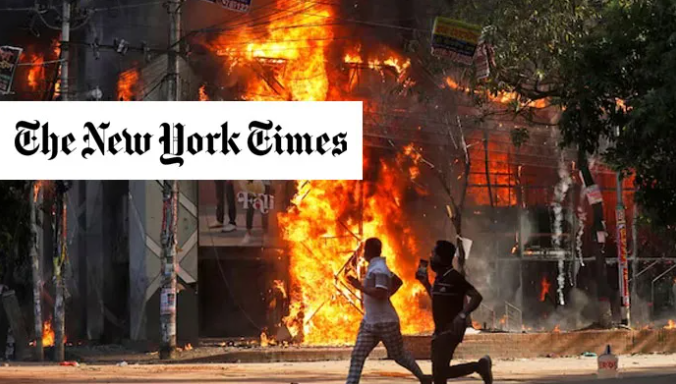
Case Summary
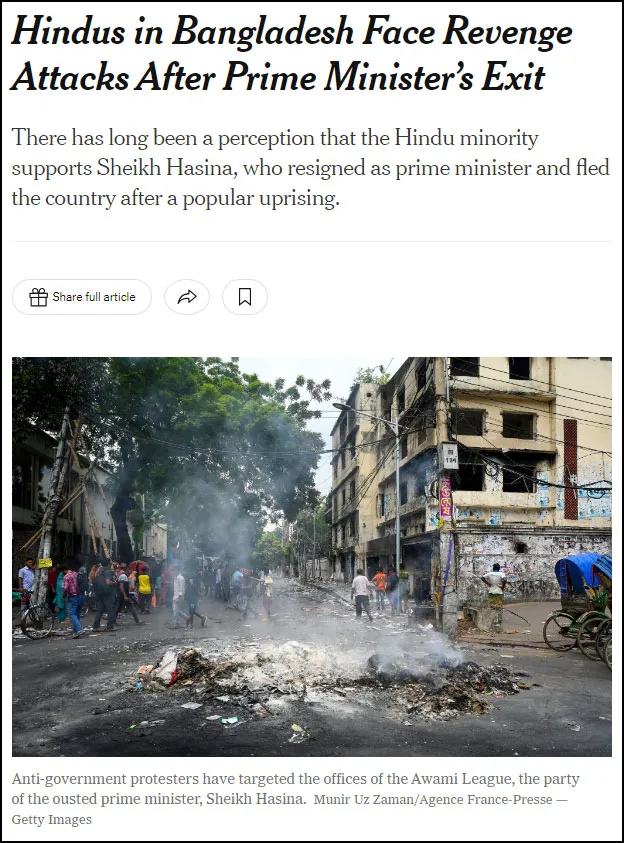
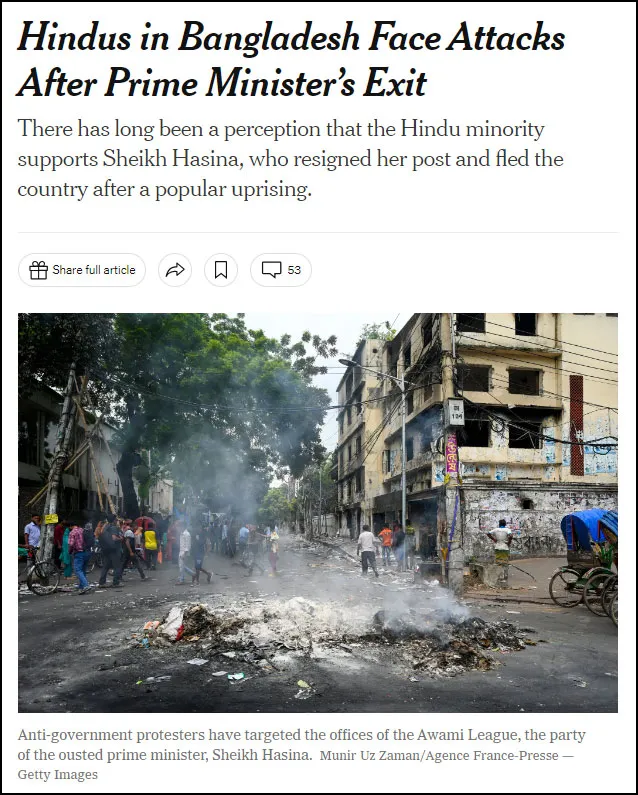
The faith-based persecution of Bangladeshi Hindus was whitewashed by a Western media outlet named The New York Times. They wrote an article trying to blame Hindus in Bangladesh for their own genocide at the hands of Muslim extremists. After Sheikh Hasina’s exile on 5th August 2024, an Islamist revolution disguised as a student movement erupted in Bangladesh, unleashing coordinated attacks against Hindus nationwide. Hindu homes, shops, and temples were looted, desecrated, and set ablaze, while Hindu women faced sexual violence and Hindu families were murdered without recourse. The scale and brutality of these acts made it a clear case of genocide targeting the Hindu minority. Despite Hasina's resignation as Prime Minister, the attacks on Hindus continued. Following this, on 7th August 2024, The New York Times faced backlash after publishing a report titled "Hindus in Bangladesh Face Revenge Attacks After Prime Minister’s Exit." The headline suggested the attacks on Hindus were not the result of religious animosity but were ‘revenge attacks’. The article was criticised on social media for downplaying the communal nature of the violence by suggesting that Hindus were targeted solely because they were seen as allies of Hasina’s party, the Awami League. In their report, The New York Times acknowledged the attacks on Hindus but attempted to shift the narrative away from a communal angle, citing a student leader, Nahid Islam, who said the attacks were meant to "destroy" the student movement. Human Rights Watch echoed this view, with Meenakshi Ganguly, deputy director for Asia at Human Rights Watch, stating that Hindus were being attacked because of their traditional support for the Awami League, not due to communal reasons. Amidst the criticism, The New York Times quietly changed the headline to "Hindus in Bangladesh Face Attacks After Prime Minister’s Exit," though the article's content remained unchanged, continuing to push the same narrative. Social media users condemned the media outlet for whitewashing the communal violence against Hindus. For instance, Indian journalist Swati Goel Sharma wrote on X, “Imagine what the ground situation must be that even The New York Times has published a report today on targeted attacks against Hindus in Bangladesh? Protesters who helped oust Hasina have been quoted saying ‘ordinary Hindus’, and not just Awami League leaders, are facing attacks on their lives, homes and temples. This, when the daily exodus of Hindus from Bangladesh has only increased over the decades. Shame on everyone who tried to whitewash communal atrocities against Hindus in Bangladesh just because the mobs are also targeting Muslim Awami leaders and policemen. The bloodshed will hopefully end soon, but eradication of Hindus from Bangladesh will not. Like in Pakistan, the world would silently watch.” Even advocate Ishkaran Singh Bhandari on X stated, “The New York Times’ justification for the GENOCIDE OF HINDUS IN BANGLADESH! The globalists have no value nor belief in human rights for Hindus. That’s why CAA, that’s why Bharat should do whatever it can to protect.” X user Anshul Saxena said, “The New York Times justified the attacks on Hindus in Bangladesh by calling them ‘revenge attacks.’ Now, a narrative is being created that Hindus are culprits, so they deserve this, while those carrying out the attacks are being whitewashed. This is international media for you.” X user Anshul Saxena said, “The New York Times justified the attacks on Hindus in Bangladesh by calling them 'revenge attacks'. Now, a narrative is being created that Hindus are culprits, so they deserve this, while those carrying out the attacks are being whitewashed. This is international media for you.” Contrary to The New York Times’ claim, Hinduphobia Tracker documented several instances of Hindus being targeted for their religious identity in Bangladesh following Sheikh Hasina’s exile. On 5th August 2024, in the Pirojpur district, Hindus were brutally attacked by a Muslim mob. Hindu homes were selectively targeted, attacked, and looted. A Hindu woman was also brutally gang-raped by members of the Muslim mob. In another instance, Jhenaidah saw extensive violence with ongoing attacks, vandalism, and looting at the homes of 10 Hindu families in Chaklapara municipality. Hindu shops in Kotchandpur were also attacked and looted. In Tilpatti, Bargola, 5-7 Hindu shops were attacked, vandalised, and looted. Similarly, the house of Dr Gautam Kumar Mondal in Sahapukur village, Dupchanchia Upazila, was attacked and looted. The house of Sahadev Roy in Sonadia, Hatiya, Noakhali, was attacked and looted. In Thakurgaon, Hindu homes in the Sadar were attacked, vandalised, and looted. Additionally, in ward 2 of Pirganj, the cremation temple was attacked and burnt. In Patuakhali, the Radha Govinda Temple in Kuakata was attacked and vandalised. The house of Ananta Mukherjee was attacked, vandalised, and looted. Hindu homes in wards 2 and 3 of the Sadar, Panchagarh, were attacked, vandalised, and looted.
Case Images
Why it is Hate Crime ?
This case has been added to the tracker under the primary category- Anti-Hindu subversion or Prejudice. The tertiary category selected is- Anti-Hindu fake news or downplaying. Hate speech is defined as any speech, gesture, conduct, writing, or display that is prejudicial against a specific individual and/or group of people, which is leading to or may lead to violence, prejudicial action or hate against that individual and/or group. Media plays a specific and overarching reach in perpetuating prejudicial attitudes towards a community owing to unfair, untrue coverage and/or misrepresentation/misinterpretation, selective coverage and/or omission of facts of/pertaining to issues affecting a specific religious group. This type of bias can dehumanise the victim group, making it easier for others to justify harmful actions against them, which aligns with the objectives of hate speech laws aimed at preventing such harm. It is often observed that the media takes a prejudicial stand against the Hindu community driven by their need to shield the aggressor community which happens to be a numeric minority, however, is the one perpetrating violence against Hindus. For example, the media is often quick to contextualise religiously motivated crimes against Hindus, omit or misrepresent facts that point towards religiously motivated hate crimes, justify and/or downplay religiously motivated hate crimes or simply present fake news to stereotype Hindus. Such media bias leads to the denial of persecution and is often used to dehumanise Hindus, leading to justification for violence against them. For example, the media covered several fake allegations of Hindus targeting Muslims and forcing them to chant Jai Shree Ram. Most of these cases were proved false and fabricated after police investigation. These fake news reports were subsequently never retracted or clarified. Such fake news led to the justification of violence and dehumanisation of Hindus based on the argument that since Hindus targeted Muslims and forced them to chant Jai Shree Ram, the dehumanisation of Hindus and violence against them was par for the course and merely a retaliation. Such media bias leads to prejudicial portrayal of Hindus and offers a justification for violence against them and therefore, is considered hate speech under this category. In this incident, The New York Times’ framing of the communal violence in Bangladesh as “revenge attacks” against Hindus is a clear instance of anti-Hindu hate speech. By shifting blame onto the victims themselves, the article attempts to justify or excuse the brutal persecution of Hindus by Muslim extremists. This narrative downplays the religious animosity driving the attacks and whitewashes the severity of the violence, masking it as mere political retribution. Such misrepresentation is deeply harmful as it invalidates the lived experiences of Hindu victims, erases the communal nature of the atrocities, and perpetuates misinformation that shields the perpetrators from rightful accountability. It fosters a dangerous environment where hate crimes against Hindus are minimised and normalised in international discourse. When widespread outrage erupted over the headline’s insensitivity, The New York Times made a superficial change, carefully adjusting the headline to “Hindus in Bangladesh Face Attacks After Prime Minister’s Exit” while leaving the article’s content unchanged. This misleading tactic aims to deceive readers and maintain the same biased narrative, effectively pushing an anti-Hindu agenda under the guise of balanced reporting. The outlet’s reluctance to acknowledge the clear communal targeting reflects a disturbing disregard for truth and justice, and an indifference to the plight of an embattled minority. In stark contrast, detailed reports from Hinduphobia Tracker document the systematic targeting of Hindus in Bangladesh solely for their religious identity following Sheikh Hasina’s exile. The recorded incidents of Hindu homes, businesses, and temples being attacked, Hindu women being sexually assaulted, and Hindu lives being lost expose an undeniable pattern of religious persecution. This evidence dismantles any narrative that frames the violence as anything but communal hatred. The deliberate targeting of Hindus, as an oppressed minority, and the media’s failure to accurately report this reality is emblematic of anti-Hindu bias—one that dehumanises the victims and obscures the true nature of the genocide the Hindu community endures. This deliberate distortion and minimisation of anti-Hindu violence not only silences the victims but also emboldens Muslim extremists and undermines efforts for justice and protection of Hindus. Given that this case meets the parameters of a hate speech targeting Hindus, it is being added to the hate crime database. Note: The Hinduphobia Tracker has documented several cases of religious persecution of Hindu minorities in Bangladesh. To read these cases, please visit our official website- hinduphobiatracker.org.


Case Status
Unknown


Perpetrators Details
Perpetrators
Others
Perpetrators Range
Unknown
Perpetrators Gender
unknown
 Sources




