Hindu genocide in Bangladesh whitewashed by Western media outlet, shifts the blame to "Hindu nationalist" Indian government
 United States
  13 August, 2024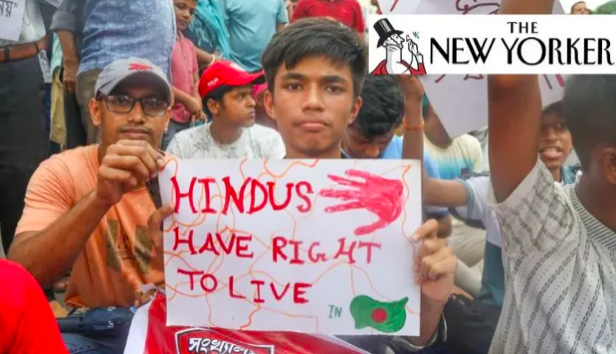
Case Summary
Since the removal of Sheikh Hasina from power in Bangladesh, Hindus have faced violence, with Muslim extremists attacking, raping, and killing Hindus, while temples are vandalised, idols destroyed, and properties looted. Despite this, some Western media, such as The New Yorker, are whitewashing the violence, with narratives justifying it as "anti-India sentiment" because India is a Hindu-majority country ruled by the "Hindu nationalist" Bharatiya Janata Party (BJP). On August 14, 2024, The New Yorker published an article by Isaac Chotiner based on an interview with Subho Basu, a professor at McGill University. Basu downplayed the role of Muslim extremist forces in the violence and instead suggested that anti-Hindu actions were driven by opposition to India, linking it to discontent over India's alleged role in press freedom curbs and political disappearances under the Awami League. Basu claimed the violence was not religiously motivated but a reaction against India's ruling Hindu nationalist party, insinuating that the rise of Hindu nationalism in India angered Muslim-majority Bangladesh into going on a violent rampage against Bangladeshi Hindus. Chotiner echoed this narrative by framing the violence as part of a broader "revolution" in Bangladesh, despite over 205 reported attacks on Hindus by Muslim mobs. He further minimised the seriousness of the situation by focusing on fears rather than facts of the violence. The article aligns with previous New Yorker coverage that has been critical of the Modi-led BJP in India, painting anti-Hindu violence in Bangladesh as a response to Indian politics rather than acknowledging the religious and Islamist motivations. Contrary to The New Yorker's claim, the Hinduphobia Tracker documented several instances of Hindus being targeted for their religious identity in Bangladesh following Sheikh Hasina’s exile. On 5th August 2024, in the Pirojpur district, Hindus were brutally attacked by a Muslim mob. Hindu homes were selectively targeted, attacked, and looted. A Hindu woman was also brutally gang-raped by members of the Muslim mob. In another instance, Jhenaidah saw extensive violence with ongoing attacks, vandalism, and looting at the homes of 10 Hindu families in Chaklapara municipality. Hindu shops in Kotchandpur were also attacked and looted. In Tilpatti, Bargola, 5-7 Hindu shops were attacked, vandalised, and looted. Similarly, the house of Dr Gautam Kumar Mondal in Sahapukur village, Dupchanchia Upazila, was attacked and looted. The house of Sahadev Roy in Sonadia, Hatiya, Noakhali, was attacked and looted. In Thakurgaon, Hindu homes in the Sadar were attacked, vandalised, and looted. Additionally, in ward 2 of Pirganj, the cremation temple was attacked and burnt. In Patuakhali, the Radha Govinda Temple in Kuakata was attacked and vandalised. The house of Ananta Mukherjee was attacked, vandalised, and looted. Hindu homes in wards 2 and 3 of the Sadar, Panchagarh, were attacked, vandalised, and looted.
Why it is Hate Crime ?
This case is being added under the primary category- Hate Speech against Hindus. Within this, the subcategory selected is- Anti-Hindu subversion and prejudice. The tertiary category selected is- Anti-Hindu fake news or downplaying. Hate speech is defined as any speech, gesture, conduct, writing, or display that is prejudicial against a specific individual and/or group of people, which is leading to or may lead to violence, prejudicial action or hate against that individual and/or group. Media plays a specific and overarching reach in perpetuating prejudicial attitudes towards a community owing to unfair, untrue coverage and/or misrepresentation/misinterpretation, selective coverage and/or omission of facts of/pertaining to issues affecting a specific religious group. This type of bias can dehumanise the victim group, making it easier for others to justify harmful actions against them, which aligns with the objectives of hate speech laws aimed at preventing such harm. It is often observed that the media takes a prejudicial stand against the Hindu community driven by their need to shield the aggressor community which happens to be a numeric minority, however, is the one perpetrating violence against Hindus. For example, the media is often quick to contextualise religiously motivated crimes against Hindus, omit or misrepresent facts that point towards religiously motivated hate crimes, justify and/or downplay religiously motivated hate crimes or simply present fake news to stereotype Hindus. Such media bias leads to the denial of persecution and is often used to dehumanise Hindus, leading to justification for violence against them. For example, the media covered several fake allegations of Hindus targeting Muslims and forcing them to chant Jai Shree Ram. Most of these cases were proved false and fabricated after police investigation. These fake news reports were subsequently never retracted or clarified. Such fake news led to the justification of violence and dehumanisation of Hindus based on the argument that since Hindus targeted Muslims and forced them to chant Jai Shree Ram, the dehumanisation of Hindus and violence against them was par for the course and merely a retaliation. Such media bias leads to prejudicial portrayal of Hindus and offers a justification for violence against them and therefore, is considered hate speech under this category. This case qualifies as hate speech against Hindus because it involves the whitewashing of Hindu genocide by a Western media outlet, The New Yorker. On the ground in Bangladesh, Muslim extremist mobs have specifically attacked Hindus by killing, looting, burning temples, destroying idols, and even committing sexual violence. These actions were not indiscriminate but deliberately targeted Hindus for their religious identity. At the same time, the media narrative, particularly in The New Yorker article, has reinforced an indirect form of hate speech. By refusing to acknowledge the religious nature of the attacks and instead framing them as “anti‑India sentiment,” the article displaces blame onto the Bangladeshi Hindus themselves by associating them with the politics of India’s ruling party. This minimises their suffering, erases the reality of religious persecution, and creates justification for violence. Such reframing implies that Hindus are legitimate scapegoats for political grievances, which is itself a dehumanising form of speech. This denial of Hindu victimhood effectively silences the community, stripping Hindus of the right to narrate their own suffering and persecution. When violent crimes and atrocities are whitewashed or reframed as political events, they are no longer recognised as targeted persecution. This erasure emboldens the Muslim perpetrators by sending them the message that their crimes will either be dismissed or excused internationally. Contrary to the Western media’s portrayal, clear evidence documented by the Hinduphobia Tracker shows that Hindus in Bangladesh were attacked precisely for their religious identity. They were not attacked for political activism or for supporting any government, but because they were Hindus. The mob violence, selective targeting of Hindu homes, looting of Hindu shops, desecration of temples, and sexual violence against Hindu women all demonstrate that the motivation was based on religious hatred rather than political difference. Given that the Western media outlet in question attempted to whitewash targeted attacks against Hindus and sought to shift the blame onto India rather than the Muslim extremists, this constitutes an instance of hate speech. Therefore, it is being added to the hate crime database.


Case Status
Unknown


Perpetrators Details
Perpetrators
Others
Perpetrators Range
From 2 To 5
Perpetrators Gender
male
 Sources




