Anti-Hindu fake news: Bangladeshi Muslim preacher spreads fake news to incite violence against Hindus, ISKCON targeted amidst large scale persecution of Hindus in Bangladesh
 Bangladesh
  5 August, 2024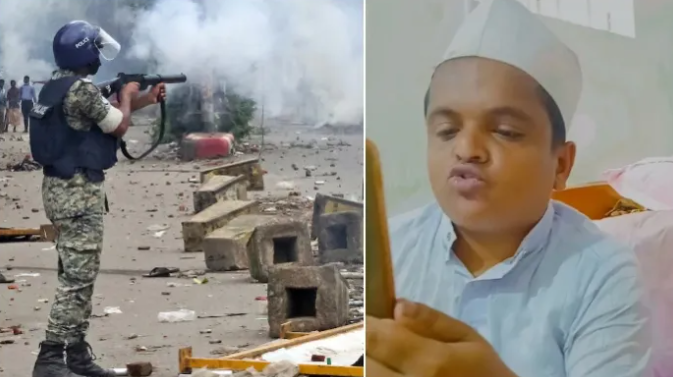
Case Summary
In Bangladesh, a Muslim preacher, Rafiqul Islam Madani, previously arrested in 2021 for inciting violence, uploaded a video on Facebook amid the ongoing political crisis. Through the video, he spread fake news against Hindus and targeted ISCON. In the video, he falsely claimed that Senior Jail Superintendent Subrata Kumar Bala of Kashimpur High-Security Central Jail in Gazipur had opened fire on prisoners, causing multiple casualties and allegedly martyring one prisoner. Madani, known for his history of spreading violence, further fueled tensions by labelling Bala as an ISKCON member and "Sheikh Hasina’s Dalal," insinuating that Bala, a Hindu, was deliberately targeting prisoners. Since Sheikh Hasina’s ousting, Bangladesh has plunged into chaos as Islamist extremists have taken advantage of the political turmoil to unleash a wave of terror and violence against the Hindu community. The Islamist mobs have attacked Hindu homes, burned them to the ground, and abducted women in a horrific descent into anarchy. Several temples have been destroyed in various parts of the Islamic country in a major crackdown on Hindus.
Why it is Hate Crime ?
This case is categorised under the primary category- Hate Speech against Hindus. Under that, the relevant sub-category is- Anti Hindu subversion and prejudice, and within it, the tertiary category selected is- Anti-Hindu Fake News or Downplaying. Hate speech is defined as any speech, gesture, conduct, writing, or display that is prejudicial against a specific individual and/or group of people, which is leading to or may lead to violence, prejudicial action or hate against that individual and/or group. Media plays a specific and overarching reach in perpetuating prejudicial attitudes towards a community owing to unfair, untrue coverage and/or misrepresentation/misinterpretation, selective coverage and/or omission of facts of/pertaining to issues affecting a specific religious group. This type of bias can dehumanise the victim group, making it easier for others to justify harmful actions against them, which aligns with the objectives of hate speech laws aimed at preventing such harm. It is often observed that the media takes a prejudicial stand against the Hindu community driven by their need to shield the aggressor community which happens to be a numeric minority, however, is the one perpetrating violence against Hindus. For example, the media is often quick to contextualise religiously motivated crimes against Hindus, omit or misrepresent facts that point towards religiously motivated hate crimes, justify and/or downplay religiously motivated hate crimes or simply present fake news to stereotype Hindus. Such media bias leads to the denial of persecution and is often used to dehumanise Hindus, leading to justification for violence against them. For example, the media covered several fake allegations of Hindus targeting Muslims and forcing them to chant Jai Shree Ram. Most of these cases were proved false and fabricated after police investigation. These fake news reports were subsequently never retracted or clarified. Such fake news led to the justification of violence and dehumanisation of Hindus based on the argument that since Hindus targeted Muslims and forced them to chant Jai Shree Ram, the dehumanisation of Hindus and violence against them was par for the course and merely a retaliation. Such media bias leads to prejudicial portrayal of Hindus and offers a justification for violence against them and therefore, is considered hate speech under this category. Rafiqul Islam Madani’s Facebook video directly qualifies as hate speech against Hindus because it fabricated an incident with the specific intent to malign a Hindu officer and to fuel animosity against the Hindu community as a whole. By falsely claiming that Senior Jail Superintendent Subrata Kumar Bala, explicitly identified as a Hindu, had opened fire on Muslim prisoners, Madani created a narrative where Hindus were cast as aggressors and persecutors of Muslims. This is classic anti-Hindu fake news designed to incite hatred, as it portrays Hindus as violent oppressors without any factual basis. It weaponises misinformation to spread prejudice against Hindus, painting them as enemies of Muslims in a time of political instability. Linking Bala to ISKCON and labelling him “Sheikh Hasina’s Dalal” amplifies the propaganda, exploiting pre-existing religious biases to deepen suspicion and hostility toward Hindus. Such fabrications are a tool for justifying future violence — by demonising the Hindu community, Madani made it easier for mobs to rationalise attacks on Hindu temples, homes, and individuals. The circulation of fake news through social media magnifies its reach, ensuring the rapid radicalisation of large audiences, making this case a textbook example of hate speech against Hindus. It is important to mention here that this incident is not an isolated case but part of a larger pattern of hostility that Muslims in Bangladesh continue to harbour against Hindus. The systematic denigration of Hindu beliefs, coupled with attacks on temples, homes, and individuals, highlights the deep-seated animosity that has only intensified in the wake of political turmoil. Such an attack serves to normalise bigotry, further emboldening radical elements to target the Hindu community with impunity.
Victim Details
Total Victim
1
Deceased
0
Gender
- Male 1
- Female 0
- Third Gender 0
- Unknown 0
Caste
- SC/ST 0
- OBC 0
- General 0
- Unknown 1
Age Group
- Minor 0
- Adult 1
- Senior Citizen 0
- Unknown 0


Case Status
Unknown


Perpetrators Details
Perpetrators
Muslim Extremists
Perpetrators Range
One Person
Perpetrators Gender
male
 Sources




