Muslim extremists object to Bajrangbali sticker on state bus, Karnataka govt promises to restrict this expression of faith
 Karnataka, India
  31 July, 2024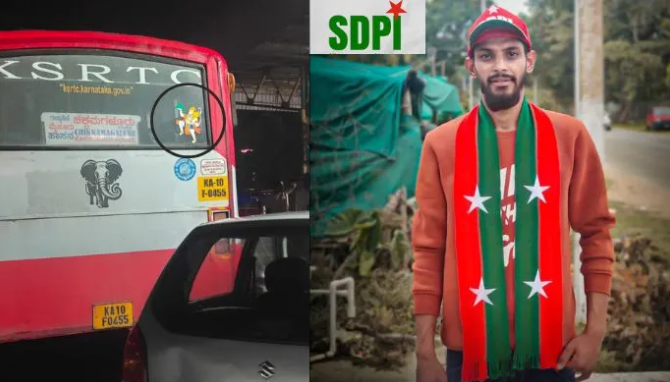
Case Summary
On August 1st, the Karnataka State Road Transport Corporation (KSRTC) faced controversy after responding to a demand from Arif Arwah, an Islamist associated with the Social Democratic Party of India (SDPI). Arwah requested the removal of a Bajrangbali sticker from a state bus, claiming it was inappropriate for a government vehicle. KSRTC acknowledged his request and forwarded it for further examination, which drew criticism for entertaining the demand. Arwah, a known SDPI member, had also called for action against the bus driver and conductor.
Why it is Hate Crime ?
In several cases, it is seen that the administration/state disallows a religious practice owing to prejudicial orders and concerns, targeted specifically against the Hindu community. Such restriction/prohibition would be considered documented as a hate crime because the orders are often a result of pressure by groups that harbour animosity towards Hinduism and Hindus. Often, the restriction by the authorities is driven by bias, hostility, or prejudice against the specific community being stopped from holding a religious practice, by pressure groups that harbour animosity towards Hindus, intrinsic to their faith. Since practices are intrinsic to the faith of the Hindus, such prejudicial restriction is considered a curtailing of the fundamental rights of the Hindu community. In several cases, for example, the authorities ban a Hindu religious practice due to pressure from groups opposed to the religion. In other instances the prohibition is selectively enforced against one religious group (Hindus) while others are allowed to proceed. There are still other cases where the authorities preemptively restrict a religious practice by Hindus because those who hold animosity towards Hindus may get “provoked” leading to them being violent, thereby assuaging the sentiments of those who hold animosity towards Hindus by curtailing the religious rights of Hindus. Such acts and orders are prejudiced, indicating discriminatory motives owing to the capitulation to groups that harbour animosity towards Hindus and therefore, would be categorized as a religiously motivated hate crime since the original pressure leading to the order itself is a result of hatred/bias/prejudice/religious hate against Hindus. In this case, a complaint from a Muslim SDPI member about a Bajrangbali (Hanuman) sticker on a state bus led the Karnataka government to take action. This has been perceived as the government prioritizing the grievances of an Islamist opposing a Hindu symbol, potentially at the expense of Hindu sentiments. The Indian state is, by design, 'secular' in nature, which means that constitutionally, the state must remain equidistant from religion and religious representations officially. In this case it could potentially be argued that the state was simply adhering the secular values by ensuring that state buses don't display religious representations of one faith, alienating the others. However, the same state has often displayed double standards, which evidences their specific bias towards the representation and expression of Hindu faith. In the Hijab case for example, where the court had upheld the schools' right to enforce uniform rules over the religious practice of Muslim girls wearing the hijab, the same Congress govt in Karnataka had revoked the ban and upheld the Muslim girls' right to wear the hijab to school. In government schools, a uniform for students exists to ensure no religious discrimination, upholding the religion-agnostic secular values of the government. However, as is seen in this case, secular principles are often enforced selectively. While the state in this case used the principle of secularism to suppress expression of the Hindu identity (by taking action against a Bajrang Bali bus sticker) and pandering to Islamist sensibilities, in the Hijab case, it overturned these very principles to allow the Muslim community their expression of religious identity. When double standards are applied by the state to suppress Hindu expression and encourage Islamic expression, prejudice against one community forms the basis of alienation of rights for the Hindu community. Due to the prejudicial attitude of the state against Hindu expression of faith, this case is being documented as a religiously motivated hate crime against Hindus.


Case Status
Unknown


Perpetrators Details
Perpetrators
State and Establishment
Perpetrators Range
N/A
Perpetrators Gender
male
 Sources




