Attack on Hindu religious sentiments: Muslim man denigrates revered Hindu deity and his mother on social media
 Bareilly, Uttar Pradesh, India
  8 July, 2024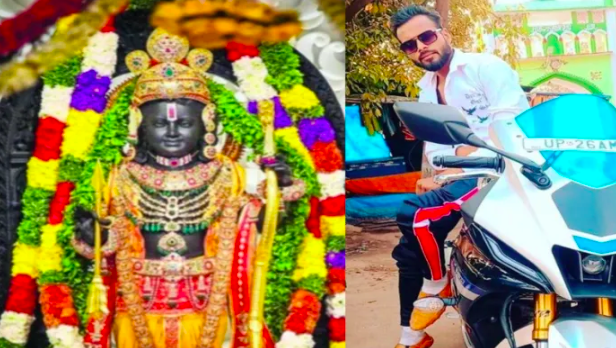
Case Summary
In Bareilly district, Uttar Pradesh, derogatory remarks against Lord Ram and his mother, two deeply revered figures in Hinduism, were made by a Muslim man named Aamir Ali. The case involved serious communal provocation ahead of Muharram and the Kanwar Yatra. On 10th July 2024, local Hindu organisations filed a complaint against Aamir Ali, stating that he had insulted Lord Ram and his mother through a social media post. A First Information Report (FIR) was registered, and an investigation was initiated by the police. The incident took place in the Baradari Police Station area. Himanshu Patel, who first discovered the objectionable content, came across a video on 9th July 2024 shared by Aamir Ali on his Facebook account. The video was described as highly offensive, containing abusive and derogatory language directed at Lord Ram’s mother and presented in a mocking and disrespectful tone. It featured three individuals creating a short video in which Lord Ram’s mother was subjected to ridicule. Police investigations confirmed that the complaint was valid. Officers stated that Aamir Ali’s intentions were to create communal tension ahead of the religious processions. Legal proceedings were initiated against him under relevant sections of the Indian Penal Code (IPC) for promoting enmity between communities and insulting religious beliefs.
Why it is Hate Crime ?
This case has been added to the tracker under the primary category- Hate Speech against Hindus. Within this, the subcategory selected is- Anti-Hindu slurs, mocking faith. Anti-Hindu slurs and the deliberate mocking of the Hindu faith owing to religious animosity involve the usage of derogatory terms, stereotypes, or offensive references to religious practices, symbols, or figures. One of the common anti-Hindu slurs used against Hindus is “cow-worshipper” and “cow piss drinker”. The intention of using this term is to demean and mock Hindus as a group and their religious beliefs since Hindus consider the cow holy. Additionally, some symbols and the slurs attached to them have a historical context that exacerbates the insult, hate, stereotyping, dehumanisation and oppression against Hindus. Cow worship has been used for centuries to denigrate Hindus, insult their faith and oppress Hindus specifically as a religious group. There has been overwhelming documentation about how cow slaughter has been used to persecute Hindus with cow meat being thrown in temples and places of worship. There has also been overwhelming documentation where cow meat (beef) has been force-fed to Hindus to either forcefully convert them to Islam or denigrate their faith. Apart from cow worship, the Swastika – which holds deep religious significance for the Hindus – has also been misinterpreted and distorted to use as a slur against Hindus. Similarly, the worship of the Shivling has been used by supremacist ideologies and religions to denigrate Hindus owing to religious animosity. Such slurs and denigration stem out of inherent animosity and hate towards Hindus and their faith, therefore, it is categorised as hate speech targeted at Hindus specifically owing to their religious identity. This incident is a clear instance of anti-Hindu hate speech, as the Muslim perpetrator makes deliberately derogatory remarks against Lord Ram and his mother, two sacred and central figures in the spiritual consciousness of Hindus. Lord Ram, venerated as an incarnation of Lord Vishnu, stands as a symbol of truth, virtue, and righteousness, while his mother, Mata Kaushalya, embodies purity, maternal devotion, and grace. The divine bond between Ram and Kaushalya forms one of the most revered aspects of Hindu devotion, representing dharma and the sanctity of motherhood. Any abuse or insult directed towards them is not merely a personal offence but an assault on the collective faith and emotional core of millions of Hindus. It shatters spiritual reverence and mirrors an attack on the essence of Hindu civilisation, which upholds compassion, virtue, and reverence for divine motherhood as sacred ideals. The abusive and mocking remarks made by Aamir Ali against Lord Ram and Mata Kaushalya expose a deeper level of religious animosity. His words are not casual or misguided; they are deliberately crafted to demean the Hindu faith and humiliate its followers. This act displays a clear intent to provoke disharmony by mocking revered deities and sacred maternal figures. Such actions cannot be considered part of legitimate expression, as they seek to injure and divide communities, exploiting faith as a target of ridicule. The ridicule of Hindu deities, particularly of Lord Ram and his mother, reveals entrenched prejudice and hostility towards Hindus, transforming digital content into a tool for hatred against the Hindu faith and its adherents. This incident, therefore, needs to be recognised as a religiously motivated hate speech designed to demean and provoke an entire faith community. The online nature of this abuse reflects a wider pattern of growing digital Hinduphobia. Across social media platforms, derogatory memes, abusive posts, slurs, and videos targeting Hindu gods, goddesses, and cultural practices have become disturbingly frequent. These patterns of cyber abuse reduce a living faith into a subject of mockery and further encourage intolerance against Hindus both online and offline. When such offensive depictions circulate widely without accountability, they normalise anti-Hindu sentiment and reinforce negative stereotypes in virtual spaces. Online hate, when mainstreamed, fuels real-world hostility, discrimination, and communal suspicion, thereby translating digital abuse into lived harm against Hindus. Given that this case meets all the parameters of a religiously motivated hate speech, it is being added to the Hinduphobia Tracker’s hate crime database. Disclaimer: The Hinduphobia Tracker records the dates of incidents based on when the crime occurred rather than when it is reported by the media. However, in this particular case, media reports do not specify the exact date on which the accused made the offensive post. They only mention the date when the content first came to the notice of the Hindu complainant, which was 9th July 2024. Therefore, this date is being considered as the indicative date of the incident for documentation purposes.


Case Status
Complaint registered


Perpetrators Details
Perpetrators
Muslim Extremists
Perpetrators Range
One Person
Perpetrators Gender
male
 Sources




