60 Hindus injured after Muslims mob attacks with stones, ransack homes of Hindus and vandalise temple in Bangladesh
 Dhaka, Dhaka District, Bangladesh
  9 July, 2024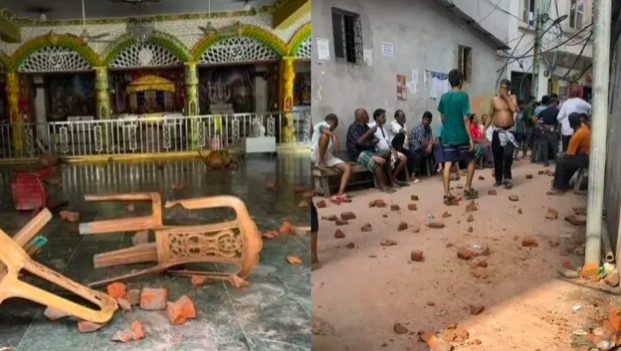
Case Summary
On July 10, 2024, in Dhaka's Miranjilla Colony, at around 1:30 PM, Magistrate Muhammad Moniruzzaman visited the newly constructed colony to rehabilitate displaced Hindu minorities. However, his efforts were violently opposed by local councillor Muhammad Auwal Hossain and his supporters, who disagreed with the decision to aid the Hindu community. The situation escalated as the Hindus were attacked with bricks and stones, their homes ransacked, and a local Hindu temple vandalised. The assault left at least 60 Hindus injured, many requiring treatment at Dhaka Medical College and Hospital. The Dhaka South City Corporation, responsible for overseeing the Miranjilla Colony, had previously ordered the eviction of local residents, primarily Hindus, a month earlier. Many homes were destroyed during this drive. However, following a nationwide outcry, the eviction was halted, and the corporation agreed to help those displaced, mostly Hindu families. Despite this, local ruling Awami League leaders and extremist factions opposed the rehabilitation efforts.
Why it is Hate Crime ?
This case has been classified under two prime categories, namely- Attack not resulting in death and Attack on Hindu religious symbols, of the hate tracker. Under Attack not resulting in death, the sub-category selected is- Attacked for Hindu identity- In several cases, Hindus are attacked merely for their Hindu identity without any perceived provocation. A classic example of this category of religiously motivated hate crime is a murder in 2016. 7 ISIS terrorists were convicted for shooting a school principal in Kanpur because they got ‘triggered’ seeing the Kalava on his wrist and tilak that he had put. In this, the Hindu victim had offered no provocation except for his Hindu religious identity. The motivation for the murder was purely religious, driven by religious supremacy. Such cases where Hindus are targeted merely for their religious identity would be documented as a hate crime under this category. The second sub-category chosen under Attack not resulting in death is- Attacked to induce migration from non-Hindu dominated area- There have been cases where the Hindus living in an area, often with a majority dwelling belonging to non-Hindus or those harbouring animosity towards the Hindu faith, the Hindu residents experience threats and violence. The violence is employed with the aim of making the Hindus leave the area and relocate, so the area could be turned into an exclusive ghetto for adherents of the non-Hindu faith or those who harbor animosity towards the Hindu faith. In several cases, the aim of exodus is explicit. However, in several cases, the demand for exodus of Hindu residents is not explicit, however, violence by non-Hindu residents leaves the Hindu residents no option but to leave the area, thereby, turning the area into an exclusive ghetto of non-Hindu residents. In such cases, there are instances of violence against the Hindu residents explicitly. For example, in the Hauz Qazi case of 2019, the Muslim residents claimed that mob violence against the Hindu residents had been triggered by a parking dispute. However, the violence did turn religious with a temple being desecrated and was directed specifically against the Hindu residents. The Hindu residents of the area were clear that the violence was religiously motivated and one of the motives was to affect an exodus of the Hindu residents. In such cases, even though the perpetrators have not explicitly expressed the aim of affecting exodus, the given circumstances and violence and precedent point to the intention of exodus and therefore would be categorized under this sub-category. Such crimes are religiously motivated and therefore are hate crimes. The sub-category chosen under Attack on Hindu religious symbols is- Attack on Temples- In Hinduism, a temple is the abode of the Deity. The Deity in the Temple is consecrated, thereby, making it a real, breathing entity. Hindus believe that not just the Deity but the temple premises itself are sacred to Hindus since Hindus hold the faith that the entire Temple space is an amalgamation of the divine energy of the deity. Given the central significance of Temples in Hindu Dharma, any attack against a Hindu Temple or its peripheral premises is an attack on the faith itself and is born out of animosity towards the faith, of which, the Temple is a central tenet. Any manner of attack against a Temple and/or its premises would therefore be considered a religiously motivated hate crime. In this case, Muslims in Bangladesh attacked the minority Hindu community solely because of their religious identity, with no provocation from the Hindu side. The details suggest that the attack aimed to force the Hindus to leave the area. It is noted that the Dhaka South City Corporation, which oversees the Miranjilla Colony, had previously ordered the eviction of local residents, primarily Hindus, but this was halted following a nationwide outcry. Despite this, local ruling Awami League leaders and radical Islamists later launched an attack to complete the unfinished task of evicting the Hindus from their homes. It is pertinent to note here that it was less than a month after this attack that an ethnic cleansing of Hindus was unleashed in Bangladesh after the ouster of Sheikh Hasina. The ingrained hostility towards Hindus is evident from the fact that it was the Muslims who got outraged at the prospect of the state helping the Hindu population and in their rage against minority Hindus, attacked a Hindu place of worship as well. Given that the Hindus were targeted specifically for their religious identity, this case has been included in the hate tracker.
Victim Details
Total Victim
60
Deceased
0
Gender
- Male 0
- Female 0
- Third Gender 0
- Unknown 60
Caste
- SC/ST 0
- OBC 0
- General 0
- Unknown 60
Age Group
- Minor 0
- Adult 0
- Senior Citizen 0
- Unknown 60


Case Status
Unknown


Perpetrators Details
Perpetrators
Muslim Extremists
Perpetrators Range
Unknown
Perpetrators Gender
unknown
 Sources




