Kerala police bans Hindu temple from displaying saffron flags
 Thiruvananthapuram, Kerala, India
  27 March, 2023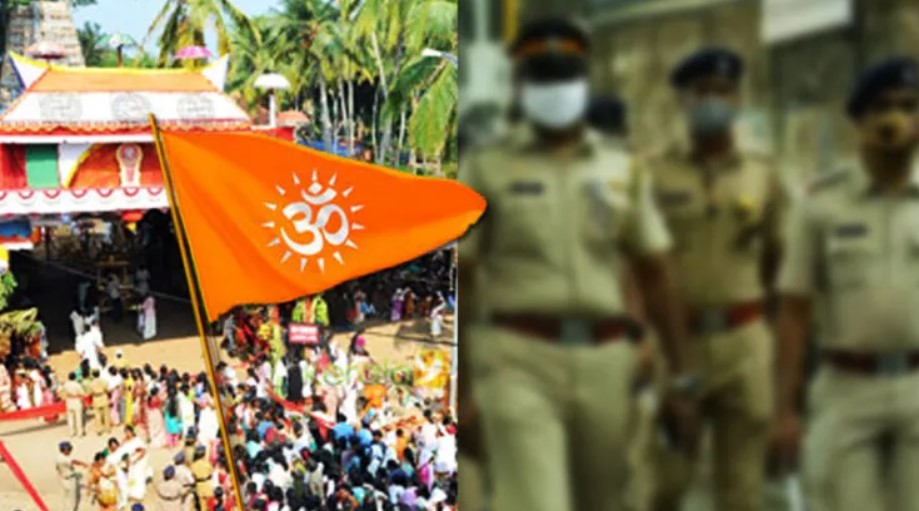
Case Summary
On March 28, 2023, reports emerged that the Kerala Police banned the Karikkakam Chamundi temple in Thiruvananthapuram from displaying the saffron flag. The police reportedly asked the temple administration to remove saffron flags and torans which were put up as part of decoration for the festivals. A report by Janam TV said that the Trust officials confirmed that the ACP has threatened to take down the flag and initiate legal action if the saffron flags are not brought down. A saffron flag with the image of the goddess was put up as part of the festive decoration. However, the police intervened and stopped the same. The police said that only saffron colours can be used for decoration. The devotees felt the move was politically motivated and said that despite the orders, they would hoist the saffron flag.
Why it is Hate Crime ?
In several cases, it is seen that the administration/state disallows a religious practice owing to prejudicial orders and concerns, targeted specifically against the Hindu community. Such restriction/prohibition would be considered documented as a hate crime because the orders are often a result of pressure by groups that harbour animosity towards Hinduism and Hindus. Often, the restriction by the authorities is driven by bias, hostility, or prejudice against the specific community being stopped from holding a religious practice, by pressure groups that harbour animosity towards Hindus, intrinsic to their faith. Since practices are intrinsic to the faith of the Hindus, such prejudicial restriction is considered a curtailing of the fundamental rights of the Hindu community. In several cases, for example, the authorities ban a Hindu religious practice due to pressure from groups opposed to the religion. In other instances the prohibition is selectively enforced against one religious group (Hindus) while others are allowed to proceed. There are still other cases where the authorities preemptively restrict a religious practice by Hindus because those who hold animosity towards Hindus may get “provoked” leading to them being violent, thereby assuaging the sentiments of those who hold animosity towards Hindus by curtailing the religious rights of Hindus. Such acts and orders are prejudiced, indicating discriminatory motives owing to the capitulation to groups that harbour animosity towards Hindus and therefore, would be categorized as a religiously motivated hate crime since the original pressure leading to the order itself is a result of hatred/bias/prejudice/religious hate against Hindus. Here, the Kerala police, working at the behest of the communist government in the state, restricted the installation of saffron flags inside the premises of a Hindu temple. The saffron flag, known as the “Bhagwa Dhwaj” or “Kesari Flag,” holds profound significance in Hinduism. It symbolises various spiritual and cultural aspects of the Sanatan Dharma. Saffron, representing purity and spirituality, is associated with the sacred fire, a central element of Hindu rituals. The flag often bears symbols like the Om, signifying the ultimate reality, and the Trishul, the divine weapon of Lord Shiva. It is seen during religious processions, ceremonies, and atop temples, signifying the presence of the divine. The saffron flag unifies devotees, fostering a sense of belonging and reverence, making it an essential emblem of Hindu faith and identity. Kerala police objected to the installation of a saffron flag inside the temple premises. This action is an infringement on the religious rights of the Hindu community and stems out of animosity and prejudice towards the Hindu community, for their religious beliefs. It can also be considered a prejudicial order denying the Hindu community its fundamental rights. Since the demand for the removal of the saffron flag and the order as a result of it both were prejudicial to the rights of Hindus and the original demand itself stemmed from animosity and prejudice against Hindu beliefs, this case is being categorized as a religiously motivated hate crime.


Case Status
Unknown


Perpetrators Details
Perpetrators
State and Establishment
Perpetrators Range
N/A
Perpetrators Gender
unknown
 Sources




