Anti-Hindu fake news: Muslim journalists and media falsely portrays Muslim man's death as 'mob lynching by Hindus'
 Shamli, Uttar Pradesh, India
  3 July, 2024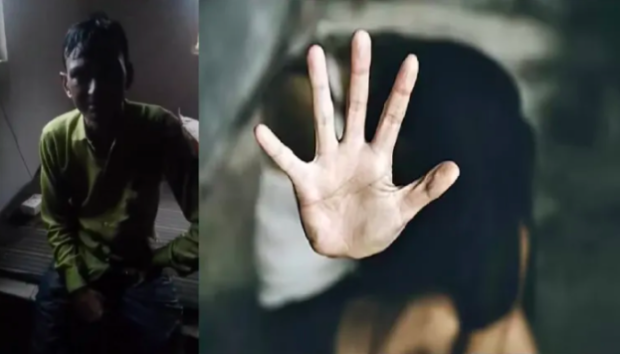
Case Summary
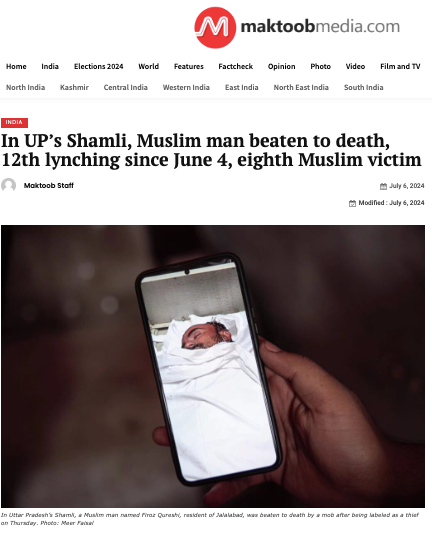
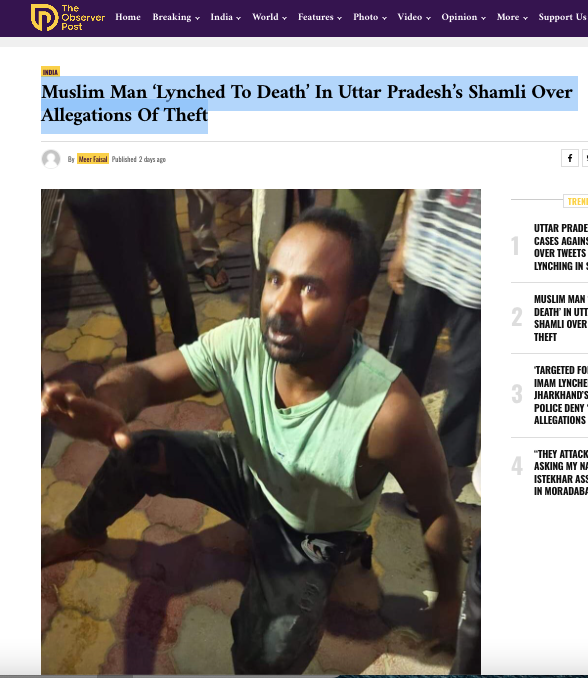
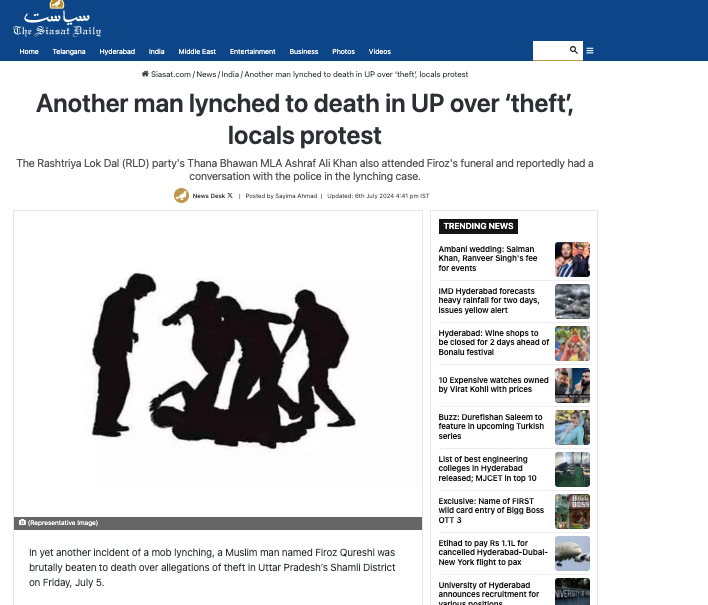
An anti-Hindu fake news had circulated on social media regarding the death of a Muslim man, falsely asserting that he had been killed by a mob of Hindus for his religious identity. This misinformation had been propagated by several Muslim journalists and left-leaning as well as Muslim-oriented news outlets. According to media reports, the incident had taken place in Shamli, Uttar Pradesh. A Muslim man named Firoz Qureshi had died following an altercation on the night of 4th July 2024 after entering the house of a local resident, Rajendra, while in an intoxicated state. The case quickly escalated on social media, where several Muslim journalists and activists misrepresented Firoz’s death as a mob lynching motivated by religious identity, ignoring official police statements that disproved such claims. Journalists Wasim Akram Tyagi and Zakir Ali Tyagi had posted on X (formerly Twitter), asserting that Firoz had been beaten to death by a Hindu mob led by Rajendra and others, suggesting that the incident reflected a pattern of anti-Muslim violence. News platforms such as Maktoob Media, The Observer Post, and The Siasat Daily—all known for their left-leaning or Muslim-centric perspectives—also spread these fabricated stories, portraying the event as a communal attack and a mob lynching of a Muslim man by Hindus. These false reports had fuelled communal tensions by insinuating that the killing was deliberate and motivated by Firoz's religious identity. However, Shamli Police refuted the mob lynching narrative, stating that Firoz’s death had not resulted from an assault but followed a scuffle that occurred when he entered Rajendra’s house in an inebriated condition. The police clarified that no serious injury marks were found on Firoz’s body, as confirmed by the post-mortem report. Furthermore, Firoz’s own brother had acknowledged his occasional consumption of intoxicating substances. Despite these clarifications, the incident had been deliberately given a communal angle on social media, prompting police intervention. On 6th July 2024, Thana Bhawan Police registered a First Information Report (FIR) against five individuals—Wasim Akram Tyagi, Zakir Ali Tyagi, Ahmad Raza Khan, Saif Allahbadi, and Asif Rana—for spreading misinformation about Firoz Qureshi’s death as a case of mob lynching. The accused were booked under Bharatiya Nyaya Sanhita (BNS) Section 196, pertaining to promoting enmity between different groups on the grounds of religion, race, place of birth, residence, or language and committing acts prejudicial to the maintenance of harmony, and Section 353, pertaining to statements conducive to public mischief. The FIR had been lodged following a complaint by Sub-Inspector Manendra Kumar of Thana Bhawan Police against these individuals responsible for circulating false news and inciting communal disharmony.
Case Images
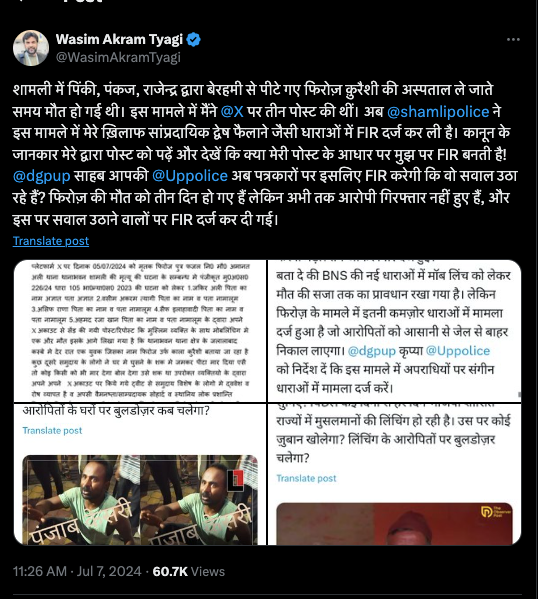
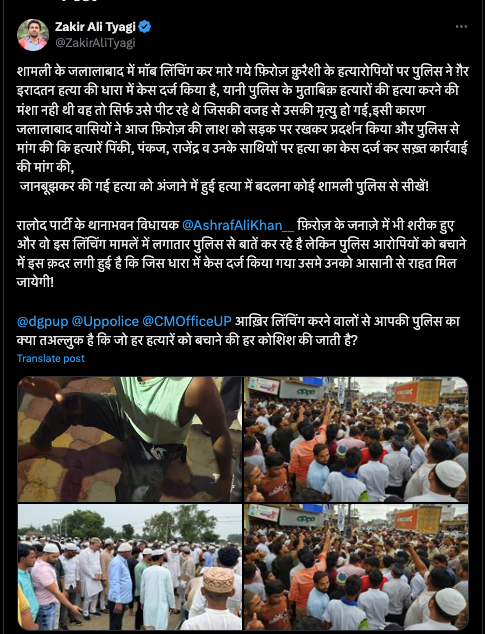
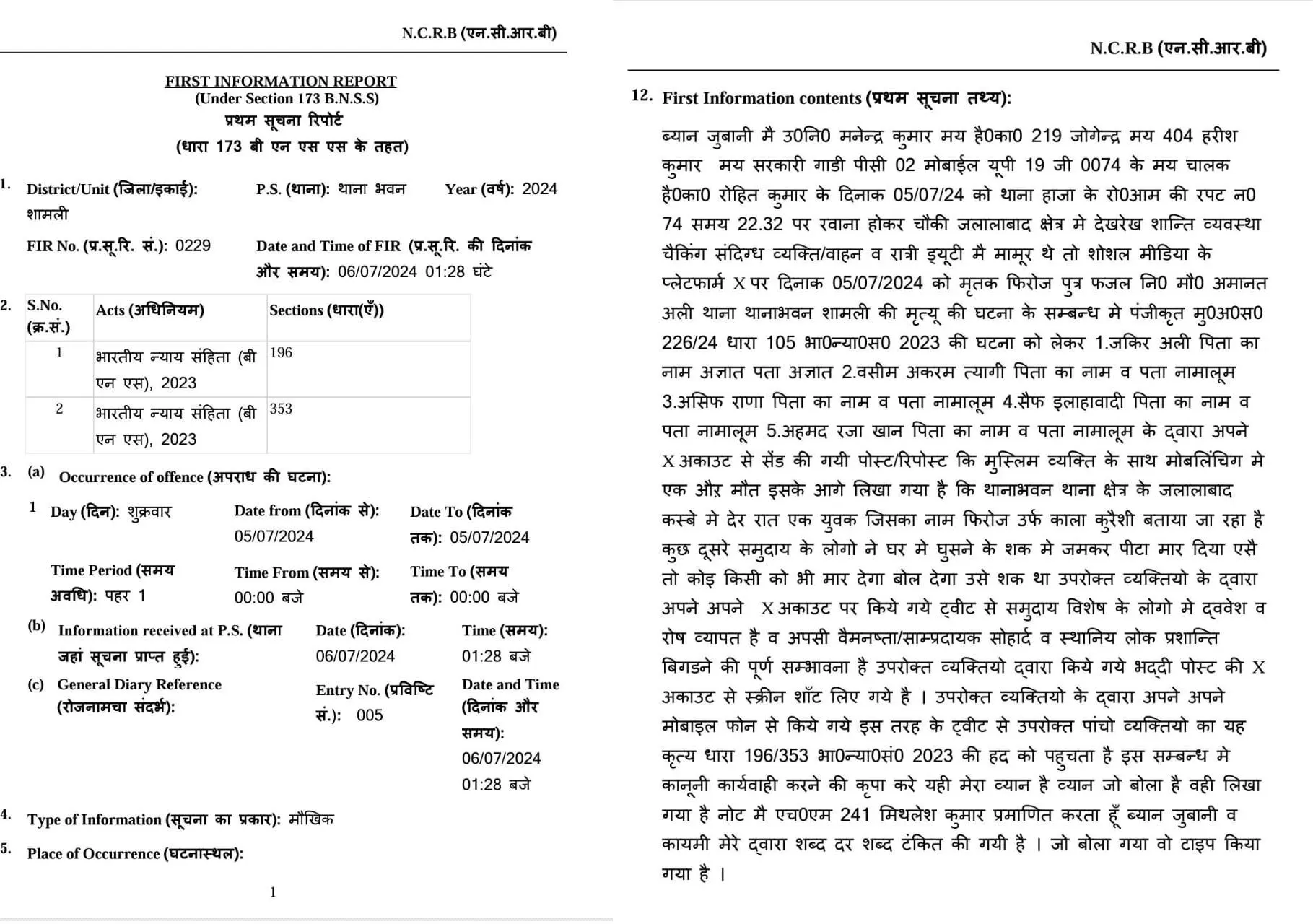
Why it is Hate Crime ?
This case has been added to the tracker under the primary category- Hate Speech against Hindus. The subcategory selected is- Anti-Hindu subversion and prejudice. The tertiary category selected is- Anti-Hindu fake news or downplaying. Hate speech is defined as any speech, gesture, conduct, writing, or display that is prejudicial against a specific individual and/or group of people, which is leading to or may lead to violence, prejudicial action or hate against that individual and/or group. Media plays a specific and overarching reach in perpetuating prejudicial attitudes towards a community owing to unfair, untrue coverage and/or misrepresentation/misinterpretation, selective coverage and/or omission of facts of/pertaining to issues affecting a specific religious group. This type of bias can dehumanise the victim group, making it easier for others to justify harmful actions against them, which aligns with the objectives of hate speech laws aimed at preventing such harm. It is often observed that the media takes a prejudicial stand against the Hindu community driven by their need to shield the aggressor community which happens to be a numeric minority, however, is the one perpetrating violence against Hindus. For example, the media is often quick to contextualise religiously motivated crimes against Hindus, omit or misrepresent facts that point towards religiously motivated hate crimes, justify and/or downplay religiously motivated hate crimes or simply present fake news to stereotype Hindus. Such media bias leads to the denial of persecution and is often used to dehumanise Hindus, leading to justification for violence against them. For example, the media covered several fake allegations of Hindus targeting Muslims and forcing them to chant Jai Shree Ram. Most of these cases were proved false and fabricated after police investigation. These fake news reports were subsequently never retracted or clarified. Such fake news led to the justification of violence and dehumanisation of Hindus based on the argument that since Hindus targeted Muslims and forced them to chant Jai Shree Ram, the dehumanisation of Hindus and violence against them was par for the course and merely a retaliation. Such media bias leads to prejudicial portrayal of Hindus and offers a justification for violence against them and therefore, is considered hate speech under this category. In this case, the deliberate spread of fake news by the accused Muslim journalists and left-leaning or Muslim-oriented media outlets constituted a clear instance of anti-Hindu hate speech. By circulating false information that a Muslim man had been beaten to death by a mob of Hindus for his religious identity, these individuals and organisations intentionally propagated a communal narrative against Hindus. The police investigation had already confirmed that the man, Firoz Qureshi, did not die from any assault but from circumstances following a scuffle while he was intoxicated. Despite this, the accused parties portrayed Hindus collectively as violent aggressors, constructing a false image of systemic Hindu hatred towards Muslims. Such deliberate misrepresentation of facts sought to vilify the Hindu community and incite hostility between religious groups. This false portrayal clearly demonstrated a pattern of religiously motivated hate speech directed against Hindus. By accusing Hindus of engaging in communal killings without evidence, the perpetrators not only defamed the community but also inflamed communal divisions. Projecting Hindus as oppressors and portraying them as inherently violent or intolerant towards minorities contributed to creating a hostile social environment against Hindus. It perpetuated harmful stereotypes and attempted to reverse the victim narrative for political and ideological ends. The consequences of such hate-driven misinformation are serious. Repeated circulation of false communal narratives against Hindus fosters public suspicion, social alienation, and potential targeting of innocent individuals based on their religious identity. When a community is continuously depicted as the aggressor, it risks both social ostracisation and actual violence in retaliation. Therefore, this act went beyond mere misinformation—it amounted to deliberate, religiously motivated hate speech that endangered communal harmony and targeted the Hindu community’s dignity and security. Therefore, this case is being added to the hate crime database of the Hinduphobia Tracker. Disclaimer: In this case, the police had filed a First Information Report (FIR) against five individuals—Wasim Akram Tyagi, Zakir Ali Tyagi, Ahmad Raza Khan, Saif Allahbadi and Asif Rana—for spreading false communal content online. These individuals were identified as cyber perpetrators. Alongside them, news outlets such as Maktoob Media, The Observer Post and The Siasat Daily were also involved in disseminating the same fabricated narrative. Hence, for the purpose of documentation, the total number of perpetrators is recorded as '8', including the aforementioned media outlets.
Victim Details
Total Victim
1
Deceased
0
Gender
- Male 1
- Female 0
- Third Gender 0
- Unknown 0
Caste
- SC/ST 0
- OBC 0
- General 0
- Unknown 1
Age Group
- Minor 0
- Adult 1
- Senior Citizen 0
- Unknown 0


Case Status
Complaint registered


Perpetrators Details
Perpetrators
Others
Perpetrators Range
From 5 to 10
Perpetrators Gender
unknown
 Sources




