Attack on Hindu sentiments: Indian politician denigrates revered Hindu scripture, maliciously associates it with violence and intolerance
 Alappuzha, Kerala, India
  1 July, 2024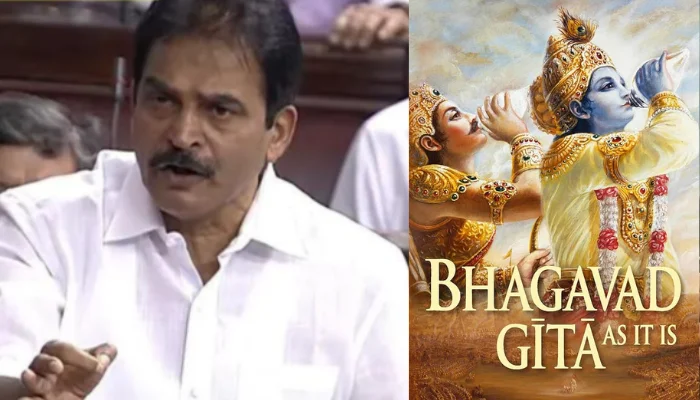
Case Summary
An anti-Hindu speech targeting the revered Hindu scripture, the Bhagavad Gita, was delivered by Congress Member of Parliament (MP) K. C. Venugopal. He asserted that Nathuram Godse was inspired by the Bhagavad Gita to assassinate Mahatma Gandhi. According to media reports, the incident took place on 2nd July 2024, when Congress MP K. C. Venugopal from Alappuzha, Kerala, made controversial remarks about the Bhagavad Gita. He insinuated that Godse had learned violence, murder, and intolerance from the revered Hindu scripture. These comments were made in support of a statement previously issued by Rahul Gandhi, a Congress (INC) politician, in which he stated that individuals identifying as Hindus were engaged in violence and hatred. Venugopal’s remarks led to widespread protests and criticism across the country. Venugopal stated, “Mahatma Gandhi and Godse believed in the Bhagavad Gita; both believed in the Bhagavad Gita, both read the Bhagavad Gita. But Gandhi learned non-violence, tolerance, and respect for human life from the Gita and the message of Lord Krishna. Godse learned violence, murder, and intolerance from the same textbook.”
Why it is Hate Crime ?
This case has been added to the tracker under the primary category- Hate Speech against Hindus. The subcategory selected is- Subversion of scriptures. Subverting the religious scriptures of Hindus has particularly devastating consequences. Subversion of the scriptures of Hindus is often done to justify or promote hatred, discrimination, or violence against specific individuals or groups of Hindus. Religious scriptures are often nuanced and those who harbour religious animosity towards Hindus often misquote or misrepresent the scripture to legitimise their animosity and hate towards the faith and its adherents. Any such misquoting of scriptures or subversion to justify hate, violence and discrimination against Hindus owing to religious animosity is hate speech and is categorised as such. The other subcategory selected is- Anti-Hindu slurs, mocking faith. Anti-Hindu slurs and the deliberate mocking of the Hindu faith owing to religious animosity involve the usage of derogatory terms, stereotypes, or offensive references to religious practices, symbols, or figures. One of the common anti-Hindu slurs used against Hindus is “cow-worshipper” and “cow piss drinker”. The intention of using this term is to demean and mock Hindus as a group and their religious beliefs since Hindus consider the cow holy. Additionally, some symbols and the slurs attached to them have a historical context that exacerbates the insult, hate, stereotyping, dehumanisation and oppression against Hindus. Cow worship has been used for centuries to denigrate Hindus, insult their faith and oppress Hindus specifically as a religious group. There has been overwhelming documentation about how cow slaughter has been used to persecute Hindus with cow meat being thrown in temples and places of worship. There has also been overwhelming documentation where cow meat (beef) has been force-fed to Hindus to either forcefully convert them to Islam or denigrate their faith. Apart from cow worship, the Swastika – which holds deep religious significance for the Hindus – has also been misinterpreted and distorted to use as a slur against Hindus. Similarly, the worship of the Shivling has been used by supremacist ideologies and religions to denigrate Hindus owing to religious animosity. Such slurs and denigration stem out of inherent animosity and hate towards Hindus and their faith, therefore, it is categorised as hate speech targeted at Hindus specifically owing to their religious identity. In this case, the accused subverted one of Hinduism’s most sacred scriptures, the Bhagavad Gita, a text held in the highest reverence by Hindus across the world. The Bhagavad Gita, forming part of the Mahabharata, is regarded as the philosophical essence of Sanatan Dharma (Hinduism). It expounds the principles of righteousness, selfless duty, and spiritual liberation through devotion to the divine. By misrepresenting such a scripture as an inspiration for violence, the accused attempted to distort its true spiritual message. His statement that Nathuram Godse killed Mahatma Gandhi as he was inspired by the Bhagavad Gita reflected deep-seated religious hostility towards the Hindu faith. This act of subversion was not an innocent comment but a deliberate attempt to defame a revered text and malign a faith tradition that promotes non-violence, duty, and self-realisation. The accused’s speech represented an effort to paint the Bhagavad Gita in a negative light, equating it with hatred and extremism, which is a direct affront to the religious sentiments of millions of Hindus. Such rhetoric amounted to anti-Hindu slurring. By demonising the Bhagavad Gita, the accused indirectly vilified the entire Hindu community and their religion, since the scripture forms the moral and spiritual foundation of Hindu life. The statement did not merely target a religious text—it attacked the identity and values of those who revere it. Associating a sacred scripture with violence and intolerance perpetuated negative stereotypes about Hindu philosophy and its followers. This form of speech, equating Hinduism’s most cherished scripture with acts like murder, worked as a tool of communal provocation. It fostered division and contributed to the social stigmatisation of Hindus as adherents of aggression rather than seekers of peace. It is also important to note that the accused is himself a sitting Member of Parliament, a position that carries significant responsibility for upholding constitutional values and maintaining communal harmony. The fact that he held such biased and discriminatory views towards the Hindu community and its sacred scripture exposed his deep-seated religious animosity. When such prejudice comes from an elected representative, it carries the weight of authority and legitimacy, amplifying its potential harm. By using his public platform to disparage the Hindu religion and its sacred text, he not only furthered anti-Hindu hostility but also undermined the constitutional principles of equality, secularism, and respect for all faiths. His words had the capacity to influence attitudes, legitimise prejudice, and embolden further acts of religious intolerance against Hindus and Hinduism. Given that this incident met the parameters of a religiously motivated offence, it was recorded as part of the Hate Crime Database of the Hinduphobia Tracker. Disclaimer: The Hinduphobia Tracker records incident dates based on when the crime occurred rather than when it was reported by the media. However, in this particular case, media sources did not specify the exact date of occurrence. Therefore, for documentation purposes, the date of 2nd July 2024—the date on which the incident was reported by the media—has been taken as the indicative date of the incident. This selection serves solely for record-keeping and documentation purposes.


Case Status
Unknown


Perpetrators Details
Perpetrators
Others
Perpetrators Range
One Person
Perpetrators Gender
male
 Sources




