Hindu man given death threats, assaulted by Muslim wife's family and locals
 Raebareli, Uttar Pradesh, India
  27 May, 2024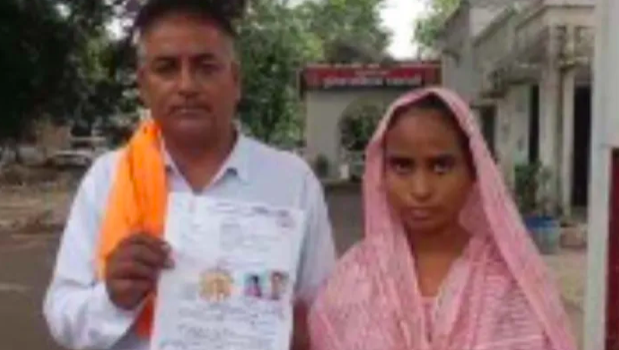
Case Summary
In the Raebareli district of Uttar Pradesh, a Nihastha village resident Nitin Awasthi, and a Muslim woman, Sarvari Begum, fell in love and performed a court marriage on May 28, 2024. Since then, the Sarvari's family members and local Muslims had been assaulting them and issuing death threats to the couple. Local Muslim residents tore the woman's clothes and paraded her in the area after she married Awasthi. Nitin Awasthi said that when he tried to save Sarvari from the attack by the woman’s cousins and local Muslims, he was also chased. Awasthi said that the sons of Sarvari’s sister, Alsama, Sarvar, Irfan, Toufeeq, and Javed among others were involved in attacking the couple. The Police, however, refuted the claims made by the couple. When she approached the police station for help, they imposed a challan on the couple under section 151. Responding to an X post, Raebareli Police said that the allegations made in the case were found “false and baseless” in the initial investigation. The police added that it appeared to be a matter of land dispute and the Lalganj Police’s area officer had been directed to conduct an investigation.
Why it is Hate Crime ?
When Hindu men are in a relationship with non-Hindu women, there are cases where the man is forced to convert his religion and upon his refusal to do so, the partner or/and her family attacks the victim. Such relationships may be consensual with the religious identity of the non-Hindu woman known to the victim. Somewhere along the relationship, the non-Hindu woman or her family starts forcing/pressurizing the Hindu man to convert. In some of these cases, the association could be non-consensual as well or, the religious identity of the non-Hindu woman could be previously unknown to the Hindu victim. In such cases, the Hindu man is first forced/pressurized to change his religion by the non-Hindu woman or her family. The force/pressure could involve threats. The trigger for directing violence against the Hindu man is in these cases his refusal to comply and change his religion under threat and/or force. In other cases that have been documented, it is also seen that the Hindu partner is assaulted by the non-Hindu woman or her family simply for his relationship with the non-Hindu woman and by virtue of him following the Hindu faith and not the religion of the non-Hindu woman. In such cases, the relationship is consensual in most cases and the religion of both partners is known to the other. Often, in such cases, there is no direct force/pressure to convert either, however, the attack is a result of the Hindu man being in a relationship with the non-Hindu partner and not following her religion/following Hinduism specifically. Such cases are driven by specific religious motivations and against the religious identity of the victim and are therefore qualified as hate crimes. This case is worthy of being documented as a religiously motivated hate crime as the family of the Hindu man's Muslim partner assaulted him for being in a relationship with her. In this case, the relationship was consensual and the man and woman were with each other knowing each other’s identity fully well. However, in the Islamic faith, a marriage is deemed illegitimate if the non-Muslim partner does not convert to Islam. For those who practice the faith, when their daughter marries a Hindu man without the man converting to Islam, the difference in religions followed becomes the main point of disapproval for the family of the Muslim woman. Because of the ingrained element of religious supremacy in Islam, the perpetrator family believes that such interfaith relationships diminish the family’s ‘honour’. In this case, also, the inherent animosity for the Hindu religion prompted the family of the Muslim girl and the local Muslims of the area to launch a vicious attack on the Hindu man. Here, it is important to understand why, despite police denying the communal angle in the crime, this case has been included in the hate tracker. In several cases where a Hindu man is in a relationship with a Muslim woman, the man ends up being assaulted or killed by the family of the Muslim woman because the family of the Muslim partner disapprove of their relationship. This disapproval mostly stems from the difference in the religious identity of the couple. According to Islamic law, a marriage is not deemed lawful until the non-Muslim spouse agrees to convert to Islam. The Muslim woman's family views this as the primary source of disapproval, and it is frequently observed that this disapproval results in the Muslim partner's family either assaulting or killing the non-Muslim partner. The police, in many such cases, where the motive behind the crime is obvious but not explicitly mentioned, deny that the crime committed was in any way motivated by a religious bias or say that there was ‘no communal angle’ to the crime. Several factors are generally at play here. Many a time the police downplay incidents of low-level communal crime because it is their jurisdiction that comes under question. The police also often say that there was ‘no communal angle’ to a crime when there was one because they wish to ensure that owing to the crime already committed, there is no further flare up in the area. Likewise, the Left media and the leftist elite are also inclined to emphasise this "no communal angle" trope, especially wherever the victim of the crime is a Hindu. However, to determine whether such cases are religiously motivated hate crimes or not, one needs to understand what is a ‘communal angle’ in a crime. When we hear the phrase ‘communal angle’, the instant image that we have in mind is that of what happened during the Delhi Riots. There are crimes where the communal angle are glaringly obvious, like the Delhi Riots, and there are others, where the trigger of the communal crime could be extremely different and even seemingly benign. Take the example of Lotan Nishad for example. In April 2020, Lotan Nishad was sitting at a tea shop in the village at around 9.30 am. While reading the morning newspaper, he got into a verbal confrontation, over the role of Tablighi Jamaat in transmitting the Wuhan Coronavirus, with some people sitting there. Mohammad Sona, who was present there, began assaulting the victim. After some time Sona brought a gun and fired at him from close range. Nishad fell to the ground and started bleeding. He died. Immediately, after a statement by the police, the ‘liberal’ ecosystem began to peddle the ‘no communal angle’ trope. However, only a police statement or a media report, for instance, cannot be enough to determine whether there is a communal angle present in the crime that has been committed. In fact, to determine whether the crime is communal in nature or not, we need to give emphasis to the ground realities. For example in the case of Rinku Sharma, the Bajrang Dal activist who was mercilessly stabbed in his house in front of his family members in Delhi’s Mangolpuri area in the year 2021, the leftist media and the leftist ecosystem had tried to peddle that there was no communal angle to the crime. Even the police denied that the crime was communal in nature. However, Opindia spoke to several people who are on the ground with the family of Rinku Sharma and we were told that the communal tension in the area is palpable. The family of Rinku Sharma has said that the Muslims of the area held a grudge against Rinku ever since he celebrated the Ram Mandir verdict. Like the case of Rinku Sharma, those cases where even if the police have denied a communal angle or the leftist media have gone on an overdrive to peddle the ‘no communal angle’ trope, the ground reality, like the victim’s family or relative's testimonies, make it clear that there was an obvious religious bias that led to the crime, will be documented in this tracker. In this case, the Hindu youth was assaulted and threatened by the family of the Muslim women simply for their relationship with each other. The Muslim women's families viewed this as the primary source of disapproval and issued threats to the Hindu youth. The Hindu youth's religious identity served as the catalyst for the assault and threat in this instance, suggesting that religious hatred was the driving force behind the crime.
Victim Details
Total Victim
1
Deceased
0
Gender
- Male 1
- Female 0
- Third Gender 0
- Unknown 0
Caste
- SC/ST 0
- OBC 0
- General 0
- Unknown 1
Age Group
- Minor 0
- Adult 1
- Senior Citizen 0
- Unknown 0


Case Status
Unknown


Perpetrators Details
Perpetrators
Muslim Extremists
Perpetrators Range
From 5 to 10
Perpetrators Gender
both
 Sources




