4% Muslim population in Nepal's Rautahat renames village to Islam Nagar, assaults Hindus, converts Brahma Sthan to Madrasa Chowk
 Narayani Zone, Nepal
  22 June, 2024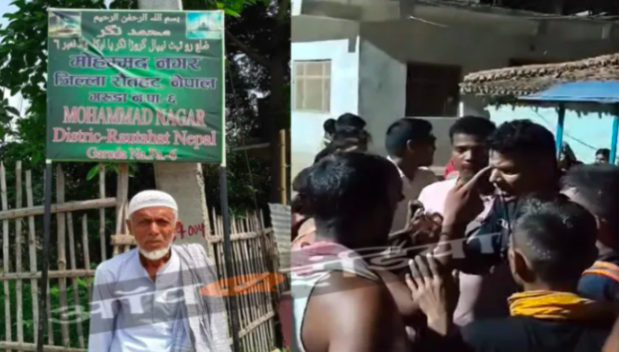
Case Summary
In Nepal's Rautahat district, communal tensions arose due to a controversial naming of a village by the Muslim community. Muslims named a crossroads in the Pothiyahi village as "Islam Nagar" and erected a green signboard featuring Arabic and Urdu words, along with images of Islamic places of worship. An elderly Muslim man’s selfie with the sign went viral, and the local Muslim community started referring to the area as Islam Nagar. Despite the village having only ten Muslim households, making up just 4% of the population, they attempted to change the hamlet's name, causing significant unrest among the Hindu majority. On June 23, members of the Hindu Samrat Sena and local Hindus removed the signboard. On the night of June 25, a dozen Muslims, led by Chand Diwan, Rafiq, Sirajul, and Manzoor, ambushed three Hindu youths accused of removing the sign. The attackers verbally abused and brutally beat the youths, who were later hospitalised for their injuries. The incident led to widespread anger among Hindus, who accused the police of shielding the assailants and providing protection to the Muslim community instead of taking action against them. Hindu groups say that the police are working under pressure from the Communist Party of Nepal (Unified Marxist–Leninist) and Prime Minister Prachanda's government, which they accuse of pandering to Muslims and trying to conceal the communal nature of the incident. The Hindu community has dismissed the police's claim that there was no communal angle, insisting it is an effort to downplay the severity of the issue. Rajesh Yadav, national president of Nepal's Hindu Samrat Sena, announced that his organisation, along with other groups, would submit a memorandum to the government on June 27. The memorandum demands action against the Muslim attackers and opposes the renaming of the village to Islam Nagar. Yadav also revealed that a similar scheme had been attempted three months prior in the Jayanagar region of Garuda Nagar Palika, where Muslims renamed Kadam Chowk (Brahma Sthan) to Madrasa Chowk, with a signboard that remains in place. The ward chairman, Sheikh Wahab, is a Muslim, further intensifying the communal discord.
Why it is Hate Crime ?
Distinct elements in this particular case demonstrate that the crime was committed while harbouring a bias against the Hindu faith. As per case details, there are two prime categories under which this case has been placed in the hate tracker, namely, 'attack not resulting in death' and 'attack on Hindu religious symbols'. To break down the case further, the sub-category 'Attacked for Hindu identity' has been selected under the first prime category while the sub-category 'Encroachment or illicit takeover of temple land/land near temple' has been chosen under the second prime category. Attacked for Hindu identity: In several cases, Hindus are attacked merely for their Hindu identity without any perceived provocation. A classic example of this category of religiously motivated hate crime is a murder in 2016. 7 ISIS terrorists were convicted for shooting a school principal in Kanpur because they got ‘triggered’ seeing the Kalava on his wrist and tilak that he had put. In this, the Hindu victim had offered no provocation except for his Hindu religious identity. The motivation for the murder was purely religious, driven by religious supremacy. Such cases where Hindus are targeted merely for their religious identity would be documented as a hate crime under this category. Encroachment or illicit takeover of temple land/land near temple: In Hinduism, a temple is the abode of the Deity. The Deity in the Temple is consecrated, thereby, making it a real, breathing entity. Hindus believe that not just the Deity but the temple premises itself are sacred to Hindus since Hindus hold the faith that the entire Temple space is an amalgamation of the divine energy of the deity. Not only the Temple but the Temple premises in its entirety are considered sacred by Hindus. In several cases, the premises of the Temple and/or religious centre are illicitly taken over by institutions belonging to other faiths – like the Waqf board or the Church. Other times, the temple property, land or the property of religious centres are illicitly encroached by non-Hindu groups. Any illicit take over or encroachment is a crime an initio, however, when non-Hindu groups illicitly take over or encroach the sacred land of Hindus, it is an affront to the Hindu community and is therefore classified as a religiously motivated hate crime under this category. In this case, the Islamists, at first, tried to illicitly take over an entire hamlet by renaming it 'Islam Nagar' and erecting a green signboard featuring Arabic and Urdu words, along with images of Islamic places of worship. Further, when local Hindus protested against this hostile and wrongful takeover, the Islamists assaulted them in return. Such acts of violence are driven by intolerance and a desire to intimidate or harm individuals based on their religious identity and qualify as a hate crime.
Victim Details
Total Victim
3
Deceased
0
Gender
- Male 3
- Female 0
- Third Gender 0
- Unknown 0
Caste
- SC/ST 0
- OBC 0
- General 0
- Unknown 3
Age Group
- Minor 0
- Adult 0
- Senior Citizen 0
- Unknown 3


Case Status
Case sub-judice


Perpetrators Details
Perpetrators
Muslim Extremists
Perpetrators Range
From 10 to 100
Perpetrators Gender
male
 Sources




