Hindu politician threatened with death by Muslim man to vacate Muslim-majority district in Haryana
 Nuh, Haryana, India
  22 June, 2024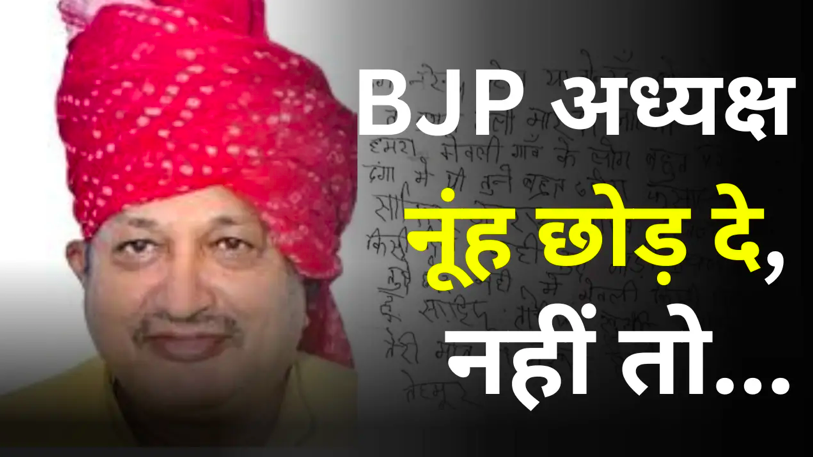
Case Summary
In Nuh, Haryana, a Hindu politician named Narendra Patel, the Bharatiya Janata Party (BJP) district chief, received a threat to leave Nuh, a Muslim-majority area, from a Muslim man. As per media coverage, the incident came to light on 24th June 2024, when BJP leaders and workers submitted a memorandum to district officials after the victim, Narendra Patel, received a threatening letter from a man identifying himself as Tehmur. Patel received the letter on 23rd June 2024, in which the sender identified himself as Tehmur. It stated: “BJP’s Narendra Patel, either leave Nuh or you will be shot. You have troubled the people of our Mewli village a lot. You have implicated many people in the riots as well. I, Sakir Abrar from Mewli village, will run you over with a car one day. I will not spare you; Mewli is not afraid of anyone. Sahid Torif Khusid says your death is certain… Tehmur.” A complaint in the matter was lodged at the City Police Station, Nuh. The police registered a case against the accused, and further investigation was carried out.
Why it is Hate Crime ?
This case has been added to the tracker under the primary category- Hate Speech against Hindus. The subcategory selected is- Violent Threats. Violent threats, explicit, implicit or implied, is the most dangerous form of hate speech since it goes beyond discriminatory and prejudicial language to express the intent of causing harm to an individual or a group of people based on their religious identity and faith. There could be several different kinds of threats that are issued to Hindus based on religious animosity. An explicit threat would mean the direct threat of violence towards an individual Hindu, a group of Hindus or Hindus at large. Physical violence, death threats, threats of destruction of property belonging to Hindus and threats of genocide would mean explicit threats against Hindus for their religious identity. Implicit threats may not be a direct threat but implied through the use of symbols of actions – for example – in the Nupur Sharma case, other than explicit threats, there were also implicit threats when Islamists took to the streets to burn and beat her effigies. It implies that they want to do the same to Nupur Sharma – thereby is considered an implicit threat. Violent threats can be delivered in person, through letters, phone calls, graffiti, or increasingly through social media and other online platforms. It would be important to understand that a threat – explicit or implicit, online or offline – to an individual who happens to be a Hindu does not qualify as a religiously motivated threat. Such a threat, while vile and dangerous, could be owing to non-religious reasons and/or personal animosity. To qualify as a religiously motivated threat, it would need to exhibit an indication that the individual is being targeted for religious reasons and/or owing to his/her religious identity as a Hindu. This case is being added to the hate crime database because it is a clear instance of anti-Hindu hate speech and involves the issuing of violent threats against a Hindu man based on his Hindu identity. Firstly, it is important to note that the Bharatiya Janata Party (BJP) is widely recognised and perceived by Muslims as a Hindu party. The BJP supports the ideology of Hindutva, a Hindu political movement that advocates for Hindu rights in response to anti-Hindu elements such as Islamists, Christian missionaries, Sikh Khalistani extremists, and an anti-Hindu Marxist-liberal ecosystem. The fact that the accused, a Muslim man, threatened the BJP leader Narendra Patel with death and demanded he leave Nuh showcases deep-seated religious animosity towards his Hindu identity and his association with a party that is perceived to support Hindu rights. Hence, the act of threatening him is motivated by religious animosity rather than mere political hostility. It is also important to state that this incident occurred in Nuh, a Muslim-majority district in Haryana, where Muslims constitute approximately 79.2% of the population. It is common for Muslims in these regions to view such places as "exclusive zones for Muslims," referring to them as 'Muslim areas.' This perspective underscores a territorial and communal mindset that regards non-Muslims, particularly Hindus, as outsiders or unwelcome within these zones. This sense of entitlement and superiority reflects deep-seated prejudice and an attempt to assert religious dominance over public spaces. The threat against the Hindu victim was motivated by this supremacist ideology, as Muslims in the area look down upon Hindus and believe they have the right to control who can move freely in ‘their area,’ rejecting any espousal of the ideology of Hindu rights. Such an act illustrates a dangerous mindset rooted in exclusion, intolerance, and religious animosity, making this case an ideal example of a crime motivated by religious animosity. Moreover, the demand that Narendra Patel leave Nuh signals an attempt to remove a figure perceived as opposing Muslim extremists and advocating Hindu rights, further underscoring the religious motivation behind the threats. This exclusion and intimidation are not isolated; Nuh has been a hotspot for anti-Hindu violence, as evidenced by the July 2023 attack on a Hindu Shobha Yatra where a Muslim mob assaulted Hindu participants, attacked police, and targeted a temple during the sacred month of Shravan. The history of communal violence in Nuh strongly demonstrates that the threats faced by Narendra Patel are driven by entrenched religious hostility towards his Hindu identity, making it a religiously motivated hate speech. Therefore, this case is being added to the hate crime database of the Hinduphobia Tracker.
Victim Details
Total Victim
1
Deceased
0
Gender
- Male 1
- Female 0
- Third Gender 0
- Unknown 0
Caste
- SC/ST 0
- OBC 0
- General 1
- Unknown 0
Age Group
- Minor 0
- Adult 1
- Senior Citizen 0
- Unknown 0


Case Status
Complaint registered


Perpetrators Details
Perpetrators
Muslim Extremists
Perpetrators Range
One Person
Perpetrators Gender
male
 Sources




