Muslim family slaughters buffalo near Shiva temple in Bareilly, Hindus protest on Bakrid
 Bareilly, Uttar Pradesh, India
  16 June, 2024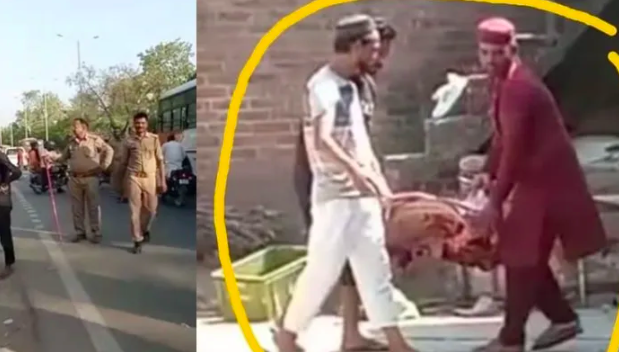
Case Summary
Communal tensions erupted in Jogidher, a Hindu-majority village in Uttar Pradesh's Bareilly district, after a Muslim family publicly slaughtered a buffalo near a Shiva temple, deviating from local customs. Outraged Hindu villagers protested, asserting they would patrol the streets during the next Bakrid to prevent large animal slaughters. Police intervened, booking eight men from the Muslim family on charges of animal cruelty and arresting two, who were released on bail. The incident began when resident Sangram Singh recorded Mohammed Israr slaughtering the buffalo near the temple, sparking outrage among the villagers. They gathered at the police station, demanding the arrest of the family involved, arguing the act violated state guidelines prohibiting visible animal sacrifices near temples. The police eventually filed an FIR against eight family members under IPC section 429 and the Prevention of Cruelty to Animals Act. Former Pradhan Mohammed Kamruddin suggested conducting future sacrifices in a neighbouring Muslim-majority village to avoid conflict. Hindu residents, including Singh, vowed to prevent any new customs during future Bakrid celebrations, planning to patrol the streets to ensure adherence to traditional practices.
Why it is Hate Crime ?
Sanatan Dharma is not a religion of one book, which is to say that while it has religious scriptures that form the central tenets of the faith, there are several traditions followed through thousands of years, mostly passed from generation to generation orally. One of these oral traditions or written traditions is the rules of specific temples. Certain temples have rules which are traditional rules, dependent on the worship of the presiding deities. These rules and traditions have been followed for thousands of years whether they find scriptural mention or not. Such traditions are based on the nature and rules of worship of the presiding deity of that temple. Any non-compliance of these traditions owing to animosity towards the faith or for the sake of activism stems not only from the lack of faith in the presiding deity but also disregard for the faith of the devotees of that deity/temple and implicit bias against the faith, the tradition and the deity itself. Since these specific traditions are central to the faith of the devotees of that specific temple and presiding deity, any non-compliance with these traditional rules would be considered a religiously motivated hate crime. In this case, despite understanding that Hindu temples are centres of worship and sanctity and introducing meat around these spaces is considered a violation of their sacredness, the perpetrators slaughtered a buffalo near a Hindu temple. It is evident that the Muslim perpetrator specifically chose the location in front of the Shiva Temple to slaughter the buffalo as a deliberate affront to Hindus and desecration of the sacred space. Further, the symbolism of the act is not lost. A buffalo/bull is considered the 'vaahan' of Lord Shiva - Nandi. It cannot be ruled out that the Muslim perpetrator was specifically slaughtering a bull in front of a Shiva Mandir to reinforce the symbolism of disrespect.


Case Status
Case sub-judice


Perpetrators Details
Perpetrators
Muslim Extremists
Perpetrators Range
From 5 to 10
Perpetrators Gender
male
 Sources




