Hindu procession taken out to celebrate Ram Mandir Pran Pratishtha attacked by Muslim mob
 Tonk, Rajasthan, India
  21 January, 2024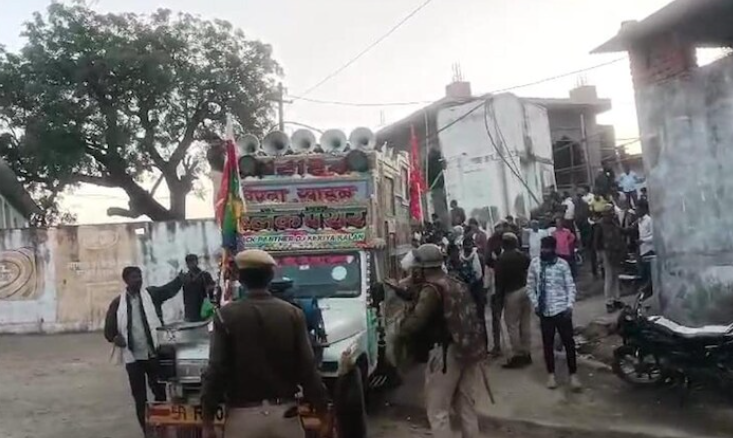
Case Summary
In Khatoli village of Tonk district, violence erupted during the Pran Pratishtha Mahotsav of Lord Shri Ramlala in Ayodhya when Muslims blocked a procession by parking a tractor trolley on the road. They protested against the procession passing in front of a mosque with DJ music. Police intervened, eventually clearing the path after three hours. On January 22, the Hindu community took out processions to celebrate the consecration of Ayodhya Ram Mandir. Tensions rose when a roadblock was set up by Muslims in the locality. Local police arrived to mediate but faced resistance. Angered by the disruption, the Hindu community condemned the incident. The police removed the tractor and other obstructions, warning of seizing the tractors. A case was filed by the Hindu side against 29 individuals, including two women, for obstructing the procession.
Why it is Hate Crime ?
This particular case has been classified as a religiously motivated hate crime under three sub-categories of the prime category- 'Attack not resulting in death' listed in the tracker because of the various distinct components that demonstrate the perpetrator's bias against the Hindu faith. The first sub-category under which this case has been placed is- 'Attacked for crossing 'Muslim area'' One of the reasons that Hindus get attacked unprovoked specifically by Islamists is for crossing ‘Muslim areas’. Essentially, Muslim mobs often attack Hindus crossing or present in certain areas which have a majority Muslim population. It has often been cited as one of the reasons to blame Hindus for attacks against themselves, signalling that Hindus displaying religious symbols, taking our religious processions or crossing any area which is dominated by Muslim residents is a provocation in and of itself. These areas are mostly ghettoized areas where mobs mobilize quickly to attack Hindus for a variety of reasons like playing music during a religious procession, crossing a mosque, wearing a tilak or any other religious symbol in a Muslim-dominated area, praying at a local temple in that area etc. There have been cases where the few local Hindus of that area have been attacked on their way to the Temple for prayers as well, simply because the area is considered a Muslim-dominated area. Several times, it is entirely possible that the immediate trigger for the violence against Hindus was non-religious in nature, however, the violence became religiously motivated in nature because the area was Muslim dominated and the residents on the whole harboured animosity towards Hindus, evidenced from the actions of the mob, the slogans, and the nature of the attack. Such crimes are motivated by the religious identity of the victims and are therefore classified as hate crimes under this category. The second sub-category under which this case has been placed is- 'Attack on religious procession'. The outward celebration and display of religious symbols in an intrinsic part of Hinduism. Religious processions on various festivals are age-old traditions and a way to manifest faith and form a part of the religious practices of Hindus. On several occasions, such religious processions come under attack by non-Hindu mobs, in a manifestation of their animosity towards Hinduism and their practices. The reasons cited for such violent attacks are many and range from crossing a non-Hindu resident-dominated area to playing loud music, crossing from an area where there is a religious structure of another faith etc. The violent attacks are triggered by the outward display of religiosity by Hindus. The attacks are mainly a manifestation of religious supremacist doctrine which believes that idolatry, essentially the Hindu faith, is one that deserves to be annihilated since the very tenets of Hinduism, its practices and traditions are considered a sin in those doctrines. Since these attacks emanate from intrinsic and doctrinal animosity towards Hindus and Hinduism, it is considered a religiously motivated hate crime under this category. The third sub-category under which this case has been placed is- 'Attack against Hindu devotees'. Hindu devotees are a few of the easiest targets of religiously motivated hate crimes because during the festival/procession/puja etc, for non-Hindus it is easy to profile their victims on the basis of religion. Hindu devotees come under attack on several occasions by individual non-Hindus or mobs of non-Hindus owing to their animosity against Hinduism, its symbols and tradition/practices. There are several instances of Hindu devotees being attacked while they worship in temples or temporary religious structures, during religious processions, doing bhajan/kirtan/puja in their own homes, in the residential society etc. These attacks are perpetrated by non-Hindus primarily because of their animosity towards Hindus and their faith. In some cases, the trigger for the violence may be non-religious, however, there are two elements that make these hate crimes. First, the Hindus who come under attack are attacked violently while indulging in religious activity. Whether they are in a place of worship or not is immaterial to the crime. When individuals are attacked while indulging in religious practices, the attack in itself is a hindrance to their freedom to practice religion and therefore constitutes a hate crime. Secondly, religious supremacist doctrines and ideologies deem religious practices of Hindus to be offensive ab initio since they are considered “sinful” by these ideologies, worthy to be annihilated by force or coercion. Driven by these religious supremacist ideologies and doctrines, the attacks against Hindu devotees stem from intrinsic animosity towards Hinduism. In some cases, the trigger for the violence may be non-religious, however, it develops into a religiously motivated crime during the course of the violence. Since these attacks stem from animosity towards Hindus and Hinduism, they are considered religiously motivated hate crimes under this category. In this case, a Hindu religious procession taken out to commemorate the Pran Pratishtha ceremony of the Ram Temple in Ayodhya came under attack by Islamists. For Hindus, the Pran Pratishtha event represents the pinnacle of centuries-long struggles to reclaim Lord Ram’s birthplace and reinstate Bhagwan Ram to his Janmabhoomi. The return of Lord Ram to Ram Janmabhoomi is a testament to the thousands of devotees, particularly the Karsevaks, who gave up everything to continue battling for a site that was forcibly taken by Islamic fundamentalists who humiliated the native Hindus by erecting a mosque on top of an already existing temple. However, Muslim mobs, owing to their animosity towards Hindus and their faith; especially the Ram Mandir at Ayodhya which has special spiritual, cultural and religious significance, launched unbridled attacks against Hindu devotees celebrating the Ram Mandir Pran Prathishtha event. Attacks, like this one, are rooted in religious bias or hatred against Hindus. Moreover, the trigger for the attack on the procession was the DJ music being played by the Hindu devotees as the procession passed through the mosque. The members of the Muslim community were the ones who initiated the attack on the Hindu devotees. Obviously, it was not the music played by the Hindu devotees that actually triggered the Islamists, in fact, that was only an excuse used by the perpetrators to target the procession because of the participants' religious identity. Such attacks are a form of symbolic aggression against the Hindu community that stems from an innate hatred for Hinduism. Given that the fundamental motivation behind such attacks is contempt for Hindus and their religion, this instance has been added to the tracker under the following category.


Case Status
Complaint registered


Perpetrators Details
Perpetrators
Muslim Extremists
Perpetrators Range
From 10 to 100
Perpetrators Gender
both
 Sources




