Hindu judge subjected to death threats by Muslim radicals for issuing videographic survey of disputed Gyanvapi mosque
 Allahabad, Uttar Pradesh, India
  21 June, 2024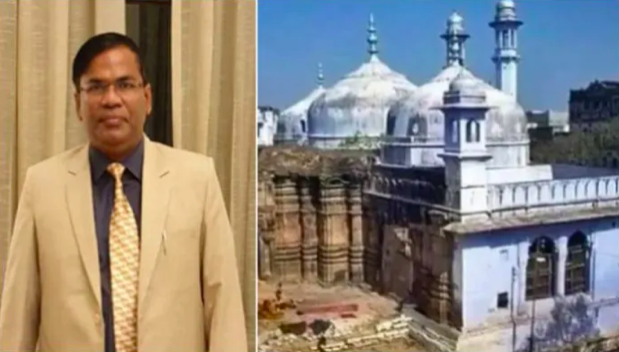
Case Summary
A Hindu judge named Ravi Kumar Diwakar was subjected to a series of death threats by Muslim radicals for allowing the videographic survey of the Gyanvapi mosque in Varanasi, a disputed site built over the Kashi Vishwanath temple by the Mughal tyrant Aurangzeb. The Gyanvapi–Kashi Vishwanath dispute was over the illegal Gyanvapi mosque, which Aurangzeb constructed after demolishing the sacred Kashi Vishwanath temple. The Mughal ruler, driven by religious hatred, destroyed several Hindu temples and massacred Hindus. The desecrated temple site remained a wound for the Hindu community, which filed cases in the Allahabad High Court demanding a survey of the mosque and the rebuilding of the Kashi Vishwanath temple at its original spot. According to media reports, the dispute was being heard by the Allahabad High Court under Judge Ravi Kumar Diwakar. During this time, he allowed the videographic survey of the Gyanvapi mosque. Following this, he began receiving death threats from radical Muslims. An NIA court requested the Allahabad High Court to enhance security for Judge Ravi Kumar Diwakar. From then onwards, Diwakar had received repeated threats to his and his family’s lives. Special Judge Vivekanand Sharan Tripathi observed that Islamic radicals were plotting to kill Diwakar. The victim, Diwakar, had long expressed concerns about his security and the inadequate protection given to his family. He had received threats, including malicious calls from international numbers. Earlier Y‑category protection provided to him was downgraded, leaving his current security detail under-equipped. Threats persisted since June 2022, including from the Islamic Aagaz Movement and a member of the banned Popular Front of India (PFI). The Uttar Pradesh Anti-Terrorism Squad (ATS) filed an FIR against Adnan Khan under various BNS (Bharatiya Nyaya Sanhita) sections and the UAPA (Unlawful Activities Prevention Act) for issuing threats to Judge Diwakar on social media.
Why it is Hate Crime ?
This case has been added to the tracker under the primary category- Hate Speech against Hindus. Within this, the subcategory selected is- Violent Threats. Violent threats, explicit, implicit or implied, is the most dangerous form of hate speech since it goes beyond discriminatory and prejudicial language to express the intent of causing harm to an individual or a group of people based on their religious identity and faith. There could be several different kinds of threats that are issued to Hindus based on religious animosity. An explicit threat would mean the direct threat of violence towards an individual Hindu, a group of Hindus or Hindus at large. Physical violence, death threats, threats of destruction of property belonging to Hindus and threats of genocide would mean explicit threats against Hindus for their religious identity. Implicit threats may not be a direct threat but implied through the use of symbols of actions – for example – in the Nupur Sharma case, other than explicit threats, there were also implicit threats when Islamists took to the streets to burn and beat her effigies. It implies that they want to do the same to Nupur Sharma – thereby is considered an implicit threat. Violent threats can be delivered in person, through letters, phone calls, graffiti, or increasingly through social media and other online platforms. It would be important to understand that a threat – explicit or implicit, online or offline – to an individual who happens to be a Hindu does not qualify as a religiously motivated threat. Such a threat, while vile and dangerous, could be owing to non-religious reasons and/or personal animosity. To qualify as a religiously motivated threat, it would need to exhibit an indication that the individual is being targeted for religious reasons and/or owing to his/her religious identity as a Hindu. In this case, Muslim extremists targeted Hindu Judge Ravi Kumar Diwakar with violent death threats merely for allowing a videographic survey of the Gyanvapi mosque, a historic site built over the Kashi Vishwanath temple after its destruction by Mughal emperor Aurangzeb. By performing his judicial duty and upholding the law, the judge faced retaliatory threats not only against himself but also towards his extended family. This harassment exposes entrenched animosity from these Muslim extremists who seek to prevent Hindus from reclaiming their sacred heritage through lawful means, using intimidation to silence justice. The issuing of death threats against Judge Diwakar exemplifies a hate crime and hate speech targeted at a Hindu official attempting to deliver justice. The threats reveal a blatant attempt by Islamic radicals to wield muscle power and street influence to obstruct legal processes that support Hindu rights. Such actions manifest deep-seated hostility toward Hindus and their lawful efforts to restore a desecrated ancient temple, showing the extremists’ determination to deny Hindus justice through fear and coercion. The Gyanvapi–Kashi Vishwanath dispute centres on the Hindu community’s rightful claim to a temple unlawfully destroyed and replaced by a mosque under Aurangzeb’s reign. Hindus are demanding restoration of their sacred site in a lawful manner, but face fierce opposition from such Muslim extremist groups who resort to threats and violence. The intimidation of judges and legal representatives underscores the extreme lengths to which these radicals will go to prevent Hindus from reclaiming their religious heritage. Such acts are deeply Hinduphobic, and henceforth, this case is being added to the hate crime database. Disclaimer: Media reports state that the judge received threats from multiple Muslim individuals; however, they do not specify the total number of perpetrators involved. The reports focused primarily on one individual, Adnan Khan, who threatened the judge via social media. Therefore, for clarity and conservatism in reporting, the perpetrator count is kept- '1', referring solely to Adnan Khan. This is a cautious estimate based on the available information.
Victim Details
Total Victim
1
Deceased
0
Gender
- Male 1
- Female 0
- Third Gender 0
- Unknown 0
Caste
- SC/ST 0
- OBC 0
- General 0
- Unknown 1
Age Group
- Minor 0
- Adult 1
- Senior Citizen 0
- Unknown 0


Case Status
Complaint registered


Perpetrators Details
Perpetrators
Muslim Extremists
Perpetrators Range
One Person
Perpetrators Gender
male
 Sources




