Violent threats issued to Hindus by Muslim man on social media during Bakrid, calls for Islamisation of India
 Muzaffarnagar, Uttar Pradesh, India
  13 June, 2024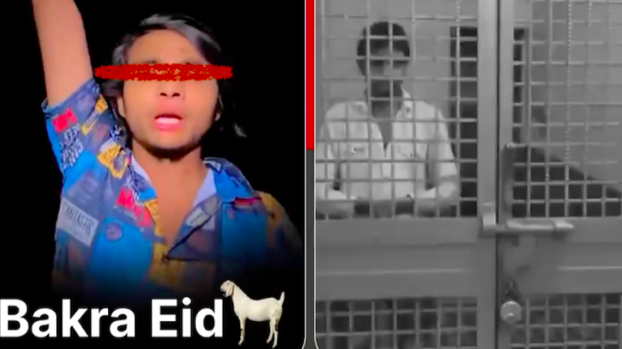
Case Summary
In Muzaffarnagar, Uttar Pradesh, violent threats were directed at the Hindu community by a Muslim man named Haroon during Bakrid, an Islamic festival. Haroon was sent to jail after posting an inflammatory reel on social media for Bakrid. In the video, he issued threats of violence, but after being arrested by the UP Police, he apologised and said he had made the video under his friends’ influence. The incident took place in the Darshan Budhana Kotwali police station area, with the video recorded on 14 June 2024. Haroon, a resident of Barkata village, declared in the video: “On Eid, we will make the scene stronger than the film Gadar. Whoever stops us, we will tear them apart. The slogan Allah-hu-Akbar will echo in every corner of India.” SP (Rural) Aditya Bansal stressed the importance of celebrating festivals in mutual harmony and warned that the UP Police were vigilant on social media, prepared to take immediate action against any inflammatory content.
Why it is Hate Crime ?
This case has been added to the tracker under the primary category- Hate Speech against Hindus. Within this, the subcategory selected is- Violent Threats. Violent threats, explicit, implicit or implied, is the most dangerous form of hate speech since it goes beyond discriminatory and prejudicial language to express the intent of causing harm to an individual or a group of people based on their religious identity and faith. There could be several different kinds of threats that are issued to Hindus based on religious animosity. An explicit threat would mean the direct threat of violence towards an individual Hindu, a group of Hindus or Hindus at large. Physical violence, death threats, threats of destruction of property belonging to Hindus and threats of genocide would mean explicit threats against Hindus for their religious identity. Implicit threats may not be a direct threat but implied through the use of symbols of actions – for example – in the Nupur Sharma case, other than explicit threats, there were also implicit threats when Islamists took to the streets to burn and beat her effigies. It implies that they want to do the same to Nupur Sharma – thereby is considered an implicit threat. Violent threats can be delivered in person, through letters, phone calls, graffiti, or increasingly through social media and other online platforms. It would be important to understand that a threat – explicit or implicit, online or offline – to an individual who happens to be a Hindu does not qualify as a religiously motivated threat. Such a threat, while vile and dangerous, could be owing to non-religious reasons and/or personal animosity. To qualify as a religiously motivated threat, it would need to exhibit an indication that the individual is being targeted for religious reasons and/or owing to his/her religious identity as a Hindu. This incident is a clear case of hate speech directed against Hindus, rooted in religious hostility and an attempt to intimidate the Hindu community through threats of violence. The Muslim man, on the occasion of Bakrid, deliberately used the medium of a social media reel to spread inflammatory rhetoric aimed at instilling fear in Hindus. By leveraging a religious festival as the setting for threats, he reinforced the religiously motivated nature of his remarks and sought to give them symbolic weight. When he declared that he would “make the scene stronger than the film Gadar,” he invoked a reference to a film associated with the partition of India and the creation of Pakistan, in which Hindus were attacked by Muslim extremists. This choice of words was not accidental; it signalled that his threats were not directed at individuals on personal grounds, but at Hindus collectively. His words implied the enactment of violence worse than what is portrayed in the film, thereby presenting Hindus as the targeted victims of his aggression. Further, his statement about “tearing apart those who stop him” was a direct threat of physical violence against members of the Hindu community. This was not mere posturing—it was a menacing warning that anyone resisting his call for Islamic assertion would face brutal consequences. This directly positioned Hindus as adversaries, creating the picture of a community at risk of violent targeting solely on account of their faith. The proclamation that “Allah hu Akbar will echo in every corner of India” carried an exclusivist and supremacist intent. India, being a Hindu-majority country, the threat implied the erasure of Hindu religious identity and the imposition of an Islamic religious order. The slogan itself, in this context, was not merely devotional but weaponised as a demand for Islamic dominance, framed as if Hinduism and Hindu spaces must be overwhelmed. The effect was to openly advocate Islamic supremacy while seeking to intimidate Hindus into submission. Taken together, these actions and declarations reveal a pattern of religious animosity rooted in doctrinal hostility against Hindus. The threats were neither casual nor personal. They reflected a calculated attempt to project power over the Hindu community, to instil fear, and to establish ideological domination. His choice of words, imagery, and timing demonstrates that this was not an isolated outburst but a deliberate act of hate speech, targeting Hindus solely because of their religious identity. Given that this case meets multiple parameters of a religiously motivated crime, it is being added to the hate crime database.


Case Status
Arrested


Perpetrators Details
Perpetrators
Muslim Extremists
Perpetrators Range
One Person
Perpetrators Gender
male
 Sources




