Hindus abused and their revered deity insulted by Muslim man over protest against goat slaughter inside apartment premises
 Mumbai, Maharashtra, India
  15 June, 2024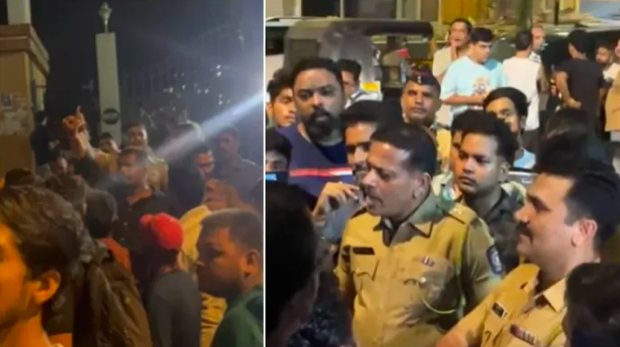
Case Summary
The Hindu community in Mira Road, Mumbai, was subjected to abuse by a Muslim man named Vajud. The accused even made derogatory remarks towards Lord Ganesha and Ganesh Chaturthi, a Hindu festival. On 17th June 2024, the Kashigaon Police Station in the Mira Road area booked Vajud for insulting and threatening Hindus and abusing their religion, after he used the words “Hinduo ke m** ki ch**”. The FIR, filed under sections 295A and 153A of the Indian Penal Code, was based on an incident from 16th June 2024. Muslim residents of Hill Galaxy Apartment had brought goats into the premises for illegal slaughter ahead of Bakrid. Hindus protested and called the police, but the police permitted the goats inside, citing the absence of a livestock ban within the society. During the protest, Vajud and his associates abused Hindus, stating that they would slaughter the goats within the premises, and used offensive language towards both Hindus and Lord Ganesha. Vajud threatened the residents, saying, “You people celebrate the Ganesh festival. Do we say anything then? We feel enraged and disgusted when we see your Lord Ganesha. We will see how you celebrate your Ganesh festival here.” The Hindu complainant who filed the FIR stated that after the Muslim resident abused Hindus, he contacted the builder, who was unavailable and could not resolve the matter. The builder, R R Builders, had permitted the construction of an illegal mosque within the Hill Galaxy Apartment premises. Rasool Shaikh, the builder, initially sold houses to Hindu residents, but subsequently, the majority of the units were sold to Muslims. At present, in both JP North Celesta and Hill Galaxy societies, around 15–20 houses were occupied by Hindus, whereas over 100 were owned by Muslims. Rasool originally informed residents that the community space would be used for a gym or club, but it was later converted into a mosque. Muslims from other societies came to the mosque to offer prayers, causing further discomfort for the Hindus residing in the society.
Why it is Hate Crime ?
This case has been added to the tracker under the primary category- Hate Speech against Hindus. The subcategory selected is- Anti-Hindu slurs, mocking faith. Anti-Hindu slurs and the deliberate mocking of the Hindu faith owing to religious animosity involve the usage of derogatory terms, stereotypes, or offensive references to religious practices, symbols, or figures. One of the common anti-Hindu slurs used against Hindus is “cow-worshipper” and “cow piss drinker”. The intention of using this term is to demean and mock Hindus as a group and their religious beliefs since Hindus consider the cow holy. Additionally, some symbols and the slurs attached to them have a historical context that exacerbates the insult, hate, stereotyping, dehumanisation and oppression against Hindus. Cow worship has been used for centuries to denigrate Hindus, insult their faith and oppress Hindus specifically as a religious group. There has been overwhelming documentation about how cow slaughter has been used to persecute Hindus with cow meat being thrown in temples and places of worship. There has also been overwhelming documentation where cow meat (beef) has been force-fed to Hindus to either forcefully convert them to Islam or denigrate their faith. Apart from cow worship, the Swastika – which holds deep religious significance for the Hindus – has also been misinterpreted and distorted to use as a slur against Hindus. Similarly, the worship of the Shivling has been used by supremacist ideologies and religions to denigrate Hindus owing to religious animosity. Such slurs and denigration stem out of inherent animosity and hate towards Hindus and their faith, therefore, it is categorised as hate speech targeted at Hindus specifically owing to their religious identity. The other subcategory selected is- Violent Threats. Violent threats, explicit, implicit or implied, is the most dangerous form of hate speech since it goes beyond discriminatory and prejudicial language to express the intent of causing harm to an individual or a group of people based on their religious identity and faith. There could be several different kinds of threats that are issued to Hindus based on religious animosity. An explicit threat would mean the direct threat of violence towards an individual Hindu, a group of Hindus or Hindus at large. Physical violence, death threats, threats of destruction of property belonging to Hindus and threats of genocide would mean explicit threats against Hindus for their religious identity. Implicit threats may not be a direct threat but implied through the use of symbols of actions – for example – in the Nupur Sharma case, other than explicit threats, there were also implicit threats when Islamists took to the streets to burn and beat her effigies. It implies that they want to do the same to Nupur Sharma – thereby is considered an implicit threat. Violent threats can be delivered in person, through letters, phone calls, graffiti, or increasingly through social media and other online platforms. It would be important to understand that a threat – explicit or implicit, online or offline – to an individual who happens to be a Hindu does not qualify as a religiously motivated threat. Such a threat, while vile and dangerous, could be owing to non-religious reasons and/or personal animosity. To qualify as a religiously motivated threat, it would need to exhibit an indication that the individual is being targeted for religious reasons and/or owing to his/her religious identity as a Hindu. This case is a clear instance of anti-Hindu hate speech, where a Muslim perpetrator subjected the Hindu community to direct verbal abuse, denigration of their faith, and threats against their right to celebrate religious festivals. The dispute arose over the illegal slaughter of goats within apartment premises ahead of Bakrid. Had the Muslim perpetrator felt aggrieved by Hindu residents objecting to the slaughter, he could have approached lawful authorities. Instead, he unleashed derogatory slurs specifically targeting Hindus for their religious identity, which was designed to humiliate and dehumanise the entire Hindu community. Such language exposed his deep-seated animosity and contempt towards Hindus as a collective. The abuse went beyond slurs. The accused intentionally denigrated Lord Ganesha, one of the most revered Hindu deities, and mocked Ganesh Chaturthi, a sacred and widely celebrated Hindu festival. By doing so, he was not expressing personal anger but directing his hostility against central symbols of Hindu faith and culture. His statement that “we will see how you celebrate Ganesh Utsav in the future” was an explicit threat aimed at intimidating Hindus and suppressing their freedom to practise their religion. This was not a dispute between individuals, but a deliberate attempt to insult Hindu beliefs, humiliate the Hindu community, and undermine their cultural identity. Such actions represent a calculated act of religious animosity. The use of slurs against Hindus, the denigration of a Hindu deity, and the threats to obstruct a sacred festival all demonstrate an intent to stigmatise and marginalise Hindus. The words and threats were not incidental; they articulated a pattern of hostility aimed at diminishing the dignity of Hindus and reinforcing subjugation under intimidation. By targeting both the people and their deity, the perpetrator exposed the hate-filled motivation behind his actions. Furthermore, the builder’s role in siding against the Hindu residents compounded the injury. Instead of intervening to protect the rights of Hindus who had been abused and whose faith had been denigrated, the builder turned a blind eye. His decision to support the Muslim side intensified the discrimination and sent a message of indifference towards Hindu suffering. This complicity aggravated the crime by reinforcing the sense of insecurity and marginalisation experienced by the Hindu residents. Taken together, these actions marked out the entire episode as a religiously motivated anti-Hindu hate crime. Therefore, this case is being added to the hate crime database.


Case Status
Complaint registered


Perpetrators Details
Perpetrators
Muslim Extremists
Perpetrators Range
One Person
Perpetrators Gender
male
 Sources




