Hindu girls targeted at Navratri Garba: Muslim student caught filming, plotting to lure and "ruin" them
 Virar, Maharashtra, India
  25 September, 2025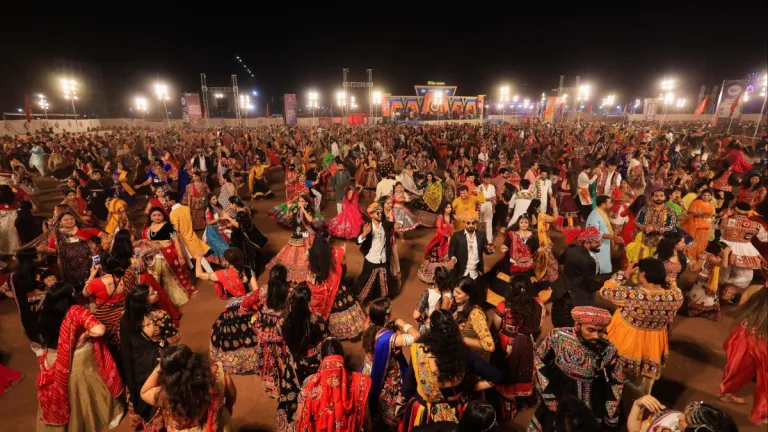
Case Summary
A class 12 Muslim student of Viva College in Virar West, Maharashtra, was caught filming Hindu girls during the Garba festival. His phone had obscene chats that outlined plans to lure Hindu girls into relationships and “ruin” them. The incident unfolded on 26 September 2025 during Navratri celebrations at one of the region’s largest Garba events, attended by thousands of students and outsiders with passes. On checking the boy's phone, organisers discovered multiple videos of girls alongside explicit messages, including one that instructed that not a single Hindu girl be “left untouched” inside the Garba grounds. Reports also revealed that the student was using a mobile app named Discord to coordinate with others in targeting Hindu girls. The chat showed a conversation between Shahid and Faiz. The student was handed over to the police the same day, and a complaint was lodged at the Bolinj police station. However, an FIR was filed only three days later, on 29 September. The delay in action sparked outrage among Hindu groups, who accused the authorities of downplaying the case. The incident inflamed tensions across the Vasai-Virar belt, where political groups were already demanding restrictions on the entry of Muslim men into Garba venues. Professor Deepa Verma, speaking on behalf of Viva College, stated that the institution had no political role in the matter, stressing that the student had joined only recently. She assured strict action pending the police investigation. Hindu organisations intensified their demands for a thorough probe into what they describe as a blatant case of 'love jihad,' warning that such attempts to target Hindu girls during festivals cannot be ignored.
Why it is Hate Crime ?
The primary category in this case is: Attack not resulting in death. The subcategory under this is: Attacked for Hindu identity. In several cases, Hindus are attacked merely for their Hindu identity without any perceived provocation. A classic example of this category of religiously motivated hate crime is a murder in 2016. 7 ISIS terrorists were convicted for shooting a school principal in Kanpur because they got ‘triggered’ seeing the Kalava on his wrist and tilak that he had put. In this, the Hindu victim had offered no provocation except for his Hindu religious identity. The motivation for the murder was purely religious, driven by religious supremacy. Such cases where Hindus are targeted merely for their religious identity would be documented as a hate crime under this category. Another primary category under this is: Hate speech against Hindus. The subcategory under this is: Violent threats. Violent threats, explicit, implicit or implied, is the most dangerous form of hate speech since it goes beyond discriminatory and prejudicial language to express the intent of causing harm to an individual or a group of people based on their religious identity and faith. There could be several different kinds of threats that are issued to Hindus based on religious animosity. An explicit threat would mean the direct threat of violence towards an individual Hindu, a group of Hindus or Hindus at large. Physical violence, death threats, threats of destruction of property belonging to Hindus and threats of genocide would mean explicit threats against Hindus for their religious identity. Implicit threats may not be a direct threat but implied through the use of symbols of actions – for example – in the Nupur Sharma case, other than explicit threats, there were also implicit threats when Islamists took to the streets to burn and beat her effigies. It implies that they want to do the same to Nupur Sharma – thereby is considered an implicit threat. Violent threats can be delivered in person, through letters, phone calls, graffiti, or increasingly through social media and other online platforms. It would be important to understand that a threat – explicit or implicit, online or offline – to an individual who happens to be a Hindu does not qualify as a religiously motivated threat. Such a threat, while vile and dangerous, could be owing to non-religious reasons and/or personal animosity. To qualify as a religiously motivated threat, it would need to exhibit an indication that the individual is being targeted for religious reasons and/or owing to his/her religious identity as a Hindu. This case has been added to the tracker because it reflects a deliberate, targeted attempt against Hindu girls during a Hindu religious festival. The perpetrators did not randomly engage in misconduct but specifically profiled Hindu girls, seeking them out as victims in the context of Navratri Garba, a sacred celebration. The obscene chats and conversations recovered from the Muslim boy’s phone show that the objective went far beyond voyeurism; it was a hate-motivated, deliberate, and coordinated plan to lure, exploit, and “ruin” Hindu girls because of their religious identity. The messages revealed explicit instructions to ensure that “not a single Hindu girl” was left untouched within the Garba grounds. Such wording constitutes a violent threat against Hindu women, rooted in their religious identity and in the cultural context of Navratri, where Hindu women participate in traditional festivities. Here, the victims were being identified, recorded, and marked for harassment explicitly because they were Hindu and participating in a Hindu festival. The perpetrators’ conduct cannot be separated from its religiously motivated dimension, as the targeting was not random but selective, directed only at Hindu girls. The meticulousness of the chats further proves premeditation, indicating that the act was not a spontaneous crime but part of a larger design to undermine the dignity and safety of Hindu women within the cultural sphere. The perpetrators not only filmed the girls without consent but also circulated instructions that amounted to open calls for harming Hindu girls. These messages were violent in their intent, reducing Hindu women to objects of conquest and explicitly threatening to “ruin” their lives. Such language, coupled with the act of secretly recording and sharing material, becomes an implicit weapon of intimidation aimed at creating fear among Hindu girls and deterring them from participating freely in their community’s festivals. The fact that the perpetrators used a mobile application to coordinate with others adds another layer of seriousness. It suggests the existence of organised grooming or entrapment efforts where Hindu women have been deliberately targeted by groups of non-Hindu men. This technological coordination transforms what might appear to be an isolated case into a systematic threat against Hindu women’s security and autonomy. For these reasons, the incident is categorised as a hate crime against Hindus. It illustrates how Hindu women, by virtue of their identity and participation in Hindu cultural and religious spaces, were deliberately identified, targeted, and threatened. The explicit messaging, the covert filming, and the evident plan to lure and harm them collectively constitute a violent, religiously motivated assault on both their individual dignity and their collective Hindu identity. This is why the case has been included in the Hinduphobia Tracker. Disclaimer: Though there appears to be a gang of Muslim boys in this incident, the number of perpetrators has been set to 1 because only 1 boy was handed over to the police while they continued the investigation. Should further details emerge, the case will be updated accordingly.


Case Status
Complaint registered


Perpetrators Details
Perpetrators
Muslim Extremists
Perpetrators Range
One Person
Perpetrators Gender
male
 Sources




