Hindu procession passing through Muslim-dominated area attacked, Hindu devotees assaulted, and women molested by Muslim men in Chhattisgarh
 Bhilai, Chhattisgarh, India
  26 September, 2025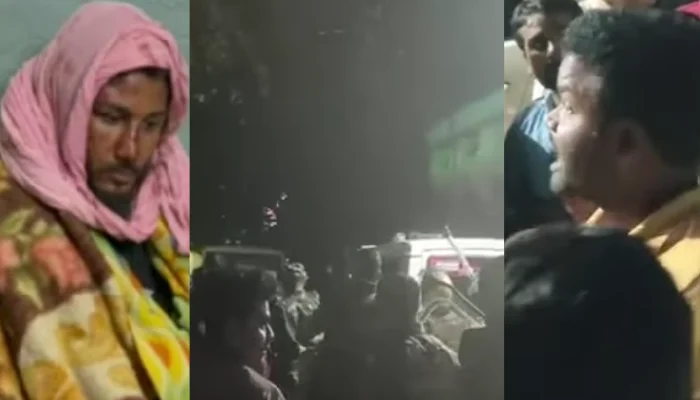
Case Summary
A Hindu religious procession named Chunari Yatra during Navratri, passing through a Muslim-dominated area in Bhilai, Durg, Chhattisgarh, came under a violent attack by Muslim men. The attack involved brutal violence against Hindu devotees, in which Hindu women were molested, and even children were assaulted. According to media reports, the incident occurred on 27th September 2025. The Yatra had started from Sheetla Mata Temple and was about to reach Gayatri Mata Temple. At the time, Hindu children were distributing prasad to devotees. This led to a minor scuffle between Hindu and Muslim children. Two Muslim men, identified as Sonu Qureshi and Sahil Qureshi, escalated the matter when they got involved. Following this, Hindus were assaulted and stabbed with sharp weapons by the Muslim accused. The attackers molested Hindu women and physically assaulted children. They also resorted to stone-pelting at the procession and Hindu devotees. In total, at least eight people were injured. Identified victims included Mukesh Sonkar, Akash Sonkar, Kamal Sonkar, and Umesh Sonkar. Mukesh Sonkar is the State General Secretary of Bajrang Dal, a Hindu organisation. Police reached the spot immediately upon receiving information and arrested the accused, bringing them to the police station. Meanwhile, other Bajrang Dal workers, who were travelling from an event in Durg to join the Chunari Yatra in Bhilai, arrived at Sharda Para amidst the ongoing disturbance. Following the assault, Bajrang Dal members surrounded the police station and demanded strict action against the Muslim attackers. The two arrested accused, Sahil Qureshi and Sonu Qureshi, claimed that they had also sustained injuries from stones and sticks during the confrontation. Police confirmed that investigations were underway to trace other accused persons based on the statement of the minor child from whom the dispute began. A special team was formed that very night to pursue further arrests. Bajrang Dal stated that on the occasion of Navratri, Hindus were performing Shastra Pujan, Kanya Pujan, and the Chunari Yatra. As soon as the procession reached the Muslim-dominated location, the Muslim group launched an organised assault. Bajrang Dal confirmed that their General Secretary sustained serious injuries from a dagger attack. At least four assailants launched the attack and were already armed and prepared. Media reports also highlighted victim testimonies. One of the victims, Mukesh Sonkar, stated, “From Sheetla Temple up to Sharda Para, some Muslim boys abused and pelted stones. Then some came with weapons and began attacking. Several people received deep injuries. I also sustained injuries. Police arrested two people, but three others are still outside.” Another victim, Umesh Sonkar, said, “When the Chunari Yatra reached near Gayatri Temple, Muslim boys began abusing. Local boys asked them to stop, but they started pelting stones. Soon, two Muslim boys brought knives and attacked. I and others from the neighbourhood were also injured.” Another victim, Kamal Sonkar, stated, “Like every year, we had taken out the Chunari Yatra to offer our Chunari to Sheetla Mata. Unknown boys began abusing, and then the quarrel escalated. One drew a dagger and attacked. I tried to stop him from saying ‘brother, don’t do it’, but I was attacked too. Several other unknown people were there, but only one had a dagger.” CSP (Circle Superintendent of Police) Hemprakash Nayak confirmed that when the Yatra reached near Gayatri Temple, Hindu children were distributing prasad at the back. A fight started among children, into which Muslim adults intervened. This escalated into violence. During the scuffle, a Muslim youth named Sonu brought out a knife and attacked. Police arrested Sonu Qureshi and Sahil Qureshi, assuring the strictest action in the matter. Media further reported that this was not an isolated case, as Hindu temples and religious processions had been previously attacked in similar ways in the same Muslim-dominated locality. The media also stated that the locality is a "sensitive area".
Why it is Hate Crime ?
This case has been added to the tracker under the primary category- Attack not resulting in death. Within this, the subcategory selected is- Attack on religious procession. The outward celebration and display of religious symbols in an intrinsic part of Hinduism. Religious processions on various festivals are age-old traditions and a way to manifest faith and form a part of the religious practices of Hindus. On several occasions, such religious processions come under attack by non-Hindu mobs, in a manifestation of their animosity towards Hinduism and their practices. The reasons cited for such violent attacks are many and range from crossing a non-Hindu resident-dominated area to playing loud music, crossing from an area where there is a religious structure of another faith etc. The violent attacks are triggered by the outward display of religiosity by Hindus. The attacks are mainly a manifestation of religious supremacist doctrine which believes that idolatry, essentially the Hindu faith, is one that deserves to be annihilated since the very tenets of Hinduism, its practices and traditions are considered a sin in those doctrines. Since these attacks emanate from intrinsic and doctrinal animosity towards Hindus and Hinduism, it is considered a religiously motivated hate crime under this category. The other subcategory selected is- Attack against Hindu devotees. Hindu devotees are a few of the easiest targets of religiously motivated hate crimes because during the festival/procession/puja etc, for non-Hindus it is easy to profile their victims on the basis of religion. Hindu devotees come under attack on several occasions by individual non-Hindus or mobs of non-Hindus owing to their animosity against Hinduism, its symbols and tradition/practices. There are several instances of Hindu devotees being attacked while they worship in temples or temporary religious structures, during religious processions, doing bhajan/kirtan/puja in their own homes, in the residential society etc. These attacks are perpetrated by non-Hindus primarily because of their animosity towards Hindus and their faith. In some cases, the trigger for the violence may be non-religious, however, there are two elements that make these hate crimes. First, the Hindus who come under attack are attacked violently while indulging in religious activity. Whether they are in a place of worship or not is immaterial to the crime. When individuals are attacked while indulging in religious practices, the attack in itself is a hindrance to their freedom to practice religion and therefore constitutes a hate crime. Secondly, religious supremacist doctrines and ideologies deem religious practices of Hindus to be offensive ab initio since they are considered “sinful” by these ideologies, worthy to be annihilated by force or coercion. Driven by these religious supremacist ideologies and doctrines, the attacks against Hindu devotees stem from intrinsic animosity towards Hinduism. In some cases, the trigger for the violence may be non-religious, however, it develops into a religiously motivated crime during the course of the violence. Since these attacks stem from animosity towards Hindus and Hinduism, they are considered religiously motivated hate crimes under this category. The other subcategory selected is- Attacked for crossing 'Muslim Area'. One of the reasons that Hindus get attacked unprovoked specifically by Islamists is for crossing ‘Muslim areas’. Essentially, Muslim mobs often attack Hindus crossing or present in certain areas which have a majority Muslim population. It has often been cited as one of the reasons to blame Hindus for attacks against themselves, signalling that Hindus displaying religious symbols, taking our religious processions or crossing any area which is dominated by Muslim residents is a provocation in and of itself. These areas are mostly ghettoized areas where mobs mobilize quickly to attack Hindus for a variety of reasons like playing music during a religious procession, crossing a mosque, wearing a tilak or any other religious symbol in a Muslim-dominated area, praying at a local temple in that area etc. There have been cases where the few local Hindus of that area have been attacked on their way to the Temple for prayers as well, simply because the area is considered a Muslim-dominated area. Several times, it is entirely possible that the immediate trigger for the violence against Hindus was non-religious in nature, however, the violence became religiously motivated in nature because the area was Muslim dominated and the residents on the whole harboured animosity towards Hindus, evidenced from the actions of the mob, the slogans, and the nature of the attack. Such crimes are motivated by the religious identity of the victims and are therefore classified as hate crimes under this category. The other subcategory selected is- Communal Clash/Attack. Communal clash is a form of collective violence that involves clashes between groups belonging to different religious identities. For a communal clash between Hindus and non-Hindus to qualify as a religiously motivated hate crime, the trigger of the violence itself would have to be anti-Hindu in essence. For example, if there is a Hindu religious procession that comes under attack from a non-Hindu mob and after the initial attack, Hindus retaliate in self-defence, leading to a communal clash between the two religious communities. While at a later stage, both communities are involved in the clash/violence, the initial trigger of the violence was by the non-Hindu mob against the Hindus and therefore, it could safely be termed as an anti-Hindu violence. Further, the trigger would also have to be religiously motivated. In the cited example, the attack by the non-Hindu mob was against religious processions and therefore, can be concluded to be religiously motivated. In some cases, the trigger may be non-religious, however, it develops into religious violence against Hindus at a later stage. In such cases too, the foundational animosity towards Hindus becomes the motivating factor of the crime and therefore, it would be classified as a religiously motivated hate crime against Hindus under this category. The incident in Bhilai, Durg, clearly represented a hate crime against Hindus. It is important to note that the dispute initially arose from a minor scuffle between Hindu and Muslim children. Instead of being handled sensibly and peacefully, the matter escalated when Muslim elders intervened. Rather than de‑escalating the quarrel, these elders took out sharp weapons and attacked Hindu devotees, including children and women. They resorted to stone pelting, stabbing, and violent assaults. Such a disproportionate and extreme reaction to a minor disagreement revealed deep-seated communal undertones and anti-Hindu hostility. The attack specifically targeted a Hindu religious procession, the Chunari Yatra. Hindu processions hold deep spiritual and cultural significance in the Hindu community, symbolising devotion, collective worship, and continuity of tradition. By violently attacking the procession and assaulting devotees during this sacred observance, the Muslim attackers demonstrated clear hostility towards Hindus because of their religious identity. The assault involved not only stone pelting but also direct physical attacks with knives, leaving Hindus injured solely for participating in a religious event. Violence directed at Hindus during worship and ritual demonstrates direct aggression against their identity and faith, making this a religiously motivated crime. It is also significant that the attack occurred while the Hindu procession was passing through a Muslim-dominated area. This act reveals a disturbing sense of Islamic supremacy harboured by the attackers. In this case, the perpetrators viewed the predominantly Muslim-occupied region as an exclusive zone where non-Muslims, particularly Hindus, were unwelcome. This sense of entitlement and superiority not only reflects deep-seated prejudice but also highlights an attempt to assert religious dominance over public spaces. The attack on the Hindu procession and devotees was motivated by this Islamic supremacist ideology, where Muslims in the area look down upon Hindus, believing that they have the right to dictate who can move freely through 'their area'. The attack illustrates a dangerous mindset rooted in exclusion, intolerance and religious animosity. The violence was not limited to Hindu men; Hindu children were also attacked, and women were molested. Stone pelting and assaults with sharp weapons inflicted injuries on at least eight devotees, including community leaders like Mukesh Sonkar, the State General Secretary of Bajrang Dal. The deliberate targeting of women and children showed the depth of communal hatred and the intention to humiliate and terrorise the Hindu community. The timing of the attack during Navratri added further weight to the communal intent. Navratri is one of the most sacred festivals for Hindus, and such violence during its observance was not coincidental. Attacking a sacred procession during Navratri was not only physical violence but also an act of desecration, driven by animosity towards Hindu traditions and their public expression. Hindu organisations stated that the attackers were already armed, suggesting premeditation rather than a spontaneous quarrel. Such acts are rooted in deep-seated hatred for the Hindu community and its faith, making it a religiously motivated crime. This was not an isolated case. Media reports pointed out that similar violent attacks on Hindu religious processions and even desecration of Hindu temples have taken place previously. Such repeated patterns of targeting Hindu processions and places of worship exposed a consistent trend of hostility grounded in religious animosity. Therefore, this incident cannot be dismissed as a one-off communal clash but must be recognised as part of a documented pattern of anti-Hindu hate crimes. Given that this case meets the parameters of a religiously motivated attack against Hindus and their sacred procession, it is being added to the Hate Crime database of the Hinduphobia Tracker. Disclaimer: Media reports highlighted that the main accused in the violence were two individuals, Sonu Qureshi and Sahil Qureshi. However, police stated that multiple other perpetrators had also been involved and that investigations were ongoing to identify and arrest them. Bajrang Dal representatives further asserted that at least four Muslim assailants took part in the attack on their member. Therefore, for the purpose of documentation, we are keeping the perpetrator count as '4'.
Victim Details
Total Victim
8
Deceased
0
Gender
- Male 4
- Female 0
- Third Gender 0
- Unknown 4
Caste
- SC/ST 0
- OBC 0
- General 0
- Unknown 8
Age Group
- Minor 0
- Adult 4
- Senior Citizen 0
- Unknown 4


Case Status
Case sub-judice


Perpetrators Details
Perpetrators
Muslim Extremists
Perpetrators Range
From 2 To 5
Perpetrators Gender
male
 Sources




