Minor Hindu students forced to make ‘I love Muhammad’ posters by Muslim school manager in Sitapur school
 Sitapur, Uttar Pradesh, India
  26 September, 2025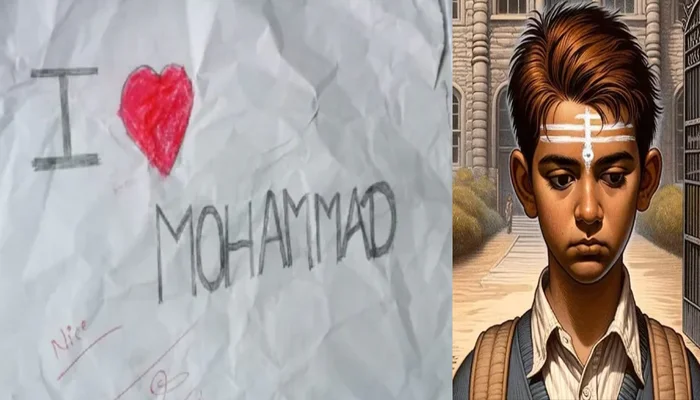
Case Summary
In the Mahmudabad area of Sitapur district of Uttar Pradesh, minor Hindu students were made to write the phrase “I Love Muhammad” in a poster-making competition at the direction of the school manager, a Muslim man named Naimuddin. According to reports, at the Amar Bapu Shiksha Niketan School in Banveerpur, Mahmudabad, a poster-making competition was organised on 27 September 2025. Minor Hindu children, of Class 3 and Class 5, were forced to participate in the competition, and it required them to write the phrase “I Love Muhammad.” The competition was organised by the school principal, Santosh Kumar, acting on the directions of their Muslim school manager, Naimuddin. Some Hindu students returned home and informed their parents about being compelled to write the Islamic religious phrase. This led to outrage among the families, who gathered at the school the next day, along with the members of the Hindu organisation and confronted the school authorities. Parents stated that the school manager, Naeemuddin, and his brother Sumiuddin had links with jihadi organisations, with some further asserting that another of their brothers had been a bomb maker who died in an explosion. Police were also informed, who promptly arrived at the school and took statements from the students and their parents. A complaint was filed, based on which an FIR was registered against three individuals, including the school manager. Police confirmed that the matter was under investigation and that necessary action would follow.
Why it is Hate Crime ?
This case has been added to the tracker under the primary category of - Predatory Proselytisation. Within it, the sub-category selected is - Proselytisation by grooming, brainwashing, manipulation or subtle indoctrination, with the tertiary category being - Conversion of minor. Religious brainwashing essentially means the often subtle and forcible indoctrination to induce someone to give up their religious beliefs to accept contrasting regimented ideas. Religious grooming or brainwashing also involves propaganda and manipulation. It involves the systematic effort, driven by religious malice and indoctrination, to persuade “non-believers’ to accept allegiance, command, or doctrine to and of a contrasting faith. Cases of such grooming or brainwashing are far more nuanced than direct threats, coercion, inducement and violence. In such cases, it is often seen that there is repeated, subtle and continual manipulation of the victim to induce disaffection towards their own faith and acceptance of the contrasting faith of the perpetrator. While subtle indoctrination is widely acknowledged as predatory, an element which is often understated in such conversions or the attempts of such conversion is the role of loyalty and trust which might develop between the perpetrator and the victim. Fiduciary relationships are often abused to affect such religious conversion. For example, an educator transmitting religious doctrine of a competing faith to a Hindu student. The Hindu student is likely to accept what the teacher is transmitting owing to existence of the fiduciary relationship. The exploitation of the fiduciary relationship to religiously indoctrinate victims would also be included in this category. Since the underlying animosity towards the victim’s faith forms the basis of predatory proselytization, such cases are considered religiously motivated hate crimes. This case has been added to the tracker because minor Hindu children were forced to make an “I Love Muhammad” poster in a poster-making competition, which was organised on the instructions of their Muslim school manager. This incident is a textbook example of predatory proselytisation targeting Hindu minors. Forcing children as young as those in Class 3 and Class 5 to write “I Love Muhammad” is not a neutral school activity but an act of religious indoctrination disguised as a competition. Hindu children were deliberately placed in a position where they had no choice but to publicly endorse an Islamic slogan, undermining their own faith and identity. This coercion constitutes grooming and subtle brainwashing, as it seeks to normalise Islamic supremacy in the impressionable minds of Hindu minors. Such tactics are often employed to weaken their Hindu identity over time and make them more susceptible to eventual conversion. The fact that it happened within a school, under the authority of Muslim management, further exposes how vulnerable Hindu children are to such systematic religious manipulation. By compelling minors to engage in acts tied to Islamic belief, this case highlights how proselytisation often begins not with overt conversion ceremonies but with manipulative practices aimed at reshaping the thinking of Hindu children, thereby threatening the future of the community’s religious continuity. Furthermore, “I Love Muhammad” is not a random statement or phrase. This incident occurred against the backdrop of previous communal flashpoints in Uttar Pradesh. On 5 September 2025, during a Barawafat procession in Rawatpur, Kanpur, Muslim youths deliberately damaged Hindu posters displayed in a local neighbourhood. The act followed a dispute the previous day, when an “I Love Muhammad” signboard was installed in front of Zafar Wali Gali for the Barawafat observance. The local Hindu residents objected to this, leading police to relocate the board. Despite police clarifying that the FIR in Kanpur was registered only for the destruction of Hindu posters and not for removing the board, a distorted narrative spread across the country that the FIR was linked to the “I Love Muhammad” banner. This falsehood fuelled nationwide protests, where Hindus were attacked, and Sar Tan Se Juda slogans were raised by Muslims as a violent threat against Hindus. The use of the phrase “I Love Muhammad” in the Sitapur poster-making competition was thus rooted in anti-Hindu hostility and was an assertion of Islamic supremacy over Hindu identity. The Hinduphobia Tracker has documented multiple such cases where "I Love Muhammad" slogans/banners were raised, which were actually rooted or accompanied by anti-Hindu hostility. It is further important to note here that the victims were minors in this case, which means the element of consent and genuine change of conscience was missing ab initio. Minors, due to their young age and lack of maturity, are particularly vulnerable to manipulation and coercion. They may not have the ability to fully understand the implications of such manipulative actions, which were aimed at conversion, and the Muslim perpetrator purposely targeted and exploited this vulnerability of the victim. The act represents a clear case of coercion and manipulation aimed at converting minors, making it a blatant example of religiously motivated hate. Such incidents are not only criminal but ideologically driven, revealing a calculated intent to alter the religious identity of children without their volition. Such actions stem from inherent hostility towards the victim's professed faith since Abrahamic faiths believe that any non-adherent to the faith is subject to being dehumanised till they convert. Therefore, religious conversions or grooming, even of minors, are often seen as a badge of honour, totally disregarding the methods used to achieve it. Since such predatory actions stem from doctrinal animosity towards the Hindu faith and its adherents, this case is being documented as a religiously motivated hate crime.


Case Status
Complaint registered


Perpetrators Details
Perpetrators
Muslim Extremists
Perpetrators Range
From 2 To 5
Perpetrators Gender
male
 Sources




