Muslim man vows to burn down temple and threatens to attack Hindus, says he has problem with ‘Puja-path’
 Jammu and Kashmir, India
  22 September, 2024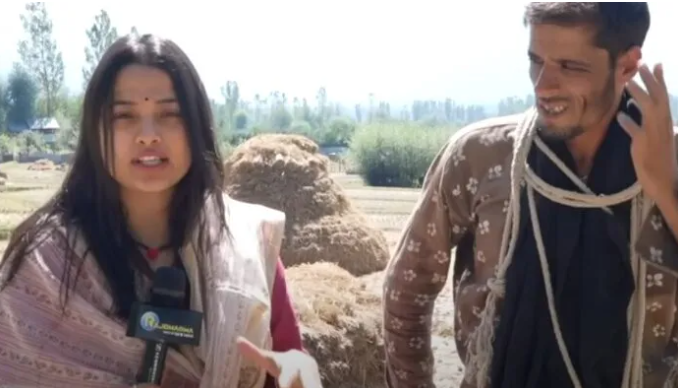
Case Summary
Journalist Archana Tiwari from the YouTube channel "The Rajdharma" visited Jammu and Kashmir to cover the first assembly elections since the abrogation of Article 370. During her visit, she interviewed a local man, Mushtaq Lone, a video of which was uploaded on her channel. Mushtaq, a supporter of Sheikh Abdul Rashid, who had been arrested on terror-funding charges, expressed strong opposition to Hindu rituals and temples. He expresses hate against Puja Path (Hindu worship). When Archana remarked that she didn’t object to mosque loudspeakers, Mushtaq reiterated his disdain for temples, claiming it was inappropriate to have one in their neighbourhood. Mushtaq threatened that if a temple were built on their land, they would be forced to burn it down. He also stated that although Hindus could buy land and build temples, locals would never sell land to them. Throughout the interview, Mushtaq made it clear that his hate for Hindus stemmed from his faith and personal beliefs as a practising Muslim, specifically in his locality.
Why it is Hate Crime ?
This case can be classified as a religiously motivated hate crime under the category of- Hate speech, where the Muslim man issued violent threats due to his animosity against the Hindu religion. Violent threats, explicit, implicit or implied, is the most dangerous form of hate speech since it goes beyond discriminatory and prejudicial language to express the intent of causing harm to an individual or a group of people based on their religious identity and faith. There could be several different kinds of threats that are issued to Hindus based on religious animosity. An explicit threat would mean the direct threat of violence towards an individual Hindu, a group of Hindus or Hindus at large. Physical violence, death threats, threats of destruction of property belonging to Hindus and threats of genocide would mean explicit threats against Hindus for their religious identity. Implicit threats may not be a direct threat but implied through the use of symbols of actions – for example – in the Nupur Sharma case, other than explicit threats, there were also implicit threats when Islamists took to the streets to burn and beat her effigies. It implies that they want to do the same to Nupur Sharma – thereby is considered an implicit threat. Violent threats can be delivered in person, through letters, phone calls, graffiti, or increasingly through social media and other online platforms. It would be important to understand that a threat – explicit or implicit, online or offline – to an individual who happens to be a Hindu does not qualify as a religiously motivated threat. Such a threat, while vile and dangerous, could be owing to non-religious reasons and/or personal animosity. To qualify as a religiously motivated threat, it would need to exhibit an indication that the individual is being targeted for religious reasons and/or owing to his/her religious identity as a Hindu. Mushtaq Lone, a practising Muslim, openly expressed disdain for Hindu rituals and temples during his interview, making it evident that his hostility stemmed from his religious beliefs. Specifically, he expressed a problem with ‘Puja-Path’ (Hindu worship rituals), stating his strong opposition to the practice. This blatant disapproval reflects a deep-seated intolerance for Hindu religious customs and serves as a direct attack on the community's right to practice their faith. His inflammatory statements went beyond mere personal opinions, escalating into hate speech with explicit threats of violence. By declaring that any temple constructed on their land would be burned down, he issued a direct and chilling threat aimed at the Hindu community, intending to intimidate and discourage them from practising their faith freely. The refusal to sell land to Hindus and the expressed disapproval of temples in the locality further underscore the discriminatory intent behind his remarks. Such hate speech, laced with violent threats, reflects deep-seated prejudice that stems from an intrinsic animosity, the Muslim perpetrator held for Hindus and their faith. Consequently, this case has been added to the database.


Case Status
Unknown


Perpetrators Details
Perpetrators
Muslim Extremists
Perpetrators Range
One Person
Perpetrators Gender
male
 Sources




