Muslim mobs attack Hindus in Bangladesh’s Chittagong hill tracts, threats issued from mosques
 Chittagong District, Bangladesh
  18 September, 2024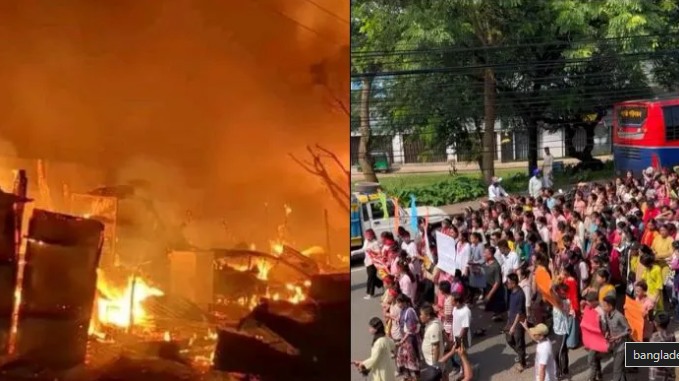
Case Summary
On September 19 2024, violent Muslim mobs attacked the minority Buddhist Chakma and Hindu Tripuri communities in Dighinala and Khagrachhari Sadar in the Chittagong Division of Bangladesh. The attackers set fire to over 200 homes and shops belonging to the Chakmas and Tripuris, also targeting a Buddhist temple in an arson attack. The official death toll was reported as three, though sources from Chittagong indicated the number was much higher. The victims were identified as 20-year-old Junan Chakma, 60-year-old Dhananjoy Chakma, and 30-year-old Rubel Tripura, all from minority communities. The violence erupted after a criminal named Mohammed Mamun, who had 17 criminal cases against him, was killed in Khagrachari while attempting to steal a motorcycle on Wednesday, September 18. In response, an organization called the Bengali Chhatra Parishad led a protest on Thursday afternoon, which quickly escalated into a brutal attack on the Chakma and Tripuri communities. The violence raged for hours, and despite attempts to control it, fresh attacks occurred the following morning on Friday, September 20. A victim, Insta Chakma, revealed that a false announcement from a local mosque accused the tribal communities of attacking Bengalis, further fueling the mob’s aggression. The Chakmas and Tripuris fled their homes, seeking shelter in nearby forests as their homes and businesses were engulfed in flames. The violence spread from Khagrachari to the neighbouring Rangamati district, where more attacks were incited by a mosque’s inflammatory announcements. In response, around 40,000 Chakmas and Tripuris took to the streets in a “March for Identity” rally to protest the targeted attacks. However, media outlets in Bangladesh largely downplayed the religious aspect of the violence, portraying it as a conflict between Bengalis and tribals, even though only Muslims participated in the attacks against the Hindu and Buddhist communities.
Why it is Hate Crime ?
The brutal attacks on the minority Hindu and Buddhist communities in Bangladesh serve as a stark example of religiously motivated hate crime. This case has been added to the tracker under two prime categories for better understanding. The first is- Attack resulting in death, under which, the sub-category chosen is- Attack for Hindu identity. In several cases, Hindus are attacked merely for their Hindu identity without any perceived provocation. A classic example of this category of religiously motivated hate crime is a murder in 2016. 7 ISIS terrorists were convicted for shooting a school principal in Kanpur because they got ‘triggered’ seeing the Kalava on his wrist and tilak that he had put. In this, the Hindu victim had offered no provocation except for his Hindu religious identity. The motivation for the murder was purely religious, driven by religious supremacy. Such cases where Hindus are targeted merely for their religious identity would be documented as a hate crime. Under this category, cases where the attack led to the death of the Hindu victim/s would be documented. The second category under which this case has been placed is- Hate speech against Hindus. Under this, the sub-category chosen is 'media bias'. Further, within this, a tertiary category named 'Anti-Hindu Fake News or Downplaying' has also been selected. Hate speech is defined as any speech, gesture, conduct, writing, or display that is prejudicial against a specific individual and/or group of people, which is leading to or may lead to violence, prejudicial action or hate against that individual and/or group. Media plays a specific and overarching reach in perpetuating prejudicial attitudes towards a community owing to unfair, untrue coverage and/or misrepresentation/misinterpretation, selective coverage and/or omission of facts of/pertaining to issues affecting a specific religious group. This type of bias can dehumanise the victim group, making it easier for others to justify harmful actions against them, which aligns with the objectives of hate speech laws aimed at preventing such harm. It is often observed that the media takes a prejudicial stand against the Hindu community driven by their need to shield the aggressor community which happens to be a numeric minority, however, is the one perpetrating violence against Hindus. For example, the media is often quick to contextualise religiously motivated crimes against Hindus, omit or misrepresent facts that point towards religiously motivated hate crimes, justify and/or downplay religiously motivated hate crimes or simply present fake news to stereotype Hindus. Such media bias leads to the denial of persecution and is often used to dehumanise Hindus, leading to justification for violence against them. For example, the media covered several fake allegations of Hindus targeting Muslims and forcing them to chant Jai Shree Ram. Most of these cases were proved false and fabricated after police investigation. These fake news reports were subsequently never retracted or clarified. Such fake news led to the justification of violence and dehumanisation of Hindus based on the argument that since Hindus targeted Muslims and forced them to chant Jai Shree Ram, the dehumanisation of Hindus and violence against them was par for the course and merely a retaliation. Such media bias leads to prejudicial portrayal of Hindus and offers a justification for violence against them and therefore, is considered hate speech under this category. The violent mobs targeted Hindu and Buddhist individuals, burning over 200 homes and shops and desecrating a Buddhist temple, actions which clearly reflect animosity toward their religious identity. The killing of members of these communities, such as Junan Chakma, Dhananjoy Chakma, and Rubel Tripura, further underscores the religious intolerance at play. In addition, local media coverage framed the attacks as an ethnic conflict between "Bengalis and tribals," failing to acknowledge the targeted, anti-Hindu and anti-Buddhist nature of the violence, despite it being perpetrated exclusively by Muslim groups against Hindu and Buddhist minorities. This biased portrayal in the media downplays the religious hostility that motivated the attacks, concealing the reality of the persecution faced by these communities. Such media bias contributes to the ongoing marginalization of these minorities by obscuring the full extent of religious intolerance they face.
Victim Details
Total Victim
3
Deceased
3
Gender
- Male 3
- Female 0
- Third Gender 0
- Unknown 0
Caste
- SC/ST 0
- OBC 0
- General 0
- Unknown 3
Age Group
- Minor 0
- Adult 3
- Senior Citizen 0
- Unknown 0


Case Status
Complaint filed


Perpetrators Details
Perpetrators
Muslim Extremists
Perpetrators Range
Unknown
Perpetrators Gender
unknown
 Sources




