Hindu persecution whitewashed by Bangladesh's Chief advisor, calls it "exaggerated", asks Hindus to disassociate with their faith
 Bangladesh
  4 September, 2024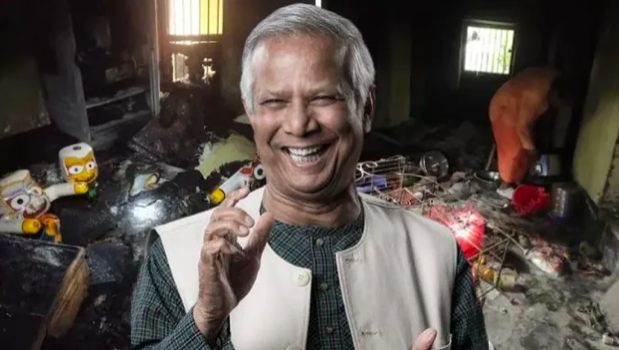
Case Summary
The religiously motivated violence unleashed on Hindus in Bangladesh by Muslim extremists following the exile of Sheikh Hasina was whitewashed and downplayed by Muhammad Yunus, the Chief Advisor to Bangladesh’s interim government. In an interview with PTI, Muhammad Yunus dismissed the nature of the violence, saying it was political rather than religious. He described the anti-Hindu violence as “exaggerated” and suggested to Indian Prime Minister Narendra Modi that the crisis had “several dimensions,” including political tensions. Yunus claimed that Hindus became victims primarily because they were identified with the Awami League, which had lost power. He stated that, “While beating Awami League cadres, they also beat Hindus, because many in Bangladesh see Hindus as synonymous with Awami League supporters.” Yunus went further by accusing India of amplifying the issue, implying that India was portraying Bangladesh as sliding into Islamist extremism without Sheikh Hasina’s leadership. Rather than addressing the atrocities committed by Muslim extremists, he shifted the burden onto the victims themselves. In a controversial remark that sparked outrage, Yunus also advised Hindus to dissociate from their religious identity, telling them to identify solely as Bangladeshi citizens instead of Hindus. He argued that they would be less likely to be targeted if they downplayed their religious identity and relied only on their rights as citizens. Contrary to Yunus's claims, Hinduphobia Tracker recorded a wave of targeted attacks on Hindus, their homes, shops, and temples across Bangladesh in the days following Sheikh Hasina’s exile on 5th August 2024. In one of the incidents, in Lalmonirhat, the house of a Hindu man, Amiya Prasad, in Panchagram Union, Sadar, was attacked, vandalised, and looted. In Mymensingh, a mob assaulted the house of Shyamal Pal in Ward 32 of Shambhuganj, and the house of journalist Dulal Saha in Sadar was similarly attacked, vandalised, and looted. In Shariatpur, the Dhanuka Temple was desecrated while nearby minority homes were destroyed. In Feni, the Durga Temple was attacked. In Dinajpur, the Fulthala cremation ground was forcibly occupied, and five temples, including Kali Mandir in Parbatipur, were vandalised. In Setabganj, Bochakganj, and Dhalla village of Chirirbandar Thana, Hindu houses were attacked and looted. In Hathuria, Bera Thana, Pabna district, Hindu homes were vandalised and ransacked. In Nilphamari, Hindu homes in Bamunia Union, Domar Upazila, were similarly attacked, while an attempted assault on Hindu properties took place in Barakali Bari. The violence extended to Jhenaidah, where Muslim mobs continuously attacked, vandalised, and looted the homes of ten minority families in Chaklapara municipality. Hindu shops in Kotchandpur were destroyed and plundered. Similarly, in Tilpatti, Bargola, five to seven Hindu shops were vandalised and looted, while in Sahapukur village, Dupchanchia Upazila, the house of Dr Gautam Kumar Mondal was targeted and looted.
Why it is Hate Crime ?
This case has been added to the tracker under the primary category- Hate Speech against Hindus. Within this, the subcategory selected is- Denial or mocking of genocide/large-scale persecution. Denial or mocking of genocide/large-scale persecution/ethnic cleansing refers to the act of denying or minimizing the fact of the ethnic cleansing and/or genocide and/or religious persecution of Hindus. This often involves denying the scale, mechanisms, religious intent, or even the occurrence of the ethnic cleansing and/or genocide and/or religious persecution of Hindus. Hate speech of this kind involves the dissemination of falsehoods that deny or distort established historical facts or mock the suffering of Hindus by saying that they deserved the persecution, motivated by Hinduphobia. Denying such atrocities is not only about the denial of facts or rewriting/revising history, but it also delegitimises the religiously motivated persecution of Hindus, the religious hate/motivation/animosity that led to the persecution, and dehumanises Hindus as a religious group. Such denial of ethnic cleansing and/or genocide and/or religious persecution of Hindus not only denies the suffering but also paves the way for future/present atrocities and hate speech, inciting prejudice and violence against Hindus. It also provides a justification for violence by delinking religious animosity from religiously motivated crimes committed against Hindus. Since such denial and/or mocking of genocide/ethnic cleansing/atrocities motivated by religious animosity leads to present and future ramifications of creating more hate speech, violence, dehumanisation and delegitimisation, it would be considered hate speech under this category. The other subcategory selected is- Anti-Hindu subversion and prejudice. The tertiary category selected is- Anti-Hindu fake news or downplaying. Hate speech is defined as any speech, gesture, conduct, writing, or display that is prejudicial against a specific individual and/or group of people, which is leading to or may lead to violence, prejudicial action or hate against that individual and/or group. Media plays a specific and overarching reach in perpetuating prejudicial attitudes towards a community owing to unfair, untrue coverage and/or misrepresentation/misinterpretation, selective coverage and/or omission of facts of/pertaining to issues affecting a specific religious group. This type of bias can dehumanise the victim group, making it easier for others to justify harmful actions against them, which aligns with the objectives of hate speech laws aimed at preventing such harm. It is often observed that the media takes a prejudicial stand against the Hindu community driven by their need to shield the aggressor community which happens to be a numeric minority, however, is the one perpetrating violence against Hindus. For example, the media is often quick to contextualise religiously motivated crimes against Hindus, omit or misrepresent facts that point towards religiously motivated hate crimes, justify and/or downplay religiously motivated hate crimes or simply present fake news to stereotype Hindus. Such media bias leads to the denial of persecution and is often used to dehumanise Hindus, leading to justification for violence against them. For example, the media covered several fake allegations of Hindus targeting Muslims and forcing them to chant Jai Shree Ram. Most of these cases were proved false and fabricated after police investigation. These fake news reports were subsequently never retracted or clarified. Such fake news led to the justification of violence and dehumanisation of Hindus based on the argument that since Hindus targeted Muslims and forced them to chant Jai Shree Ram, the dehumanisation of Hindus and violence against them was par for the course and merely a retaliation. Such media bias leads to prejudicial portrayal of Hindus and offers a justification for violence against them and therefore, is considered hate speech under this category. Muhammad Yunus’s statements dismissing the atrocities faced by Hindus in Bangladesh by reducing them to “attacks on Awami League supporters” clearly amounted to religiously motivated hate speech against the Hindu community. By refusing to acknowledge that Hindus were specifically targeted because of their religious identity, Yunus not only trivialised the violence but also attempted to distort its nature. In doing so, he revealed deep-seated animosity towards Hindus and indulged in the same appeasement politics that embolden Islamist mobs. Such whitewashing and downplaying directly protected Muslim perpetrators while denying justice to Hindu victims. Yunus’s narrative shifted the blame away from the religious identity of the Hindu victims and offered legitimacy to violent Muslim attackers, emboldening them to continue persecution under the guise of ‘political conflict.’ In a country where Hindus already lived as a vulnerable minority, the dismissal of anti-Hindu violence as merely political was not only false but dangerous—it sent the clear message that attacks on Hindus, their homes, shops, and temples would not be acknowledged as crimes against humanity but brushed aside as “collateral damage.” Moreover, Yunus went a step further by urging Hindus to abandon their religious identity and present themselves only as Bangladeshi citizens. This was not an act of reconciliation but an attempt at erasure. By effectively telling Hindus that they would be safe only if they stopped identifying as Hindus, Yunus sought to normalise religious cleansing. This was a statement rooted in prejudice, tantamount to enabling the complete erasure of Hindu culture and identity from Bangladesh. It was an endorsement of the Islamist demand that religious minorities, particularly Hindus, must efface themselves in order to escape religious persecution. The timing of this violence, erupting immediately after Sheikh Hasina’s exile, made the religious motivations of the mobs clear. Hinduphobia Tracker recorded extensive attacks on Hindu families, shops, and temples — from Lalmonirhat to Mymensingh, from Dinajpur to Nilphamari. Each of these incidents followed a similar pattern: mobs targeted Hindus for being Hindus. To call this merely “political” defied the overwhelming evidence of a coordinated campaign to terrorise and erase the Hindu community. Muhammad Yunus’s statements, therefore, were not neutral observations but explicit hate speech. By refusing to recognise that Hindus were being attacked for their religious identity, by downplaying and whitewashing violence, and by advising Hindus to erase their identity altogether, he emboldened Islamist extremists and justified their actions. Given that this case meets the parameters of a religiously motivated hate speech, it is being added to the hate crime database. Note: Hinduphobia Tracker has documented several cases of religious persecution of Hindu minorities in Bangladesh. To read these cases, please visit our official website: hinduphobiatracker.org.


Case Status
Unknown


Perpetrators Details
Perpetrators
State and Establishment
Perpetrators Range
One Person
Perpetrators Gender
male
 Sources




