Ganesh procession attacked by Muslim mob when it nears mosque, stones pelted, idol desecrated
 Bhiwandi, Maharashtra, India
  16 September, 2024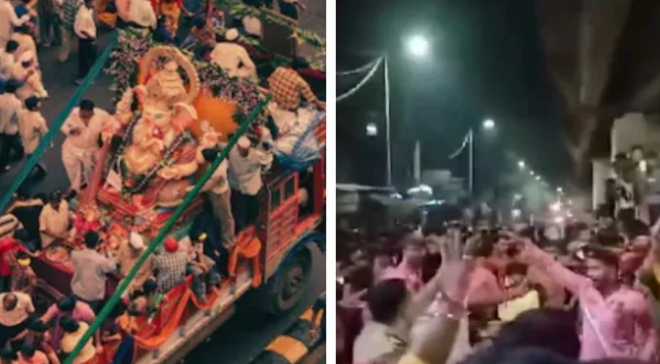
Case Summary
In Bhiwandi, Maharashtra, a Ganpati immersion procession was disrupted by a stone-pelting incident near the Hindustani Mosque at Vanjarpatti Naka. The immersion procession, which was transporting a large Ganpati idol from Ghughat Nagar to the Nadinaka Kamwari River on September 17, was targeted by stonepelters. A stone struck the idol, causing damage, which triggered a confrontation between the groups present. The altercation escalated, with the Ganesh Mandal demanding the arrest of those responsible and halting the immersion. Local police intervened, using a lathi charge to bring the situation under control, leading to several injuries. Some individuals were detained, and an investigation was initiated to identify the culprits.
Why it is Hate Crime ?
This case has been added to two Primary categories and respective sub-categories. The first primary category this case is being added to is 'attack not resulting in death'. The first sub-category under this primary category is 'attack on religious procession'. The outward celebration and display of religious symbols in an intrinsic part of Hinduism. Religious processions on various festivals are age-old traditions and a way to manifest faith and form a part of the religious practices of Hindus. On several occasions, such religious processions come under attack by non-Hindu mobs, in a manifestation of their animosity towards Hinduism and their practices. The reasons cited for such violent attacks are many and range from crossing a non-Hindu resident-dominated area to playing loud music, crossing from an area where there is a religious structure of another faith etc. The violent attacks are triggered by the outward display of religiosity by Hindus. The attacks are mainly a manifestation of religious supremacist doctrine which believes that idolatry, essentially the Hindu faith, is one that deserves to be annihilated since the very tenets of Hinduism, its practices and traditions are considered a sin in those doctrines. Since these attacks emanate from intrinsic and doctrinal animosity towards Hindus and Hinduism, it is considered a religiously motivated hate crime under this category. The secon sub-cateogry is 'attacked for crossing 'Muslim area''. One of the reasons that Hindus get attacked unprovoked specifically by Islamists is for crossing ‘Muslim areas’. Essentially, Muslim mobs often attack Hindus crossing or present in certain areas which have a majority Muslim population. It has often been cited as one of the reasons to blame Hindus for attacks against themselves, signalling that Hindus displaying religious symbols, taking our religious processions or crossing any area which is dominated by Muslim residents is a provocation in and of itself. These areas are mostly ghettoized areas where mobs mobilize quickly to attack Hindus for a variety of reasons like playing music during a religious procession, crossing a mosque, wearing a tilak or any other religious symbol in a Muslim-dominated area, praying at a local temple in that area etc. There have been cases where the few local Hindus of that area have been attacked on their way to the Temple for prayers as well, simply because the area is considered a Muslim-dominated area. Several times, it is entirely possible that the immediate trigger for the violence against Hindus was non-religious in nature, however, the violence became religiously motivated in nature because the area was Muslim dominated and the residents on the whole harboured animosity towards Hindus, evidenced from the actions of the mob, the slogans, and the nature of the attack. Such crimes are motivated by the religious identity of the victims and are therefore classified as hate crimes under this category. The second primary category this case has been added to is 'Attack on Hindu religious representation' under the sub-category 'desecration of Hindu religious symbol'. Icons and symbols or a religious representation of a spiritual ideal are widely revered in Hinduism. Iconography is of vital significance in the Hindu milieu. It helps connect people’s spiritual beliefs with the real world. Iconography within the Hindu faith takes several shapes and forms. Murtis are of most significance to Hindus, to which daily rituals, prayers and offerings are done. Besides the murtis, there are several other symbols which have deep significance in the Hindu faith – the Om and Swastika for example. Since these Hindu religious symbols hold paramount importance in Hinduism, any desecration of symbols, icons, murtis, religious representations and manifestations, is driven by animosity towards the faith itself which manifests itself through these murtis, icons and symbols. Therefore, any desecration of these Hindu religious symbols and representations is considered religiously motivated hate crimes under this category. In this case, the Hindu religious procession was attacked with stone pelting by a Muslim mob when it crossed a mosque. The stone pelting resulting in the desecration of the Murti as well. Often, when religious processions cross Muslim dominated areas or passes by a mosque, the procession is attacked by Muslim mobs who believe that the very existence of the religious procession in an area where they are numerically stronger is an offending act in and of itself. In Islam, Hinduism and its representations are considered 'shirk' and therefore, adherents of Islam hold inherent animosity towards Hindus and their faith. A direct manifestation of the hostility is mobs attacking peaceful Hindus merely following their faith and its representations. Since this attack was driven by doctrinal animosity towards Hindus and their faith, this case is being added as a religiously motivated hate crime against Hindus.


Case Status
Arrested


Perpetrators Details
Perpetrators
Muslim Extremists
Perpetrators Range
Unknown
Perpetrators Gender
unknown
 Sources




