Hindu women subjected to abusive social media targeting and sexualisation, derogatorily labelled “prostitutes”
 India
India  3 June, 2021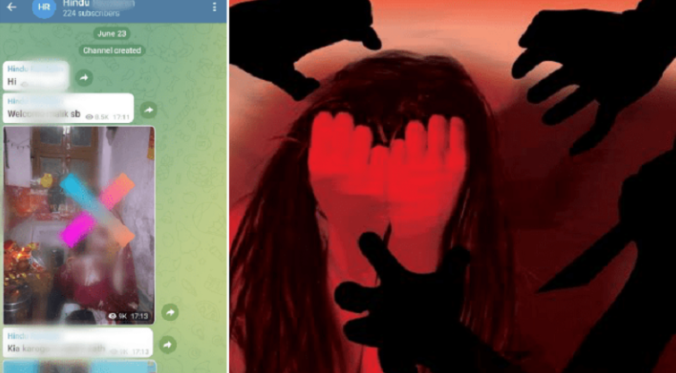
Case Summary
Hindu women were offensively targeted on a social media application named Telegram. A channel was created in June 2021 under the name “Hindu R@ndiyaan”, which meant “Hindu prostitutes”. The incident came to light when Anshul Saxena, an active Twitter user, raised a complaint about the channel that singled out Hindu women for abuse and objectification. He tagged the Mumbai Police, questioning why no action had been taken against such platforms. Despite his post receiving more than 6,000 retweets and growing public concern, the Mumbai Police did not issue any response. Many other social media users also demanded action against the offensive channel. Subsequently, a user named Meera Mohanty asked Anshul, asking why he had not addressed the IT Minister or the Home Minister directly if he was genuinely concerned. In response to her message, India’s IT Minister Ashwini Vaishnaw took swift action. He confirmed that the offensive Telegram channel had been blocked and that the Government of India was coordinating with state police for further measures. Anshul later confirmed on Twitter that the Telegram channel had been reported and deleted. He also highlighted several Facebook pages insulting Hindu women by branding them “Deewani of Muslim men”, meaning “obsessed with Muslim men”. The IT Ministry responded to these complaints as well, leading Meta to remove the abusive pages from its platform.
Why it is Hate Crime ?
This case has been added to the tracker under the primary category- Hate Speech against Hindus. Within this, the subcategory selected is- Anti-Hindu slurs, mocking faith. Anti-Hindu slurs and the deliberate mocking of the Hindu faith owing to religious animosity involve the usage of derogatory terms, stereotypes, or offensive references to religious practices, symbols, or figures. One of the common anti-Hindu slurs used against Hindus is “cow-worshipper” and “cow piss drinker”. The intention of using this term is to demean and mock Hindus as a group and their religious beliefs since Hindus consider the cow holy. Additionally, some symbols and the slurs attached to them have a historical context that exacerbates the insult, hate, stereotyping, dehumanisation and oppression against Hindus. Cow worship has been used for centuries to denigrate Hindus, insult their faith and oppress Hindus specifically as a religious group. There has been overwhelming documentation about how cow slaughter has been used to persecute Hindus with cow meat being thrown in temples and places of worship. There has also been overwhelming documentation where cow meat (beef) has been force-fed to Hindus to either forcefully convert them to Islam or denigrate their faith. Apart from cow worship, the Swastika – which holds deep religious significance for the Hindus – has also been misinterpreted and distorted to use as a slur against Hindus. Similarly, the worship of the Shivling has been used by supremacist ideologies and religions to denigrate Hindus owing to religious animosity. Such slurs and denigration stem out of inherent animosity and hate towards Hindus and their faith, therefore, it is categorised as hate speech targeted at Hindus specifically owing to their religious identity. In this case, the creation of a Telegram channel named “Hindu R@ndiyaan” was not merely an offensive use of vulgar language; it was an outright act of anti-Hindu hate speech on social media. By branding Hindu women as “prostitutes” solely on the basis of their religious identity, the perpetrators engaged in targeted abuse designed to degrade their dignity due to their Hindu identity. This was not casual social media trolling but a calculated attempt to weaponise sexuality as a tool of humiliation. Such instances cross the line into hate speech because they are directed, not at individuals in isolation, but at an entire community’s women who are stereotyped, fetishised and disparaged. Labelling Hindu women in sexualised and derogatory ways places them directly in danger. It strips them of individuality and exposes them to the threat of harassment both in digital and offline spaces, where such language fosters a culture of impunity against them. The reduction of Hindu women to vulgar caricatures or as objects of desire feeds into a deeply troubling trend: their portrayal as being available, dishonourable, or obsessed with men from other faiths. This not only subjects them to degradation but also legitimises a narrative that they are to be dominated and controlled. Such objectification is not entertainment; it has real-life consequences in how Hindu women are perceived and treated in society. As highlighted by Anshul Saxena, this was not an isolated episode. He identified several other Facebook pages that described Hindu women as “Deewani of Muslim men”, meaning obsessed or crazed after men of the Muslim community. Such portrayals are deliberate acts of fetishisation where Hindu women are framed as objects of lust, their identities reduced to sexual stereotypes. When an entire group of women is mocked, maligned, and objectified because of their faith, the pattern is unmistakable: it is religiously motivated hatred disguised as casual vulgarity. This animosity goes beyond language; it reflects an entrenched hostility against Hindus by seeking to discredit and shame their women, striking at the community’s core dignity. Behind these headlines and digital skirmishes are real women who deserve to live with safety, respect, and honour. To call Hindu women “prostitutes” is not a faceless insult; it is a wound inflicted on countless Hindu daughters, sisters, and mothers. It tells them, in cruel terms, that their religion makes them fair targets for sexual abuse. In this case, even though the perpetrators are unknown, the act was motivated by religious animosity. Therefore, this case is being added to the hate crime database. Disclaimer: Media reports do not state the exact date when the offensive Telegram channel named ‘Hindu R@ndiyaan’ was created. However, according to Anshul Saxena, the active Twitter user who highlighted this incident on social media, the channel was created in June 2021. Anshul Saxena first tweeted about this on January 4, 2022. Since the exact date of creation is not independently confirmed, for reference and record-keeping purposes, we are using an indicative date of June 4, 2021, as the approximate date of the incident.


Case Status
Complaint registered


Perpetrators Details
Perpetrators
Unknown
Perpetrators Range
Unknown
Perpetrators Gender
unknown
 Sources




