Anti-Hindu hate speech: Muslim politician threatens violence against Hindu community in Punjab
 Malerkotla, Punjab, India
  19 January, 2022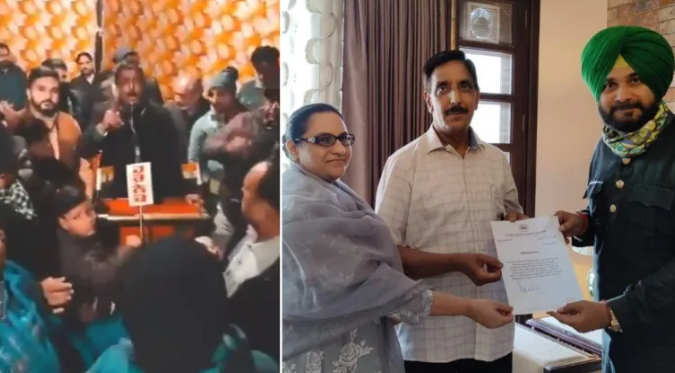
Case Summary
In Malerkotla, Punjab, a hate speech targeting the Hindu community was delivered by former Director General of Police, Punjab, Mohammad Mustafa, who is also a senior Congress politician. The accused explicitly threatened Hindus with violence. According to news reports, on 20th January 2022, a video emerged featuring Mohammad Mustafa, who served as a key adviser to the Punjab Pradesh Congress Committee president, Navjot Singh Sidhu. In this video, Mustafa threatened Hindus during a public gathering in the Malerkotla district while campaigning for his wife, Razia Sultana. He warned the Hindu community against organising events in proximity to his own and vowed to prevent any such gatherings by force. He threatened to "enter their houses and beat them up" if they attempted it again. These inflammatory remarks, made in Baghwala Mohalla, triggered widespread outrage and accusations that Mustafa had incited violence. Shazia Ilmi, spokesperson for the Bharatiya Janata Party, shared the video on social media, condemning Mohammad Mustafa for disturbing communal harmony and urging the Election Commission of India to take action. The video rapidly went viral, drawing significant public attention to the rising tensions in the run-up to the Punjab Legislative Assembly elections. In the widely shared video posted by Shazia Ilmi, Mustafa was heard saying: “Allah ki kasam kha ke kheta hoon inka koi jalsa nahi hone denge. Main quami fauji hoon, main quami sipahi hoon, mein Rashtriya Swayamsevak Sangh ka agent nahi hoon jo dar ke ghar mein ghus jaonga.” This translates as: “I swear by Allah that I would not allow them (Hindus) to organise any event. I am a warrior and soldier of my community, I am not a Rashtriya Swayamsevak Sangh (RSS) agent who will hide in fear.” He further stated: “Agar dobara inhone aaisi harkat ki, khuda ki kasam inke ghar mein ghus kar marunga. Aaj mein sirf warning de raha hoon. Mein voto ke liye nahi lad raha…mein kaum ke liye lad raha hoon. Main zila police aur zila prashasan ko bhi batana chahata hoon…agar dobara aisi harkat hui…mere jalse ke barabar mein agar Hinduon ko ijaazat di gayi, toh mein aaise halat paida kar doonga ke sambhalne mushkil ho jayega.” This means, “If they (Hindus) try to do something like this again, I swear on Allah I will enter their (Hindus) houses and beat them up. I am not fighting for votes but for my community. I warn the district administration and police officials that if, in future, Hindus are permitted to hold gatherings alongside ours, I will create such conditions that it will become difficult to maintain order.” This incident occurred during a confrontation between Congress and Aam Aadmi Party supporters in Malerkotla, where both parties had set up stages for their respective events in close proximity. Supporters of the Aam Aadmi Party raised slogans against both the police and Mustafa, further escalating the situation. Waseem Sheikh, secretary of the Muslim Sikh Federation Punjab, explained that the Congress party's loudspeakers disrupted the Aam Aadmi Party's event, leading to the confrontation. Shazia Ilmi, the Bharatiya Janata Party leader, also demanded the disqualification of Razia Sultana from the elections, citing Mohammad Mustafa’s hate-filled speech as grounds.
Why it is Hate Crime ?
This case has been added to the tracker under the primary category- Hate Speech against Hindus. The subcategory selected is- Violent Threats. Violent threats, explicit, implicit or implied, is the most dangerous form of hate speech since it goes beyond discriminatory and prejudicial language to express the intent of causing harm to an individual or a group of people based on their religious identity and faith. There could be several different kinds of threats that are issued to Hindus based on religious animosity. An explicit threat would mean the direct threat of violence towards an individual Hindu, a group of Hindus or Hindus at large. Physical violence, death threats, threats of destruction of property belonging to Hindus and threats of genocide would mean explicit threats against Hindus for their religious identity. Implicit threats may not be a direct threat but implied through the use of symbols of actions – for example – in the Nupur Sharma case, other than explicit threats, there were also implicit threats when Islamists took to the streets to burn and beat her effigies. It implies that they want to do the same to Nupur Sharma – thereby is considered an implicit threat. Violent threats can be delivered in person, through letters, phone calls, graffiti, or increasingly through social media and other online platforms. It would be important to understand that a threat – explicit or implicit, online or offline – to an individual who happens to be a Hindu does not qualify as a religiously motivated threat. Such a threat, while vile and dangerous, could be owing to non-religious reasons and/or personal animosity. To qualify as a religiously motivated threat, it would need to exhibit an indication that the individual is being targeted for religious reasons and/or owing to his/her religious identity as a Hindu. This case amounts to hate speech because the accused, Mohammad Mustafa, explicitly expressed anti-Hindu animosity by invoking his Muslim identity as a justification to threaten violence directly against Hindus. Firstly, the accused threatened Hindus with physical violence. Mustafa declared himself a "kaumi fauji" (warrior/soldier of the community) and stated he was not fighting for electoral votes but for his community, the Muslim community. By framing the conflict as one between communities and threatening violence—stating he would enter Hindu homes and "beat them up" if Hindus held events near his own—he issued an explicit, targeted threat against a religious group due to their Hindu identity. This is more than political rhetoric; it reflects deep-rooted hostility towards Hindus as a community based on their identity, amounting to hate speech. Secondly, the explicit invocation of religious identity to justify threats shows how the accused’s statements are motivated by anti-Hindu animosity rather than mere political competition. By stating “I am not an RSS agent who will hide in fear” and positioning himself as a defender of Muslims, Mustafa underscored a dangerous communal binary. His speech singles out Hindus as the enemy and demonises them collectively, fostering an atmosphere of fear and intimidation specifically against the Hindu community. Such rhetoric goes beyond disagreement or political rivalry to actively malign and dehumanise a religious group, in this case, Hindus, fulfilling the criteria of hate speech through targeted communal animosity. Threatening violence against an entire community, Hindus, over a logistical dispute between political parties, further reveals a profound religious hostility. The readiness to use violent intimidation against Hindus based on identity rather than individual actions or evidence signifies bigotry entrenched in religious bias. This speech does not merely provoke communal tension but explicitly advocates hostility and aggression targeted at Hindus, reinforcing an exclusionary and divisive worldview. Consequently, Mustafa’s words constitute clear, hateful animosity against Hindus, aimed at marginalising and threatening them solely on the basis of faith, which is the essence of anti-Hindu hate speech. Therefore, this case is being added to the hate crime database of the Hinduphobia Tracker.


Case Status
Unknown


Perpetrators Details
Perpetrators
Muslim Extremists
Perpetrators Range
One Person
Perpetrators Gender
male
 Sources




