Bangladesh: Madrasa student vandalises three Hindu temples, desecrates idols
 Rajshahi Division, Bangladesh
  22 August, 2024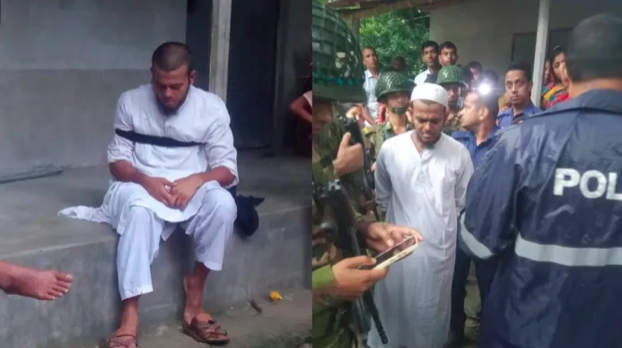
Case Summary
An 18-year-old Madrasa student, Rabbi Hossain, was arrested in Bangladesh on August 23, 2024, for vandalising three Hindu temples, driven by rumours that floods in Bangladesh were caused by water released from India. Rabbi vandalised temples in Pakuria and Kaligram areas of Rajshahi's Bagha Upazila, breaking idols and other items. He was caught by locals while attacking the third temple and handed over to the police. Rabbi admitted to the police that he acted alone after seeing a video on his sister’s phone that blamed India for the floods. Overwhelmed by emotions, he attacked the temples, believing India was responsible for the flooding. The targeted temples included Kaligram Sarvajanin Durga Temple, Panikamara Temple, and Pakuria Temple. A case was registered against Rabbi, and he was sent to jail. The incident followed protests in Bangladesh sparked by false claims that floods were caused by water released from India’s Dumbur Hydroelectric Project, which the Indian government denied, explaining that the floods were caused by heavy local rainfall.
Why it is Hate Crime ?
This case has been added to the hate tracker under the prime category of 'Attack on Hindu religious symbols'. Under this, two sub-categories have been selected. The first is- Attack on Temples. In Hinduism, a temple is the abode of the Deity. The Deity in the Temple is consecrated, thereby, making it a real, breathing entity. Hindus believe that not just the Deity but the temple premises itself are sacred to Hindus since Hindus hold the faith that the entire Temple space is an amalgamation of the divine energy of the deity. Given the central significance of Temples in Hindu Dharma, any attack against a Hindu Temple or its peripheral premises is an attack on the faith itself and is born out of animosity towards the faith, of which, the Temple is a central tenet. Any manner of attack against a Temple and/or its premises would therefore be considered a religiously motivated hate crime. The second sub-category chosen here is- Desecration of Hindu religious symbol. Icons and symbols or a religious representation of a spiritual ideal are widely revered in Hinduism. Iconography is of vital significance in the Hindu milieu. It helps connect people’s spiritual beliefs with the real world. Iconography within the Hindu faith takes several shapes and forms. Murtis are of most significance to Hindus, to which daily rituals, prayers and offerings are done. Besides the murtis, there are several other symbols which have deep significance in the Hindu faith – the Om and Swastika for example. Since these Hindu religious symbols hold paramount importance in Hinduism, any desecration of symbols, icons, murtis, religious representations and manifestations, is driven by animosity towards the faith itself which manifests itself through these murtis, icons and symbols. Therefore, any desecration of these Hindu religious symbols and representations is considered religiously motivated hate crimes under this category. This incident where a madrasa student vandalized three Hindu temples and desecrated idols after hearing rumours that India was responsible for causing floods in Bangladesh is a clear case of a religiously motivated hate crime. The student's actions, fuelled by false information, targeted Hindu places of worship, symbolizing an attack on the faith and cultural identity of the Hindu community. This crime was not a random act of vandalism but one driven by deep-seated animosity toward Hindus, with religious symbols deliberately chosen as the focal point of the violence. It is important to understand that the Muslim perpetrator viewed India as a Hindu collectivity and therefore, attacking Temples and Idols was his form of 'revenge' against India. Any attack on India as a Hindu collectivity or any attack on Hindus to extract revenge on India as a Hindu collectivity is considered a religiously motivated hate crime against the Hindu community.


Case Status
Arrested


Perpetrators Details
Perpetrators
Muslim Extremists
Perpetrators Range
One Person
Perpetrators Gender
male
 Sources




