Hindus threatened with violence by Islamic scholar and politician in Uttar Pradesh
 Bareilly, Uttar Pradesh, India
  6 January, 2022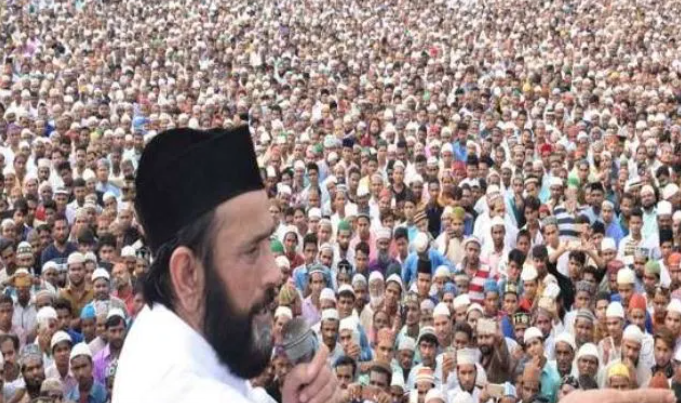
Case Summary
Hindus were issued chilling threats of violence by Islamic scholar Maulana Tauqeer Raza Khan, a prominent Muslim cleric and chief of the Ittihad-e-Millat Council (IMC) party. During a speech in Bareilly, Uttar Pradesh, he incited Muslims against Hindus. Addressing a large gathering, the cleric warned that Hindus would have nowhere to escape if Muslim anger erupted. He stated: “I see the anger within my Muslim youths, and I am afraid that the day this anger bursts out, the day I lose control over them… I want to warn my Hindu brothers that I fear the day my Muslim youths are forced to take the law into their hands, you will not find a place to hide anywhere in India.” His words reflected an open display of hostility towards Hindus. Khan’s remarks were part of a wider pattern among certain Islamic leaders and politicians in India who had publicly called for violence against Hindus. Earlier, in 2020, at the time of the passing of the Citizenship Amendment Act (CAA), Maulana Tauqeer Raza had urged for a bloodbath in the country, saying: “We are Allah wale, what we say happens, there will be a bloodbath, Inshallah.”
Why it is Hate Crime ?
This case has been added to the tracker under the primary category- Hate Speech against Hindus. Within this, the subcategory selected is- Violent threats. Violent threats, explicit, implicit or implied, is the most dangerous form of hate speech since it goes beyond discriminatory and prejudicial language to express the intent of causing harm to an individual or a group of people based on their religious identity and faith. There could be several different kinds of threats that are issued to Hindus based on religious animosity. An explicit threat would mean the direct threat of violence towards an individual Hindu, a group of Hindus or Hindus at large. Physical violence, death threats, threats of destruction of property belonging to Hindus and threats of genocide would mean explicit threats against Hindus for their religious identity. Implicit threats may not be a direct threat but implied through the use of symbols of actions – for example – in the Nupur Sharma case, other than explicit threats, there were also implicit threats when Islamists took to the streets to burn and beat her effigies. It implies that they want to do the same to Nupur Sharma – thereby is considered an implicit threat. Violent threats can be delivered in person, through letters, phone calls, graffiti, or increasingly through social media and other online platforms. It would be important to understand that a threat – explicit or implicit, online or offline – to an individual who happens to be a Hindu does not qualify as a religiously motivated threat. Such a threat, while vile and dangerous, could be owing to non-religious reasons and/or personal animosity. To qualify as a religiously motivated threat, it would need to exhibit an indication that the individual is being targeted for religious reasons and/or owing to his/her religious identity as a Hindu. In this case, Maulana Tauqeer Raza's speech openly provokes Muslims to commit violence against Hindus. He declares that he sees anger rising within Muslim youth and issues a stark warning to Hindus, saying he fears the day this anger bursts out. He warns: “The day I lose control of them, the day my Muslim youths take the law into their own hands, you will not find a place to hide anywhere in India.” His words place Hindus directly under threat, projecting them as targets of potential mass violence. The speech reflects open hostility, racialised stereotyping, and the deliberate stigmatisation of Hindus. It normalises hatred, reinforces negative perceptions, and puts the entire Hindu community at risk by fuelling an environment of fear and violent animosity. Such actions demonstrate religious animosity towards the Hindu community and their faith, making it a religiously motivated hate speech. This case is not an isolated incident of anger or an impulsive remark. In 2020, during the protests against the Citizenship Amendment Act (CAA), Maulana Tauqeer Raza had called for a “bloodbath” in India, with Hindus becoming the primary target. That episode, like the present one, was not random but premeditated and directed hate speech targeting Hindus due to their religious identity. Such acts are a result of deep-rooted animosity towards Hinduism and its followers, making the religiously motivated nature of the crime very evident. The continuity between these incidents highlights a pattern of deliberate hate rhetoric, rather than stand-alone instances. It reflects a systematic culture of hostility, where Islamic scholars in India repeatedly invoke threats of violence against Hindus. This pattern stems from ingrained religious animosity within Islamic theological doctrine that views non-adherents—particularly Hindus—as adversaries and calls for violence against them. This demonstrates that such hate speeches are a result of doctrinal animosity towards Hindus. Therefore, this case meets the parameters of a religiously motivated hate speech, and it is being added to the hate crime database.


Case Status
Unknown


Perpetrators Details
Perpetrators
Muslim Extremists
Perpetrators Range
One Person
Perpetrators Gender
male
 Sources




