Hindu faith insulted; effigies of Lord Ram, Sita, and Lakshman burnt on Dussehra under police presence in Chennai
 Chennai, Tamil Nadu, India
  30 September, 2025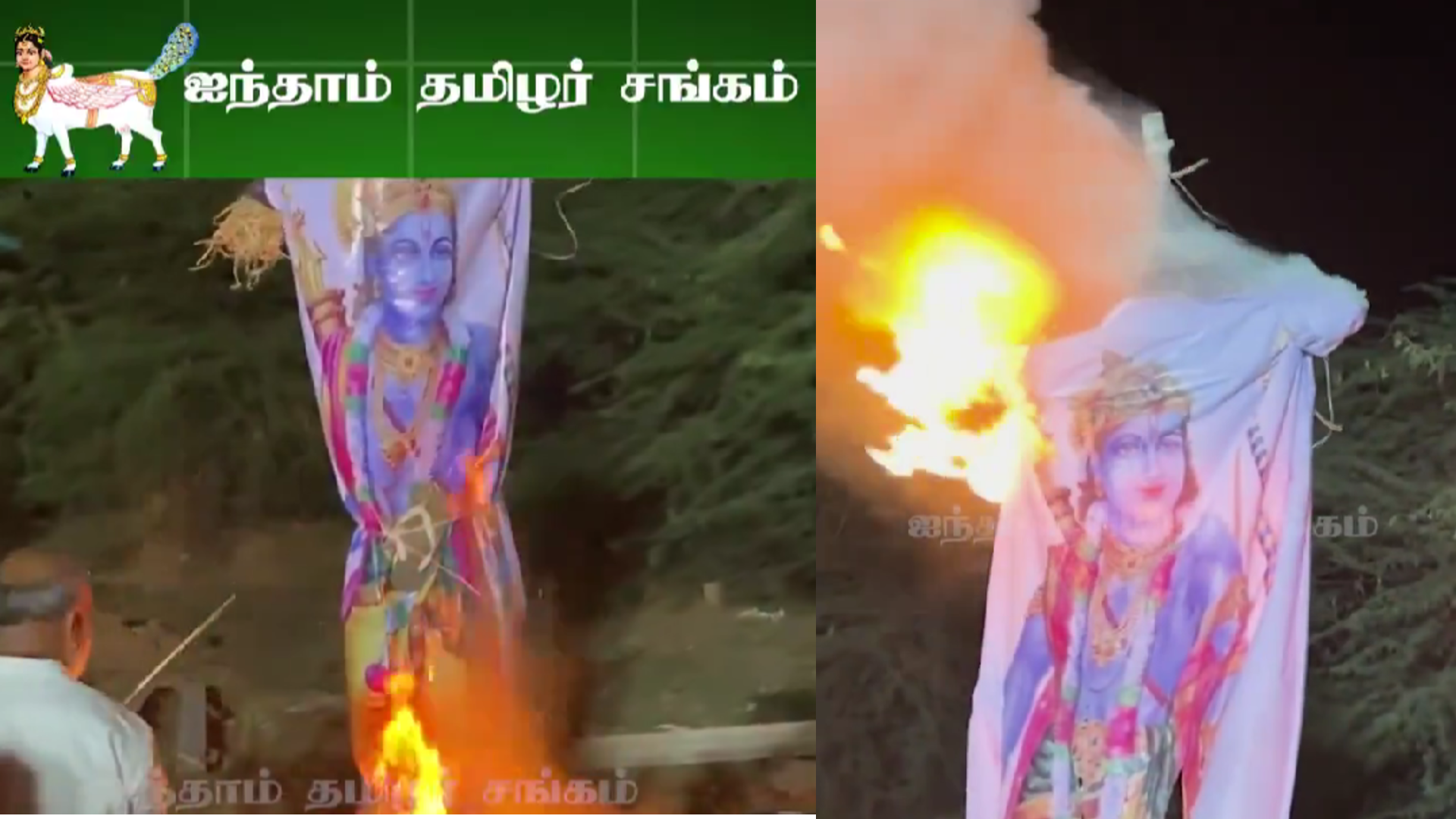
Case Summary
A group of followers of anti-Hindu activist EV Ramaswamy aka Periyar insulted Hindu religious figures in Chennai, Tamil Nadu, by burning effigies of Lord Ram, Sita, and Lakshman on Vijayadashami. The act took place outside the Sanskrit College in Mylapore on 01 October 2025, when members of the Periyarist outfit Thanthai Periyar Dravidar Kazhagam (TDPK) set the effigies on fire under police presence. The organisation declared the event as ‘Ravana Leela’, claiming it to be their counter to Ramlila. Despite barricades and restrictions, around forty individuals broke through security and carried out the burning. Police detained eleven activists, who were subsequently remanded by the court. TDPK leader S Kumar openly admitted to organising the act, stating that it was a protest against what he called the portrayal of Dravidians as demons in the Ramayana and against what he described as the supremacy of Hindu culture. He further added that since effigies of Ravana are burnt in Delhi every year during Dussehra, which they link with their Dravidian identity, they too would respond by burning Hindu deities. The incident is not without precedent. Similar activities were carried out by Periyarist groups in the past, with one of the most notable instances being in 1974 when Maniam Mai, the wife of Periyar, burnt an effigy of Ram at Periyar Thidal in Chennai. The practice, however, did not continue for long in later years.
Why it is Hate Crime ?
The primary category in this case is: Attack on Hindu religious representations. The first subcategory under this is: Desecration of Hindu religious symbol. Icons and symbols or a religious representation of a spiritual ideal are widely revered in Hinduism. Iconography is of vital significance in the Hindu milieu. It helps connect people’s spiritual beliefs with the real world. Iconography within the Hindu faith takes several shapes and forms. Murtis are of most significance to Hindus, to which daily rituals, prayers and offerings are done. Besides the murtis, there are several other symbols which have deep significance in the Hindu faith – the Om and Swastika for example. Since these Hindu religious symbols hold paramount importance in Hinduism, any desecration of symbols, icons, murtis, religious representations and manifestations, is driven by animosity towards the faith itself which manifests itself through these murtis, icons and symbols. Therefore, any desecration of these Hindu religious symbols and representations is considered religiously motivated hate crimes under this category. Another subcategory under this is: Defiling religious customs. Sanatan Dharma is not a religion of one book, which is to say that while it has religious scriptures that form the central tenets of the faith, there are several traditions followed through thousands of years, mostly passed from generation to generation orally. There are several such customs and traditions that are followed by various Hindus and Hindu sects. Defiling of these traditions and customs is a breach of an individual or group’s religious practices. Such practices can range from dietary restrictions like not eating non-vegetarian food for a certain period of the year, not eating non-vegetarian food at all, not eating beef since the cow is considered holy in Hinduism, the sanctity of religious customs followed in the house (like many ISCKON devotees), etc. Any malicious action leading to the breach of such traditions or defilement of these traditions owing to animosity towards the faith or for the sake of activism stems not only from the lack of faith in the religion itself but also from disregard for the faith of the devotees who follow the customs/traditions and implicit bias against the faith, the tradition itself. Since these specific traditions are central to the faith of the devotees of that specific sect of Hindus, any non-compliance with these traditional rules would be considered a religiously motivated hate crime. The other subcategory chosen is- Iconoclastic representation of Hindu Gods/Goddesses. An icon is a symbol of someone or something that is revered, or a religious representation of a spiritual ideal. Iconography is of vital significance in the Hindu milieu. It helps connect people’s spiritual beliefs with the real world. Iconography within the Hindu faith takes several shapes and forms. Murtis are of most significance to Hindus, to which daily rituals, prayers and offerings are done. Besides the murtis, there are several other symbols which have deep significance in the Hindu faith – the Om and Swastika for example. Any iconoclastic representation of these symbols, images and murtis is an affront to the religious beliefs and faith of the Hindu community itself since the symbols and icons are deeply religious in nature. In this sub-category of crime, we would record hate crimes and iconoclastic representations, in words, art, or any other form of representations of symbols that hold religious significance for the Hindu community. Since these symbols, icons and murtis are central to the Hindu faith, any iconoclastic representation of these symbols is born out of animosity towards the faith itself, manifesting itself through these symbols and therefore, these representations would be considered religiously motivated hated crimes. This case has been included in the Hinduphobia Tracker because it constitutes a deliberate attack upon Hindu religious representations and the sanctity of one of the most cherished Hindu festivals. On Vijayadashami, Hindus across India and the world commemorate the victory of dharma over adharma by enacting the burning of Ravana’s effigy. The symbolism is profound: Ravana embodies arrogance, deceit, and the misuse of power, while the triumph of Lord Ram signifies truth, virtue, and moral order. By burning the effigy of Lord Ram himself, together with Sita and Lakshman, the Thanthai Periyar Dravidar Kazhagam (TDPK) did not merely stage a protest but enacted a direct inversion of Hindu religious symbolism, transforming a sacred ritual of victory over evil into an insult against the very deities revered as embodiments of good. This inversion of meaning cannot be interpreted as a simple political gesture. It targets Hindu iconography and tradition at their core. In Hinduism, icons, murtis, and symbols such as Om, the Swastika, and sacred effigies are not inert objects but living conduits of faith, devotion, and spiritual practice. Desecrating these forms is not a neutral act of expression but a calculated affront to the faith itself. By burning the effigies of Lord Ram, Sita, and Lakshman, the organisation explicitly attacked the sacred imagery central to the religious observance of Dussehra. Such desecration, by design, communicates contempt for Hindu beliefs and aims to diminish the dignity of the religion in the public sphere. Moreover, this act also constitutes the defilement of a Hindu religious custom. The burning of Ravana’s effigy is not a mere spectacle of theatre but a time-honoured ritual that has endured for centuries, symbolising the cosmic truth that virtue ultimately defeats vice. It is a unifying practice, performed in towns and villages, where families, devotees, and entire communities gather in celebration. For a group to subvert this custom by replacing Ravana with Ram is to denigrate not only the figure of Lord Ram himself but also the lived faith of Hindus who honour this ritual. It strikes at the very ethos of Sanatan Dharma, which has preserved its traditions through generations. The protestors’ action thus represents both animosity towards the religion and disregard for the sentiments of its followers. The perpetrators openly acknowledged their intent. They justified their actions by claiming to resist the portrayal of Dravidians as demons in the Ramayana. Yet their chosen method—burning the effigies of Hindu deities—cannot be read as a dialogue or intellectual critique. It is a performative desecration designed to insult Hindu faith in a public manner. By turning Ram into the target of symbolic destruction, the perpetrators equated good with evil, and vice versa, which is offensive not only to Hindus but to the ethical essence of the festival itself. Hate crimes against religious groups often manifest not only in direct violence against persons but also in acts that seek to degrade and dishonour the symbols, icons, and customs of a faith. In this case, the attack was upon the most revered figures of the Ramayana, at a time when Hindus were observing Dussehra, making the insult sharper and the offence deeper. It was timed to coincide with the very moment Hindus were reaffirming the triumph of truth over falsehood, thereby negating their devotion in an act of calculated provocation. It is for these reasons that the incident qualifies as a hate crime against Hindus. It was not incidental or accidental, but purposeful and directed at the heart of Hindu tradition. By reversing the ritual of Vijayadashami, the perpetrators attempted to symbolically dismantle the narrative of dharma’s triumph. For Hindus, this act was profoundly offensive, since it degraded Lord Ram, who is venerated as an ideal king, husband, son, and upholder of righteousness. The effigies of Ram, Sita, and Lakshman embody ideals of virtue and familial dharma, and their desecration is not only disrespectful but malicious. Thus, the addition of this case to the Hinduphobia Tracker is necessary to document how hostility towards Hinduism often takes the form of undermining its sacred customs and iconography. It underscores how even cultural and religious festivals are not immune to targeted actions aimed at humiliating the faith and its followers. By cataloguing such cases, the tracker highlights the pattern of religiously motivated provocations against Hindus and provides evidence of how desecration of symbols and defilement of customs are weaponised to perpetuate animosity.


Case Status
Arrested


Perpetrators Details
Perpetrators
Others
Perpetrators Range
From 10 to 100
Perpetrators Gender
both
 Sources




